Dumbbell Rack: How to Choose the Right One for Your Home Gym Setup
A dumbbell rack is one of those purchases that people tend to underestimate until they do not have one. Dumbbells stored on the floor create a tripping hazard, a disorganized training space, and a frustrating experience every time you need to find a specific weight. A quality rack organizes your collection, protects your floor, and makes the entire training experience more efficient and safer. Getting the right one requires understanding what you actually need based on your current dumbbell collection and your space constraints.
This guide covers the main types of dumbbell racks, the specifications that matter for safety and durability, sizing considerations for different training spaces, and practical buying advice for both budget and premium options in the US and UK markets.
Types of Dumbbell Racks
A-Frame Racks
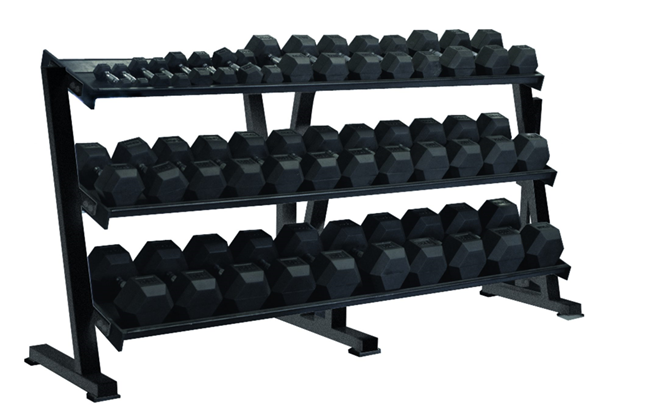
The A-frame is the most common dumbbell rack design found in commercial gyms and well-equipped home gyms. The name comes from the triangular cross-section profile when viewed from the side. Dumbbells sit on angled rails at two or three tier levels, with heavier weights typically stored lower for stability and convenience. A-frame racks allow you to see all available weights at a glance and pull any dumbbell from the rack without moving others.
High-quality commercial A-frame racks are built from heavy-gauge steel, have angled storage that prevents dumbbells from rolling forward, and are designed to hold 10 to 20 pairs across two to three tiers. They are the most space-efficient organized storage solution for a large dumbbell collection and are available from budget-friendly options at retailers like Rogue, Titan Fitness, and Rep Fitness in the US, and Mirafit and Body-Solid in the UK.
Flat or Horizontal Racks
Flat racks store dumbbells horizontally in designated slots or on flat shelves. They are generally lower-profile than A-frame racks and work well in spaces with ceiling height constraints. The main disadvantage is that flat storage makes it harder to read weight labels quickly and requires pulling each dumbbell out fully before seeing whether it is the right one. For small collections of four to six pairs, flat racks work fine. For larger collections, the organizational disadvantage becomes noticeable over time.
Vertical Stands and Floor Storage
Vertical stands store individual dumbbells in upright slots arranged in a row. They work well for fixed-weight dumbbells with a consistent head diameter but poorly for dumbbells with large, varying head sizes. Some designs accommodate adjustable dumbbells like PowerBlocks or Bowflex SelectTech sets with dedicated cradles. If your home gym uses a single set of adjustable dumbbells, a dedicated cradle stand keeps them organized without requiring the footprint of a full rack.
Weight Capacity and Safety
The most important specification on any dumbbell rack is its total weight capacity, which should comfortably exceed the total weight of all dumbbells you plan to store on it. A rack rated for 500 pounds storing 600 pounds of dumbbells is a safety issue. Commercial-grade racks typically carry ratings of 1,000 to 3,000 pounds total capacity. Budget home gym racks may rate as low as 300 to 500 pounds, which is adequate for smaller collections but can become limiting as you add heavier pairs.
Research on structural loading from PubMed and engineering standards both confirm that static loading capacity should include a meaningful safety margin above the expected maximum load. For gym equipment that will see regular heavy use, buying a rack rated at roughly twice your expected load provides adequate safety margin. Cheap racks loaded beyond their rating can collapse suddenly and without warning, which is a serious injury risk.
Steel Gauge and Build Quality
The gauge of steel used in the frame is the primary determinant of rack durability. Lower gauge numbers indicate thicker, stronger steel. 11 to 14 gauge steel is the range used in quality commercial and prosumer home gym equipment. Budget racks built from 16 to 20 gauge steel feel noticeably flimsier, flex under load, and are more prone to weld failures with heavy regular use.
The finish quality also matters for longevity. Powder-coated finishes resist rust and scratching far better than paint. Check welds at connection points: clean, continuous welds indicate quality manufacturing. Spotty or porous welds are a sign of cost-cutting that shows up as structural weakness under heavy loading. A rack that wobbles when empty will develop worse wobble as loading increases.
Sizing Your Rack to Your Space
Before buying any rack, measure your dedicated training space and determine how much floor area the rack itself occupies versus the floor space needed to use it safely. A standard A-frame rack holding 10 pairs of dumbbells occupies roughly 48 to 60 inches wide and 16 to 20 inches deep. Add at least 36 inches of clearance in front for retrieving and replacing dumbbells safely. Racks with three tiers require slightly more clearance because the top tier requires more extension to reach.
For home gyms in garages or spare rooms with limited space, compact two-tier racks holding 6 to 8 pairs are available and occupy a much smaller footprint. Wall-mounted vertical dumbbell storage eliminates floor footprint entirely at the cost of needing secure wall attachment points and being limited to lighter dumbbells that can be safely hung. Measure twice, buy once. A rack that is too large for your space creates more problems than having no rack at all.
Floor Protection
Any dumbbell rack placed on hardwood, tile, or laminate flooring needs rubber feet to prevent sliding and floor scratching. Most quality racks include rubber feet. If yours does not, aftermarket rubber feet are inexpensive and simple to add. For additional floor protection and safety, placing a rubber gym mat under the rack and in the immediate use area prevents floor damage and provides a non-slip surface for your feet during training.
Rubber horse stall mats from agricultural supply stores are the most cost-effective gym flooring option in the US. They are 3/4 inch thick, extremely durable, available in 4×6 foot sections, and cost roughly 50 to 70 dollars per mat. Two or three mats cover a standard training area and provide sufficient cushioning for dropped dumbbells. In the UK, similar rubber matting is available from equestrian suppliers and specialist gym equipment stores. Protecting your floor investment is part of the same approach that protects your joints with quality knee sleeves and a good lifting belt.
Budget vs Premium: What the Price Difference Actually Gets You
Entry-level dumbbell racks in the 80 to 150 dollar range are made from thinner steel, have lower weight capacities (typically 300 to 500 pounds), and often have less precise manufacturing tolerances that result in slight unevenness. They work adequately for light dumbbell collections (up to 50 pounds per pair) and for occasional use. For a dedicated home gym where the rack sees daily use and holds heavier weights, they will show wear within one to two years.
Mid-range racks in the 200 to 400 dollar range provide meaningfully better steel gauge, higher weight capacities, and more durable finishes. For most serious home gym users, this is the appropriate tier. Premium commercial-grade racks above 500 dollars are built for decades of heavy commercial use and are more than most home gym setups require unless you are storing a very large and heavy collection.
FINAL WORDS
A dumbbell rack is a training space investment that pays off in organization, safety, and the quality of your training environment every single session. Choose a rack rated for at least twice the total weight of your current collection with room to grow, built from 11 to 14 gauge steel, with a powder-coated finish and rubber feet. Measure your space before buying. Set it up on proper flooring. Everything in your training environment should support your performance, and a well-organized, safe training space is the foundation that everything else builds on.
Certified strength and conditioning specialists with over 10 years of experience in powerlifting, nutrition, and evidence-based fitness content. Based in New York City.