Genghis Fitness · Equipment and Powerlifting
Leather Weight Lifting Belt: Why Leather Outperforms Nylon and Neoprene, IAP Research, Stiffness Benefits, Breaking In, and Choosing the Right One
Updated 2026 | By Team Genghis Fitness | 22 min read
The leather weightlifting belt is the standard tool of powerlifters, Olympic weightlifters, and strength athletes who train at high loads for a straightforward reason: leather provides a level of stiffness, durability, and intra-abdominal pressure support that no other belt material matches. Nylon and neoprene belts are adequate for general fitness training and moderate loads, but they flex and compress under the bracing demands of maximum effort squats and deadlifts in ways that leather does not. Understanding why stiffness matters for belt function, what the research shows about belts and intra-abdominal pressure, how to choose between the main leather belt formats (prong, lever, tapered, uniform), and how to break a new leather belt in are the foundations of making an informed leather belt purchase that will last a career.
Why Belt Stiffness Matters: The IAP Mechanism
A weightlifting belt works by providing a rigid surface for the abdominal muscles to brace against, increasing intra-abdominal pressure (IAP) above what is achievable through bracing alone. When the athlete breathes in deeply and braces the core against the belt, the air pressure inside the abdominal cavity increases, creating a hydraulic-like stiffening of the trunk that reduces the compressive and shear forces on the lumbar spine during heavy lifts. Research published in the Journal of Orthopaedic and Sports Physical Therapy confirmed that wearing a stiff leather belt significantly increased intra-abdominal pressure and reduced erector spinae electromyographic activity at equivalent loads, indicating that the belt takes over some of the stabilisation work that the lower back muscles would otherwise perform. Critically, the IAP increase is greater with a stiffer belt. A soft neoprene belt that flexes when braced against provides less resistance for the abdominals to push against, producing lower IAP than a rigid leather belt. The stiffness of a quality leather belt is therefore not just a durability characteristic but a functional performance property that directly determines the belt’s effectiveness as a spinal support tool.
Leather Belt Formats: Prong vs Lever, Tapered vs Uniform
Prong buckle: The traditional belt fastening using a metal prong through punched holes in the belt. Provides reliable fastening with infinite position adjustment within the hole spacing. The tightening process requires effort (pulling the belt through the buckle) but the result is a firmly fixed position. Standard for most powerlifting federations and the traditional format that most leather belts use.
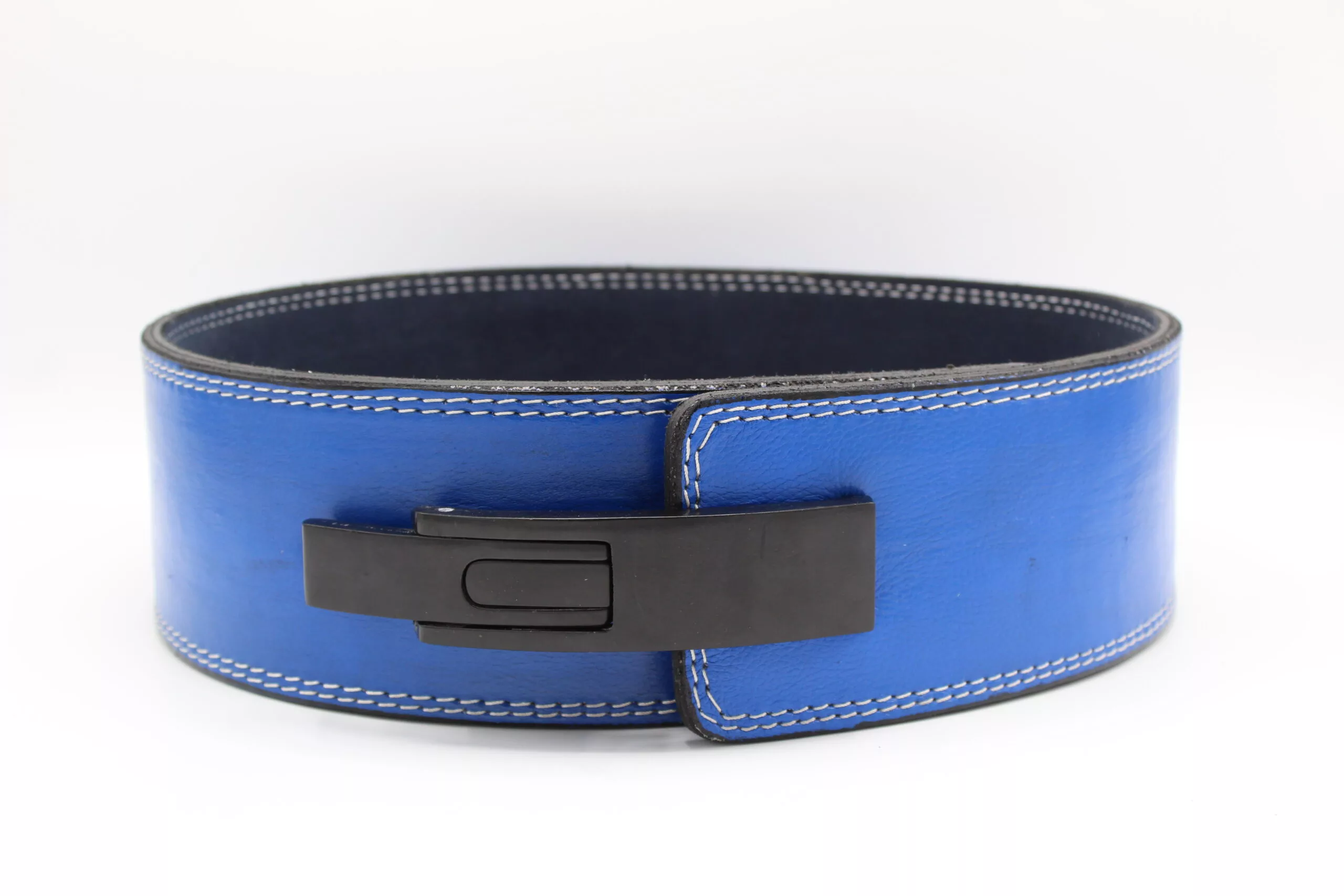
Lever buckle: A snap-open metal lever that locks the belt at a single preset hole position. Provides faster on/off (important for competition when time between lifts is limited) and a very firm fastening that cannot loosen during a lift the way a prong can potentially slip. The single-position adjustment means that the hole position must be set correctly during fit testing and requires a screwdriver to change, but this is a minor inconvenience for the convenience advantage during competition and heavy training. The Genghis Fitness 10mm lever belt provides competition-quality lever fastening at the standard 10mm competition thickness.
Tapered vs uniform width: Tapered belts are narrower at the front and wider at the back, which some athletes find more comfortable for movements that require forward hip flexion (such as the bottom of a squat or the setup position of a deadlift) because the narrower front does not dig into the hip flexors. Uniform width belts maintain the same width (typically 10 cm) all the way around, providing consistent IAP support in all directions. Powerlifting competition rules typically specify maximum belt widths rather than requiring uniformity, so both styles are competition-legal in most federations. The Genghis Fitness powerlifting leather belt provides the uniform 10 cm width that maximises IAP support for squat and deadlift competition work.
Breaking In a New Leather Belt
New leather belts are stiff to the point of discomfort until they are broken in, a process that takes several training sessions. The standard break-in process: wear the belt during training from the first session at a tighter position than you eventually plan to use, allowing your body’s heat and movement to gradually soften and form the leather to your torso shape. Bending the belt manually in opposite directions between training sessions accelerates the process. Applying a small amount of leather conditioner (neatsfoot oil or a commercial leather conditioner) to the inside surface reduces stiffness without removing the structural integrity. Avoid soaking the belt in water to speed up break-in as this can damage the leather fibres and reduce longevity. A fully broken-in leather belt moulds to the athlete’s torso shape while retaining the stiffness that makes it effective, creating a custom-fit support tool that improves with use. The complete leather belt care and maintenance guide is in our leather belt care guide.
Leather Belt Positioning: Getting the Most From Every Set
A leather belt worn incorrectly provides significantly less IAP support than the same belt in the correct position. The belt should be positioned at the natural waist, the narrowest point between the lower rib cage and the iliac crest, not low on the hips where many athletes wear it for comfort. The correct position encircles the trunk at the widest abdominal circumference, typically at or just above belly button level. The belt should be snug enough that you can fit no more than two fingers underneath it when relaxed, and noticeably tighten when you take a full diaphragmatic breath and brace. The complete guide covering exact positioning for squats, deadlifts, and overhead pressing is in our how to wear a lifting belt guide. Pairing a correctly positioned leather belt with knee sleeves for squats and lifting straps for deadlifts creates a complete equipment foundation that addresses all primary limiting factors in heavy compound training. Athletes who invest in quality leather, sleeves, and straps from the beginning of serious training avoid the false economy of cheaper equipment that fails at the loads where equipment matters most.
Frequently Asked Questions
What Thickness Leather Belt Should You Buy?
10mm is the standard and the correct choice for most athletes. It provides sufficient stiffness for maximum IAP support while being manageable to break in and comfortable during extended training sessions. 13mm belts are used by some elite powerlifters for maximum support, but their greater stiffness makes them harder to break in and less comfortable for the variety of movements in training beyond the competition lifts. For athletes who compete in powerlifting, verify that the 10mm thickness meets the specifications of your specific federation (most allow up to 13mm). The complete 10mm versus 13mm comparison is in our belt thickness comparison guide.
Is Leather Better Than Nylon for All Lifting?
For maximum strength work at heavy loads (squats and deadlifts above 80 percent of maximum), leather is clearly superior due to its greater stiffness and IAP support. For general fitness training at moderate loads, Olympic lifting, and athletes who prioritise flexibility over support (CrossFit, circuit training), nylon belts provide adequate support with more freedom of movement and lower break-in requirements. The choice between leather and nylon ultimately depends on the type of training and the loads involved. The complete nylon versus leather comparison with specific training context recommendations is in our nylon vs leather belt guide.
The Belt That Grows With You. Leather Lasts a Career.
Stiff enough for maximum support. Durable enough for a lifetime of training.
Shop Powerlifting Belt Shop 10mm Lever BeltCertified strength and conditioning specialists with over 10 years of experience in powerlifting, nutrition, and evidence-based fitness content. Based in New York City.
Related guides and comparisons are collected in the weightlifting belt guides, covering all belt materials, thicknesses, closure systems, and sport-specific recommendations in one location.