NYLON VS LEATHER LIFTING BELT: THE HONEST COMPARISON FOR ATHLETES WHO TRAIN SERIOUSLY
Nylon versus leather is the most common belt material comparison question in strength training, and the answer is not that one material is universally better. Both nylon and leather belts use the same fundamental IAP mechanism to protect the spine during heavy lifting. Both provide a rigid or semi-rigid surface for the core musculature to brace against. The differences are in how each material delivers that bracing surface: leather through maximum rigidity from a structural material, nylon through width, adjustability, and immediate conforming fit. Matching the material to the specific training demands and practical priorities of the individual athlete is what produces the best long-term outcome rather than a categorical preference for one material.
THE IAP MECHANISM: WHERE THE MATERIALS DIFFER AND WHERE THEY DO NOT
Research on belt stiffness and intra-abdominal pressure confirms a direct relationship between belt rigidity and IAP generation at equivalent bracing effort: stiffer belts produce higher IAP. Full-grain leather at 10mm thickness is the stiffest material available in lifting belt construction and produces the highest IAP per unit of core bracing effort. Quality high-denier nylon provides meaningful rigidity that supports IAP generation well across the full intensity range of most athletes’ training programs. The performance gap between leather and nylon IAP generation is most significant at near-maximum loading where every fraction of additional IAP support translates into reduced spinal stress at the highest absolute loads. Below 90 percent of maximum effort, the practical IAP difference between leather and quality nylon is less significant than the comfort and usability differences between the two materials.
THE LEATHER EXPERIENCE: BREAK-IN, PERSONALIZED FIT, AND LONG-TERM PERFORMANCE
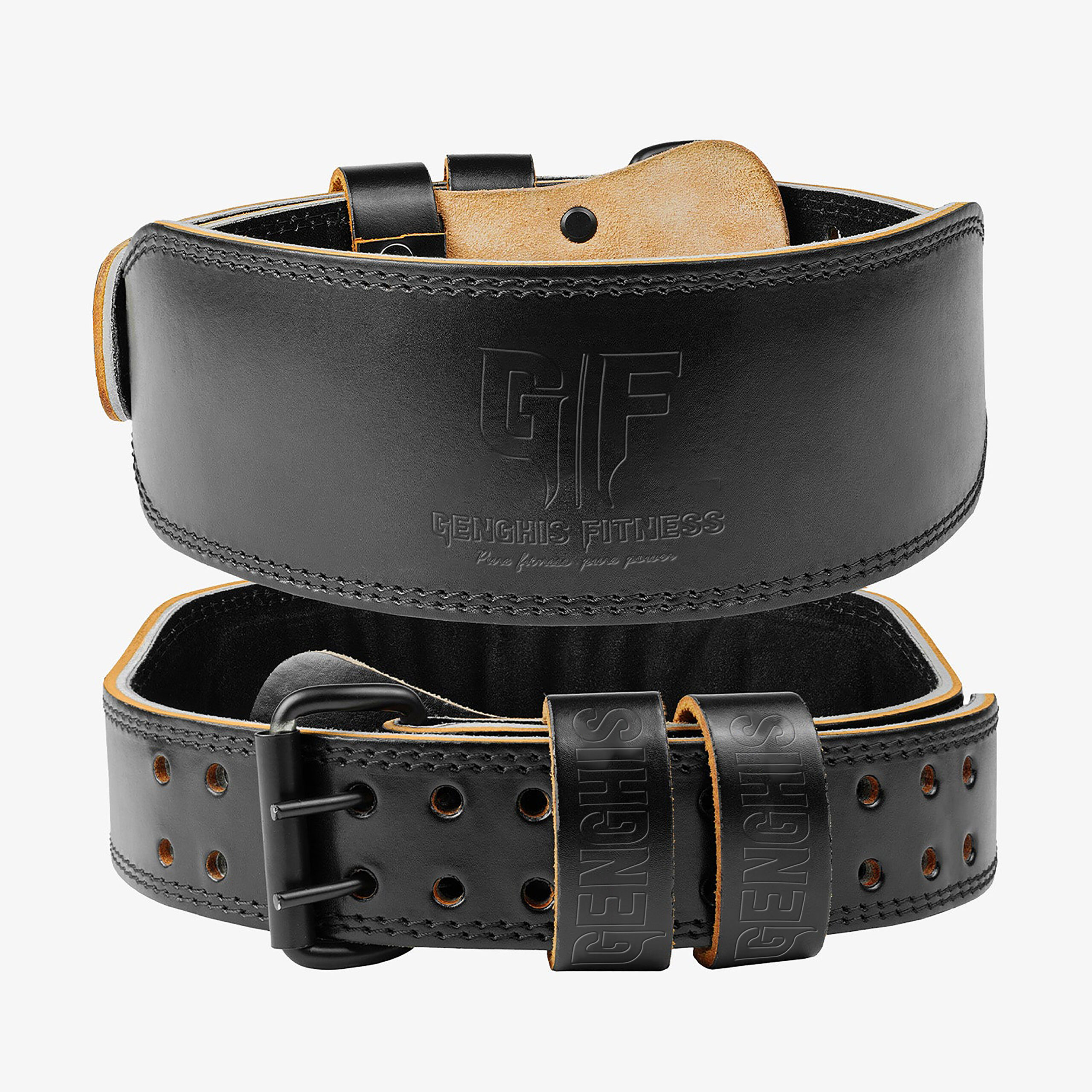
Full-grain leather begins stiff and becomes progressively more personalized over a four to six week break-in period as the leather conforms to the specific body geometry of the individual athlete. After break-in, a quality leather belt fits more precisely than nylon because it has physically adapted to the contours of the torso rather than simply compressing against them. This personalized fit is one of the reasons experienced leather belt users are reluctant to switch: their leather belt fits differently from any new belt because it has become specific to them. The trade-off is that the break-in period is genuinely uncomfortable for some athletes, with stiff edges creating pressure points that take weeks to soften to a comfortable level.
THE NYLON EXPERIENCE: IMMEDIATE COMFORT AND PRACTICAL USABILITY
Quality nylon lifting belts are comfortable from the first session. There is no break-in period, no edge pressure, and no period of training through discomfort to reach a comfortable fit. The nylon webbing conforms to the body geometry of the athlete immediately, providing comfortable support from rep one of session one without any adaptation period. For athletes new to belt use who want to build productive belted training habits without a discouraging break-in phase, this immediate usability is a meaningful practical advantage. For athletes who have already broken in a quality leather belt, this advantage is less relevant because the leather has already passed through the adaptation phase and now provides its own comfortable, personalized fit.
MAINTENANCE REQUIREMENTS: LEATHER NEEDS CONDITIONING, NYLON DOES NOT
Leather maintenance requires periodic conditioning to prevent the material from drying, becoming brittle, and cracking under the repeated flexion stress of training. Quality leather conditioners applied every four to eight weeks of heavy use maintain the leather’s suppleness and extend its service life across the multi-year span that full-grain leather is capable of providing. This maintenance is not complicated or time-consuming, but it is a recurring requirement that nylon does not share. Nylon is essentially maintenance-free beyond rinsing with water after sweaty sessions and air drying. For athletes who want to minimize equipment maintenance responsibilities or who train in environments where equipment care is difficult, this maintenance difference is a practical consideration in the material choice.
LONG-TERM VALUE: LEATHER LASTS LONGER AND COSTS LESS PER YEAR
Full-grain leather maintains its structural rigidity for a decade or more of regular heavy training with proper conditioning. Nylon webbing at adequate denier rating maintains structural integrity for two to four years of heavy training before the webbing shows abrasion that has progressed through the outer weave layers and reduced tensile strength at the affected zones. The cost-per-year calculation often favors leather despite its higher upfront cost: a leather belt that lasts ten years at a total cost of eighty to one hundred dollars costs eight to ten dollars per year of service, while a nylon belt that lasts three years at forty to fifty dollars costs thirteen to seventeen dollars per year of service. This long-term value calculation changes the economic comparison significantly from the initial purchase price.
WHERE NYLON WINS: PACKABILITY, MOISTURE RESISTANCE, CONVENIENCE
The practical advantages of nylon over leather include packability, moisture resistance, and immediate usability that make nylon the better choice for athletes who train across multiple locations, who travel frequently for work or competition, or who value a belt they can rinse and air dry without conditioning requirements. The Genghis Fitness nylon lifting belt is significantly lighter and packs flat compared to any leather belt of equivalent width, making it the most practical daily training belt for athletes whose equipment travels with them across training environments. These packability and convenience advantages do not affect the belt’s IAP performance but directly affect training quality in athletes whose alternative is leaving the belt at home when it cannot fit conveniently in a packed bag.
WHERE LEATHER WINS: COMPETITION PREPARATION AND MAXIMUM INTENSITY TRAINING
The powerlifting leather belt and 10mm lever belt are the right choice for athletes who compete in powerlifting or who consistently train at the near-maximum intensities where the rigidity advantage of full-grain leather produces meaningfully higher IAP and better spinal protection than nylon can match. Competition-standard powerlifting belts are leather in every major federation, which means athletes preparing for competition should train in leather to develop the bracing pattern and body-position adaptations specific to the leather belt’s stiffness and geometry. Training habitually in a nylon belt and competing in leather introduces a mechanical change on competition day that is avoidable with consistent equipment in training.
THE CASE FOR OWNING BOTH AND USING EACH STRATEGICALLY
Many serious athletes own both a leather belt and a nylon belt and use them strategically: leather for the heaviest training sessions and competition preparation where maximum IAP is the priority, nylon for volume training days and everyday heavy work where the comfort advantages of nylon translate into better training quality across a full session without the edge pressure that a stiff leather belt can create during extended high-rep sets. This dual-belt approach is more expensive upfront but produces the best outcome across the full range of training contexts that serious athletes navigate across a complete annual training cycle. Pair either belt with knee sleeves for joint warmth and lifting straps for heavy pulling as part of a complete training support system.
FINAL WORDS
Nylon versus leather is not a competition with a universal winner. It is a matching exercise between the material’s properties and the athlete’s specific training demands, practical lifestyle, and long-term value priorities. For maximum IAP at maximum intensity and competition-standard performance, leather wins. For immediate comfort, packability, moisture resistance, and maintenance simplicity, nylon wins. Many athletes find that one material serves their training better in one context and use both strategically across different training phases. The Genghis Fitness 10mm lever belt delivers full-grain leather performance for the contexts where it matters most. The nylon lifting belt delivers immediate comfort and practical convenience for the contexts where those properties matter most. Know your priorities, choose accordingly, and use the right belt on every heavy set.
Certified strength and conditioning specialists with over 10 years of experience in powerlifting, nutrition, and evidence-based fitness content. Based in New York City.
Explore the full weightlifting belt guides for lever belt comparisons, leather belt reviews, neoprene belt recommendations, sizing guides, and sport-specific belt selection across powerlifting, CrossFit, and Olympic lifting.