Best Booty Bands: How to Choose the Right Hip Circle Band and What to Look For
The booty band market is saturated. There are hundreds of options at every price point, made from every combination of materials, in every color imaginable. Most of them are not worth buying, not because resistance bands are inherently poor training tools, but because cheap construction produces bands that roll, snap, or stretch out within weeks of regular use. A band that rolls up during a lateral walk delivers inconsistent resistance, interrupts reps, and leaves a line of pressure on the skin that has nothing to do with training the intended muscles.
This guide covers what separates a quality hip circle band from a poorly made one, the properties to evaluate before purchasing, the resistance levels that suit different training stages, and what the Genghis Fitness hip circle bands offer within this framework.
The Two Material Categories: Fabric vs Latex
Fabric Hip Circle Bands
Fabric bands use a woven polyester or cotton outer shell with latex or elastic rubber strands running through the interior. The fabric exterior is the defining quality advantage: it stays flat against the skin or clothing during dynamic movements, does not roll into a rope under lateral tension, and is comfortable during extended wear without the skin irritation that latex can cause on direct contact.
The resistance in a fabric band comes from the internal elastic strands. Quality fabric bands use multiple strands of consistent thickness, producing a smooth and linear resistance curve throughout the full stretch range. Cheap fabric bands use fewer or inconsistently thick strands, which creates a snap-or-slack feel where resistance jumps rather than building gradually.
Latex Loop Bands
Standard latex loop bands are cheaper to manufacture and provide reasonable resistance for basic exercises. Their significant disadvantage for hip-level work is that they roll. Under lateral tension during a lateral band walk or banded squat, the natural tendency of a latex loop is to roll into a narrower shape, concentrating the resistance on a narrow band of pressure rather than distributing it across the band’s full width. This rolling also shifts the band’s position during the exercise, moving it away from the intended placement above the knees.
For ankle-level resistance work and upper body exercises where the band stays stationary during the movement, latex loops are adequate. For hip circle work involving lateral movement, fabric construction is the practical standard.
What Makes a Quality Fabric Band
Number and Consistency of Elastic Strands
The elastic strands running through the fabric shell determine the resistance level and the smoothness of the resistance curve. A quality band uses enough strands to create meaningful resistance throughout the full stretch range without a sudden spike at the end of the range. Check product specifications for descriptions of internal construction where available.
Fabric Weave Tightness
A tightly woven outer shell maintains the band’s shape under repeated stretching and stays flat against the leg during dynamic movements. Loosely woven fabric stretches unevenly across the width of the band, causing the resistance to distribute non-uniformly and the band to deform during use.
Seam and Edge Finish
The edges and seams of the band should be cleanly finished without loose threads or fraying. Fraying at the edges progresses to structural failure as the fibers that hold the internal strands in position begin to separate. Inspect the edges before purchase when possible, or look for product descriptions noting reinforced edge construction.
Width
Wider bands distribute the resistance pressure over a larger surface area, which is more comfortable during sustained wear and more effective for hip circle work where the band needs to stay in position across multiple movement patterns. Most quality hip circle bands are 2 to 3 inches wide. Narrower bands concentrate pressure and are more prone to rolling during lateral movements.
Resistance Levels: Choosing the Right Starting Point
Hip circle bands typically come in sets of three to five resistance levels. Matching the resistance to the exercise and your current strength level is as important as the band’s construction quality.
- Light resistance: appropriate for activation work at the start of a session, beginners building hip abductor strength, and upper body exercises where the target muscles are smaller.
- Medium resistance: the standard working resistance for lateral band walks, clamshells, and banded squats in intermediate training.
- Heavy resistance: appropriate for stationary exercises like banded hip thrusts and glute bridges where the primary muscles are strong enough to produce meaningful force against high resistance.
- Extra heavy: used by advanced athletes for stationary glute exercises and by those with highly developed hip abductor strength who have progressed past the standard heavy band.
Start with a resistance level where you can maintain perfect form throughout the full set without the band causing compensations like hip drop, torso lean, or knee collapse. The band challenges the target muscles. It should not override your ability to execute the movement correctly.
The Genghis Fitness Hip Circle Bands
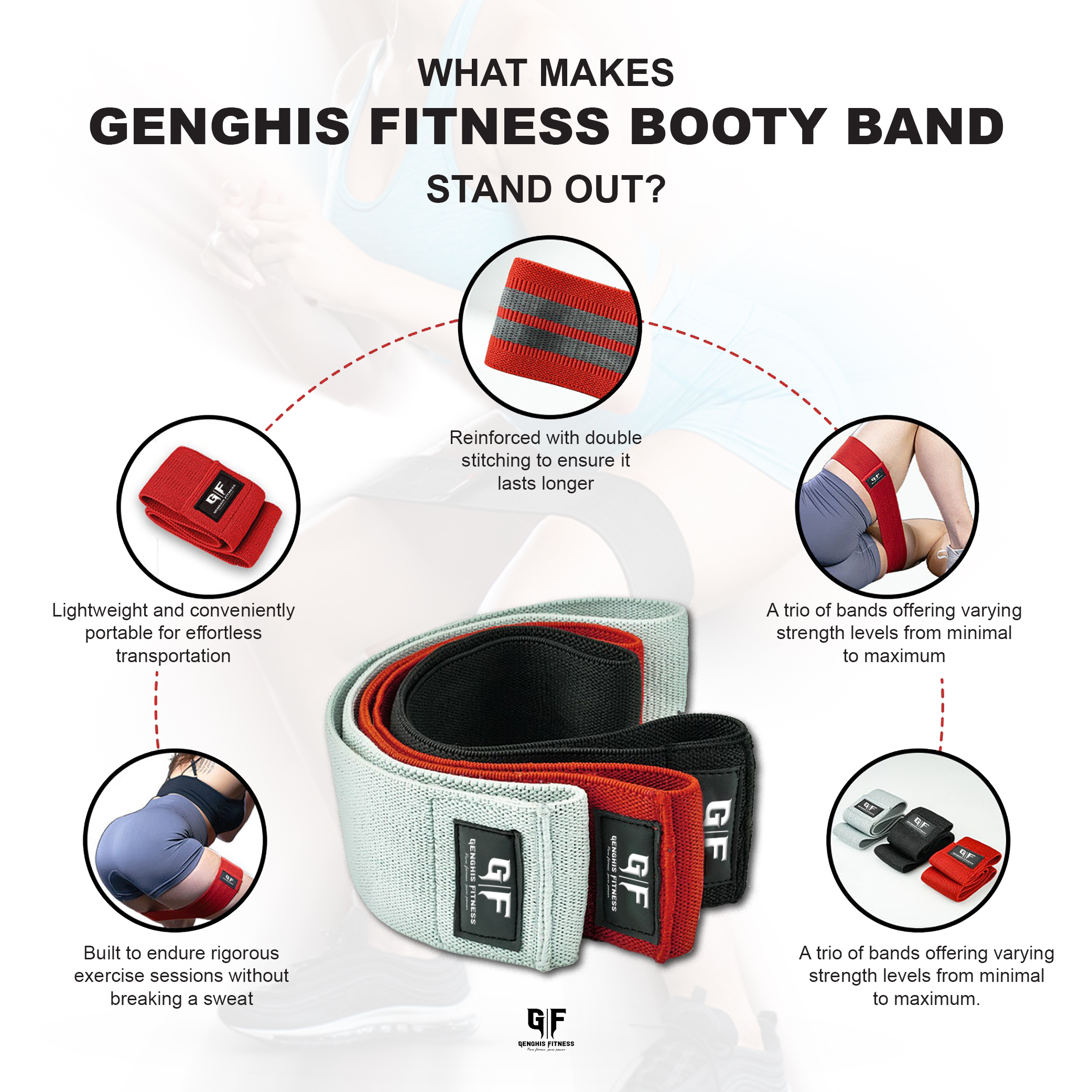
The hip circle bands are designed specifically for the hip-level work where band quality matters most. The hip circle design stays in position above the knees during lateral walks, banded squats, and hip thrusts without the rolling and repositioning that affects standard latex loops. The construction uses the fabric-over-elastic principle that provides consistent, smooth resistance through the full range of motion of each exercise.
For athletes who also use cable machine ankle work as part of their lower body program, the ankle straps for cable machine complement the hip circle bands by adding cable-loaded glute isolation exercises that progress beyond what band resistance alone can provide as strength develops.
Matching Bands to Training Goals
Pre-Barbell Activation
For warming up the hip abductors before heavy squat sessions, a light to medium band used for 2 to 3 sets of lateral walks and banded squats is the appropriate choice. The goal is activation, not fatigue. The band should feel challenging without producing the muscle burn that indicates near-maximal effort.
Standalone Glute Training
For sessions using bands as the primary training tool, a medium to heavy band used across the full exercise menu provides the stimulus needed for muscle development. Progress through the resistance levels systematically rather than staying on the same band indefinitely.
Rehabilitation and Injury Prevention
Light resistance bands are the standard starting point in rehabilitation protocols for knee and hip conditions. The American Council on Exercise and most physical therapy frameworks for patellofemoral pain and IT band syndrome include progressive hip abductor work with resistance bands as a primary intervention. Begin at the lightest resistance that provides a challenge and progress methodically.
Care and Lifespan
Fabric bands should be hand washed in cool water with mild detergent after every 3 to 5 sessions and air dried away from heat and direct sunlight. Avoid machine drying. Inspect the edges and seams periodically for early signs of fraying. A fabric band that has developed holes in the outer shell, fraying at the edges that exposes the internal elastic strands, or uneven resistance across the width has reached the end of its usable life. Replace before the internal strands begin snapping under load.