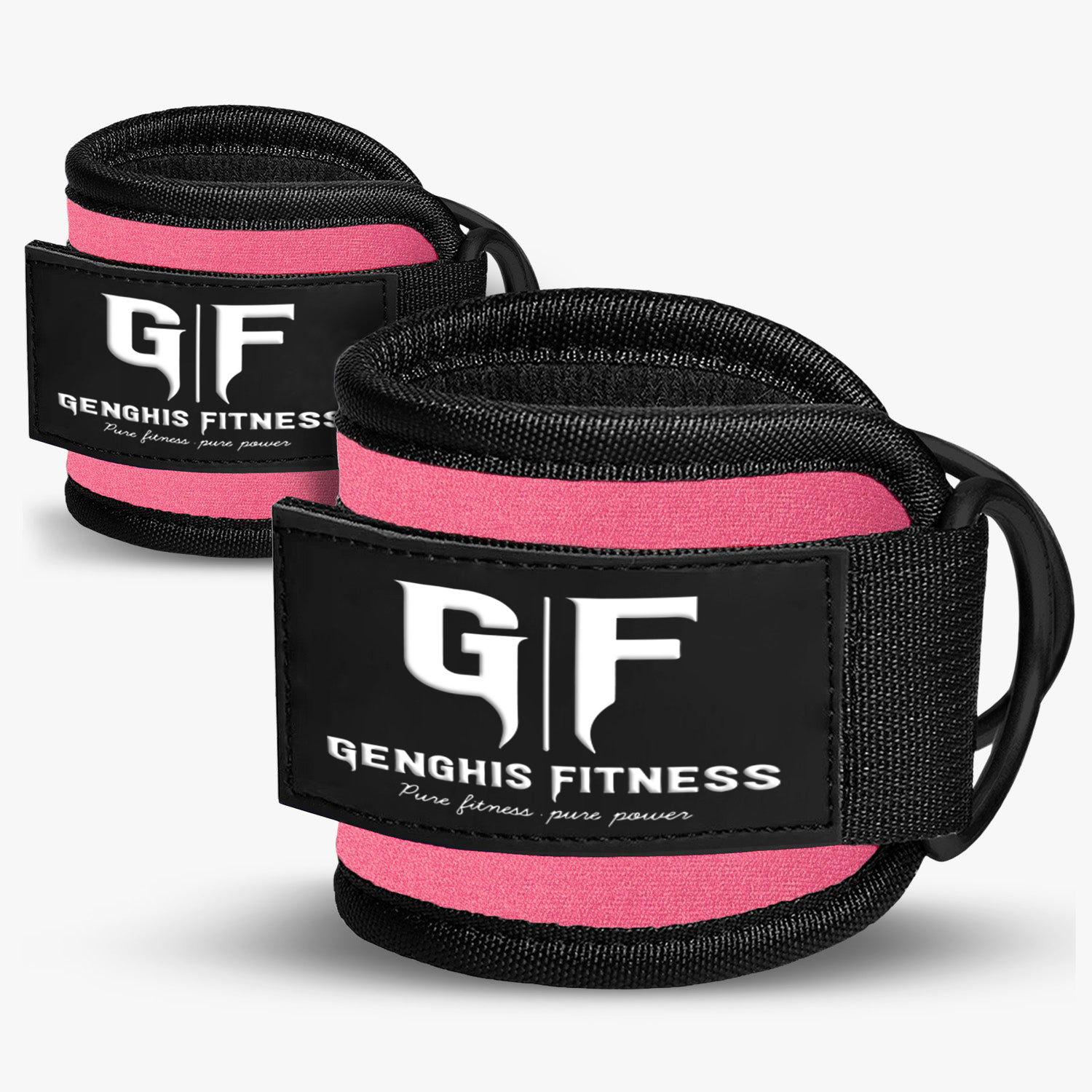
BEST ANKLE STRAPS FOR CABLE MACHINES: HOW TO FIND THE RIGHT PAIR AND WHAT TO AVOID
Ankle straps for cable machines are one of those pieces of gym equipment where the difference between a great pair and a mediocre pair is immediately obvious the first time you use them under real training conditions. The right pair stays fixed through 20 reps of cable kickbacks without shifting a millimeter. The wrong pair slides down mid-set, digs into the ankle bone, and requires more attention to managing the strap than to the exercise itself. This guide covers what makes the best ankle straps for cable machines genuinely worth using and how to evaluate your options without getting misled by marketing.
THE NON-NEGOTIABLE FEATURES OF A QUALITY ANKLE STRAP
WELDED D-RING HARDWARE
The D-ring is the link between your strap and the cable machine carabiner. It needs to maintain its shape and structural integrity under the repeated tension of loaded cable exercises across hundreds of sessions. Welded D-rings are formed as complete round rings and then shaped; they do not have a weak point where a seam could open under force. Stamped D-rings are pressed flat from sheet metal into a D shape and have significantly lower load tolerance and a tendency to deform and bind against the carabiner over time. The Genghis Fitness ankle straps use welded hardware that handles consistent training loads without the deformation that interrupts sessions and eventually creates a safety issue under heavy cable resistance.
DUAL VELCRO CLOSURE SYSTEM
A single-closure Velcro system creates one contact zone that the strap relies on entirely to maintain position. Sweat, repeated application, and the lateral forces of abduction and extension exercises progressively reduce the grip strength of that single closure, and the strap begins sliding down the ankle during sets. A dual-closure design creates two independent contact zones that must both fail before the strap loses its position. In practice, dual-closure straps stay in place throughout full training sessions without requiring mid-set adjustments, which is the baseline requirement for a tool to be genuinely useful during cable work.
NEOPRENE PADDING AND ANKLE PROTECTION
The medial and lateral malleoli, the bony prominences on either side of the ankle, are vulnerable to pressure from inadequately padded straps during high-rep cable exercises. Thin foam padding that compresses completely under the closure force offers no meaningful protection at these contact points. Dense neoprene lining that maintains its shape under closure force and distributes pressure evenly across the ankle surface rather than concentrating it over the bony prominences is the meaningful standard. Research on pressure distribution in orthotic devices confirms that even pressure distribution significantly reduces discomfort and tissue damage risk compared to concentrated loading at bony prominences, the same principle that applies to ankle strap padding design.
WHERE THE BEST ANKLE STRAPS EXCEL IN REAL TRAINING
STANDING CABLE GLUTE KICKBACKS
The cable glute kickback is the primary use case for ankle straps and the exercise that most thoroughly tests strap security. Facing the cable machine, with the strap on the working leg, extending the leg backward against cable resistance requires the strap to resist both the backward tension of the cable and the rotational forces created by hip extension. A strap that slides even 5mm during a kickback set disrupts the force transfer and requires stopping to readjust. Quality ankle straps that maintain complete positional stability through full sets of 15 to 20 kickback reps allow full focus on the glute contraction rather than equipment management.
CABLE HIP ABDUCTIONS FOR GLUTEUS MEDIUS DEVELOPMENT
Standing cable abductions, performed with the strap on the leg farthest from the cable stack, are one of the most effective exercises for the gluteus medius, the hip stabilizer that controls pelvic drop during single-leg activities. The multi-directional forces during abduction, lateral tension from the cable plus the slight rotational component of lifting the leg sideways, create a demanding test for strap attachment security. Pair consistent cable abduction training with hip circle bands for activation work before cable loading and you have a comprehensive gluteus medius development protocol that addresses both activation and progressive resistance loading.
CABLE HIP FLEXOR WORK FOR ATHLETIC PERFORMANCE
Facing away from the cable machine with the strap on the working leg, driving the knee upward against cable resistance loads the hip flexor complex in its shortened position, the range that is most undertrained in most athletes. Strong hip flexors contribute directly to sprint mechanics, vertical jump height, and the ability to generate power through the frontal plane in athletic movements. Cable hip flexor work is one of the few exercises that directly loads this muscle group against meaningful resistance rather than bodyweight alone.
HOW TO EVALUATE ANKLE STRAPS BEFORE BUYING
When evaluating ankle straps, apply this five-point checklist. First, identify the D-ring type: look for welded construction rather than stamped flat metal. Second, assess closure design: dual-closure wins over single-closure for security during dynamic loading. Third, evaluate padding thickness and material: press the padding with your thumb and confirm it does not compress completely to the backing layer. Neoprene that holds shape under moderate thumb pressure will hold shape against an ankle under strap tension. Fourth, check strap width: wider straps distribute force more evenly and feel more comfortable during high-rep sets. Minimum 2 inches of strap width is the practical standard. Fifth, look at the attachment point positioning: the D-ring should sit at the center of the ankle front, not offset to one side, for optimal force transfer geometry during all exercise directions.
THE GENGHIS FITNESS ANKLE STRAP ADVANTAGE
The Genghis Fitness ankle straps for cable machines meet every criterion on that checklist. The welded D-ring maintains its shape through continuous heavy cable training use. The dual Velcro closure system creates secure ankle attachment that does not require mid-set adjustment. The neoprene padding distributes pressure evenly across the ankle without bottoming out at the malleoli. The strap width covers enough surface area to feel comfortable across extended high-rep sets. And the D-ring positioning ensures correct force transfer geometry whether you are driving the leg backward, sideways, or forward against cable resistance.
For athletes who train their lower body thoroughly, pairing quality ankle straps with knee sleeves for heavy compound work and a complete lower body accessory protocol using cable exercises represents the kind of complete training investment that produces the posterior chain development and hip stability that compound lifts alone cannot fully build.
CARING FOR YOUR ANKLE STRAPS TO MAXIMIZE THEIR LIFE
Rinse your ankle straps with cold water after every training session to flush out sweat before it penetrates and breaks down the neoprene lining. Allow them to air dry completely before storing, never rolling them up damp and leaving them in a closed gym bag where mold can develop within days. Hand wash with mild soap once every one to two weeks depending on training frequency. Avoid machine washing, which stresses the Velcro closures and accelerates delamination of the neoprene from the backing fabric. With consistent simple maintenance, a quality pair of ankle straps lasts years of regular cable training use.
FINAL WORDS
The best ankle straps for cable machines are not the cheapest or the most expensive option. They are the ones built with welded hardware, dual-closure security, genuine neoprene padding, and appropriate strap width to handle real training loads across real training sessions. The Genghis Fitness ankle straps deliver all of that in a package designed for athletes who train their lower body with the same seriousness they bring to barbell work. Get them, use them on every cable day, and build the glutes, hip stabilizers, and hip flexors that heavy compound lifting alone was never going to fully develop.
Certified strength and conditioning specialists with over 10 years of experience in powerlifting, nutrition, and evidence-based fitness content. Based in New York City.
This guide is part of the Genghis Fitness gym accessories guides, where 80 articles cover dip belts, arm blasters, lifting hooks, ankle straps, and hip circle bands.