MUSHROOM COFFEE: THE BENEFITS, THE HYPE, AND WHAT THE SCIENCE ACTUALLY SHOWS
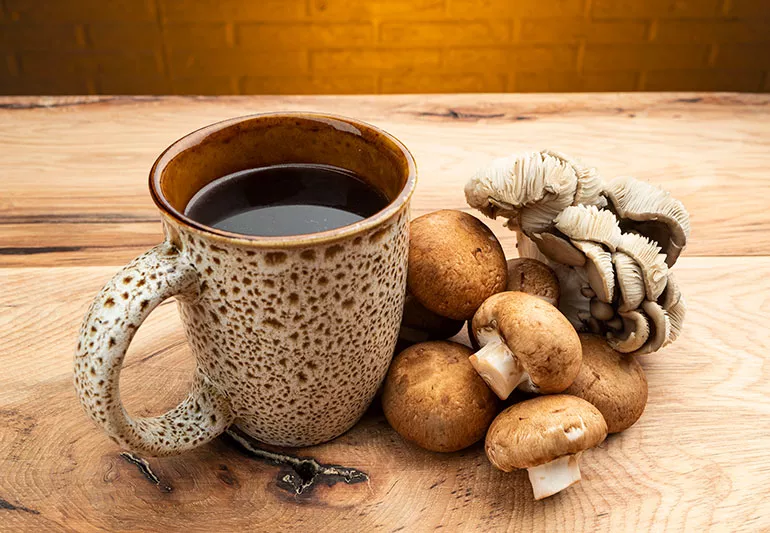
Mushroom coffee blends functional mushroom extracts with coffee or other bases to create a beverage marketed for focus, energy, immune support, and adaptogenic stress management. The category has exploded in the US and European wellness markets over the past several years, driven by brands like Four Sigmatic and a growing consumer interest in functional foods. The question worth asking carefully is whether the mushroom components add meaningful health value at the doses typically present in a single serving, or whether the benefits rest primarily on the underlying coffee’s caffeine content.
THE FUNCTIONAL MUSHROOMS USED IN MUSHROOM COFFEE
The most commonly used functional mushrooms in coffee blends are lion’s mane, chaga, reishi, cordyceps, and turkey tail. Each has a distinct bioactive profile and evidence base that differs substantially in quality and clinical development. Understanding each mushroom’s specific properties prevents both dismissing the entire category and overstating what any particular product can do.
Lion’s mane contains hericenones and erinacines that stimulate nerve growth factor synthesis. Chaga provides beta-glucans and melanin compounds with antioxidant and immune-modulating properties. Reishi contains triterpenes including ganoderic acids with documented anti-inflammatory and immune-regulating effects. Cordyceps provides cordycepin and adenosine derivatives with documented effects on ATP production and oxygen utilization. Turkey tail contains the polysaccharide PSK used in Japan as an approved cancer adjuvant therapy. Studies indexed on PubMed confirm distinct bioactive profiles and bioavailability for each species.
LION’S MANE: THE COGNITIVE FOCUS CLAIM
Lion’s mane is the most marketed mushroom for cognitive benefits, and it has the most specific evidence for this application. A randomized controlled trial in older adults with mild cognitive impairment found that lion’s mane supplementation significantly improved cognitive function scores compared to placebo over sixteen weeks. The nerve growth factor stimulation mechanism is plausible and confirmed in cell and animal studies.
The critical question for mushroom coffee is whether the dose of lion’s mane per serving is sufficient to produce these effects. Studies showing cognitive benefits used doses of 500mg to three grams of lion’s mane extract daily. Many mushroom coffee products contain 100 to 250mg of lion’s mane per serving, which is below the doses used in positive clinical trials. Higher-dose standalone lion’s mane supplements provide more reliable delivery of the active compounds for the cognitive application specifically.
CORDYCEPS: THE PERFORMANCE CLAIM
Cordyceps’ reputation for improving physical performance comes from traditional Tibetan medicine and has been partially supported by research showing that cordycepin and beta-glucans improve mitochondrial efficiency and oxygen utilization. An animal study found significant improvements in aerobic capacity with cordyceps supplementation. Human trials have produced more mixed results, with some studies finding modest improvements in VO2 max and others finding no significant effect compared to placebo.
For athletes seeking performance enhancement from mushroom coffee, cordyceps is the most relevant ingredient, but the evidence is weaker than for more established ergogenic aids like creatine and caffeine. The caffeine in mushroom coffee is doing more for physical performance than the cordyceps for most users, and managing expectations around the mushroom component is important for informed purchasing decisions. Compare with the performance evidence for beet root nitrate as an example of a better-evidenced natural performance ingredient.
REISHI AND CHAGA: IMMUNE AND ADAPTOGENIC EFFECTS
Reishi has the most robust evidence for immune modulation and stress adaptation among the commonly used functional mushrooms. Beta-glucans and ganoderic acid triterpenes regulate NK cell activity, T-cell proliferation, and cytokine production. Multiple human trials confirm immune-modulating effects. The adaptogenic properties reduce anxiety and improve sleep quality through effects on the HPA axis that complement ashwagandha’s cortisol-normalizing mechanism through different molecular pathways.
Chaga provides extraordinary antioxidant capacity from its melanin content and beta-glucan polysaccharides. While chaga’s antioxidant activity is impressive in standardized assays, direct clinical trial evidence for specific health outcomes from chaga consumption in humans is limited. The antioxidant contribution from daily chaga consumption is plausible and consistent with the documented compound profile even without strong clinical trial evidence for specific disease outcomes.
IS MUSHROOM COFFEE WORTH IT?
The answer depends on what you are buying it for. If the primary goal is cognitive focus and energy, mushroom coffee provides the caffeine needed for these effects, but the mushroom dose in many products is too low to add meaningful cognitive benefit beyond the caffeine. Choosing a high-quality mushroom coffee with transparent mushroom content labeling and doses matching those used in positive clinical trials provides better value than products where the mushroom content is a marketing element rather than a functional dose.
If the goal is immune support, adaptogenic stress management, or the specific benefits of lion’s mane nerve growth factor stimulation, standalone mushroom extract supplements provide more reliable and cost-effective dosing than mushroom coffee products where the coffee base dominates the per-serving cost.
HOW TO BUILD A FUNCTIONAL MUSHROOM ROUTINE
The most evidence-consistent approach is consuming functional mushrooms as standalone supplements at clinically relevant doses alongside your regular coffee or alternative caffeinated beverage. Lion’s mane at 500mg to one gram daily for cognitive support. Reishi at 500mg to one gram daily for immune and adaptogenic effects. Cordyceps at 500mg to one gram for potential aerobic performance support. This approach provides transparent dosing and separates the caffeine stimulus from the mushroom therapeutic effect.
For those who genuinely prefer the convenience of a single mushroom coffee product, choosing products that disclose mushroom extract content per serving, use dual extraction methods that capture both water-soluble beta-glucans and fat-soluble triterpenes, and contain at least 300 to 500mg of mushroom extract per serving gives the best chance of functional benefit from the mushroom components.
THE EXTRACTION METHOD MATTERS AS MUCH AS THE MUSHROOM
Functional mushroom bioavailability depends critically on the extraction method used to produce the supplement. Mushroom beta-glucans, the primary immune-modulating compounds, are found in the cell wall and require hot water extraction to make them bioavailable. Mushroom triterpenes from reishi, the adaptogenic compounds, are fat-soluble and require alcohol extraction. Products using only ground mushroom powder without extraction provide dramatically lower bioavailable compound content than properly extracted products.
Dual extraction, using both hot water and alcohol extraction methods, captures both the water-soluble beta-glucans and the fat-soluble triterpenes and hericenones. When evaluating mushroom coffee or standalone mushroom supplement products, the extraction method should be explicitly stated on the label. Products describing themselves simply as mushroom powder without mentioning extraction methodology are unlikely to deliver bioactive compounds at meaningful concentrations regardless of the dose stated on the label.
BUILDING A MUSHROOM SUPPLEMENT STACK
For athletes and health-focused individuals who want to incorporate functional mushrooms seriously rather than through a single mushroom coffee product, a targeted mushroom stack addresses specific goals more efficiently. Lion’s mane as a standalone dual-extract supplement at 500mg to 1g daily for sustained cognitive support. Reishi at 500mg daily in the evening for sleep quality improvement and immune regulation. Cordyceps before training sessions for potential aerobic performance and mitochondrial support.
This targeted approach provides known doses of properly extracted compounds aligned with the specific evidence for each mushroom, rather than accepting whatever dose a coffee blend happens to include. The combined cost is often comparable to or lower than premium mushroom coffee brands when evaluated per effective dose of active compounds. Add an anti-inflammatory tea protocol alongside the mushroom stack for a comprehensive daily approach to immune health, cognitive support, and training recovery.
FINAL WORDS
Mushroom coffee is a legitimate functional food category when the mushroom dosing is adequate, the extraction method is appropriate for bioavailability, and the product transparently labels its content. The underlying mushrooms have genuine health properties confirmed in research: lion’s mane for cognitive support, reishi for immune regulation and stress adaptation, cordyceps for potential performance effects, chaga for antioxidant density. The coffee component provides well-documented cognitive and performance effects from caffeine. The combination is rational as a daily functional beverage. The honest caveat is that many commercial mushroom coffee products underdose the mushroom components relative to clinical trial doses, and standalone functional mushroom supplements provide better dosing control for the same investment.
Certified strength and conditioning specialists with over 10 years of combined experience in powerlifting, nutrition coaching, and evidence-based fitness content. Based in New York City, the Genghis Fitness team tests every protocol in the gym before writing about it.