ADJUSTABLE ANKLE STRAPS: WHY ADJUSTABILITY MATTERS AND HOW TO USE IT FOR BETTER TRAINING
Not all ankle straps are built the same, and the adjustability of the closure system is one of the variables that separates a strap that works consistently across a full training session from one that requires constant fiddling to maintain proper position and tension. Adjustable ankle straps give you control over how tightly and precisely the strap fits your specific ankle circumference, how it sits relative to your malleoli, and how much pressure the padding applies to the tendon and bone structures of the joint. This guide covers why adjustability matters, what a quality adjustable ankle strap design looks like, and how to use the adjustment capability to optimize your cable training.
WHY A FIXED-SIZE ANKLE STRAP IS A PROBLEM
Ankle circumference varies significantly across athletes. A strap sized for a 200-pound male athlete’s ankle will be too large on a 130-pound female athlete’s ankle, creating excess material that bunches, shifts position during sets, and delivers inconsistent pressure across the joint surface. A strap that is too tight restricts circulation and creates discomfort that truncates sets and discourages use of cable lower body exercises entirely. Fixed-size straps attempt to solve this problem through medium-sized compromises that fit nobody perfectly. Adjustable straps solve it entirely by allowing each athlete to find the precise closure point that delivers consistent, secure, comfortable compression for their specific anatomy.
THE COMPONENTS OF A QUALITY ADJUSTABLE ANKLE STRAP
DUAL-CLOSURE VELCRO SYSTEM WITH WIDE ADJUSTMENT RANGE
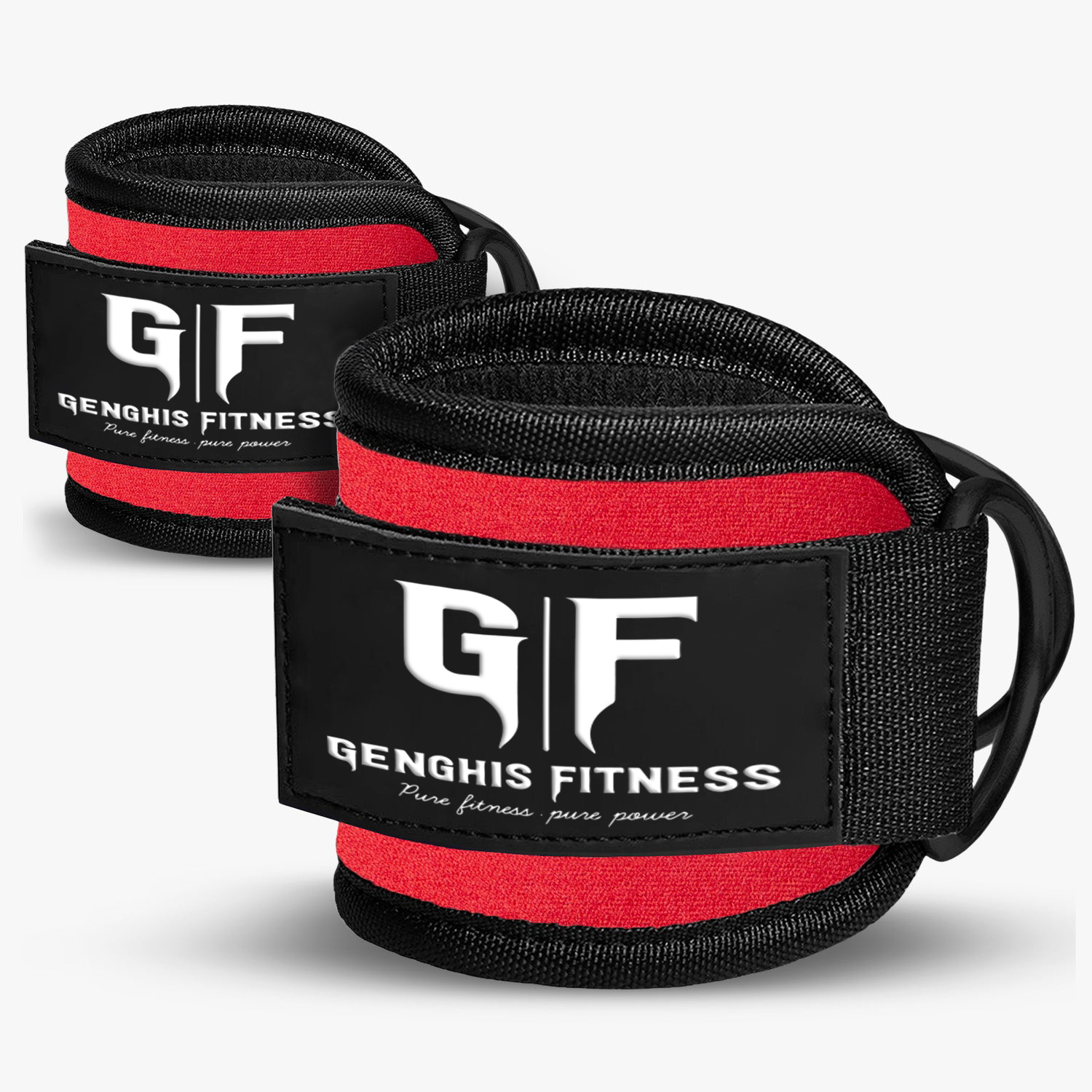
A quality adjustable ankle strap uses a dual Velcro closure system with a wide enough adjustment range to accommodate ankle circumferences from roughly 8 to 14 inches without the strap running out of Velcro contact at either extreme. The dual closure creates two independent securing zones that together provide more stability than any single-closure design while the adjustment range within each closure allows fine-grained positioning. The Genghis Fitness ankle straps use this dual-closure architecture to deliver secure, position-stable attachment across the full range of athlete ankle sizes.
NEOPRENE LINING THAT MAINTAINS SHAPE ACROSS THE ADJUSTMENT RANGE
The padding material must deliver consistent pressure and comfort regardless of where within the adjustment range the strap is closed. A thin foam lining that compresses completely under the strap tension at tighter closure points bottoms out on smaller ankles and provides no meaningful cushioning. Dense neoprene that maintains its shape and cushioning properties across the full compression range delivers consistent comfort whether the strap is worn at the loose end or the tight end of its adjustment range. Research on orthotic device pressure distribution confirms that consistent padding density across a device’s size range is essential for maintaining the protective properties the padding is designed to deliver.
WELDED D-RING POSITIONED FOR CORRECT FORCE TRANSFER
The D-ring that connects the ankle strap to the cable machine carabiner must sit at the center-front of the ankle when the strap is correctly positioned. A D-ring that is offset to one side or that shifts position as the strap stretches under cable tension creates a misaligned force vector that pulls the leg off the intended exercise plane. Welded D-rings that cannot deform under load maintain the correct ring geometry that allows the carabiner to attach and articulate cleanly across every exercise direction from kickbacks to abductions to hip flexor pulls.
HOW TO ADJUST YOUR ANKLE STRAP CORRECTLY
FINDING THE RIGHT TENSION
The correct tension for an ankle strap is firm enough that the strap cannot slide down the ankle during a working set but not so tight that it restricts blood flow or creates numbness in the foot or toes. As a practical test, close the strap to your intended training tension and perform 10 bodyweight squats. If the strap slides at all during this test, tighten the closure. If you experience tingling or numbness in the foot within 30 seconds of closing the strap, loosen slightly. The correct tension sits between these two failure modes and typically feels noticeably firm but not uncomfortable during the first several reps of a set.
POSITIONING RELATIVE TO THE MALLEOLI
Position the strap so that the padding sits above the medial and lateral malleoli (the bony ankle prominences) rather than directly over them. The malleoli are the most pressure-sensitive structures of the ankle, and a strap that applies direct circumferential compression over these bony points becomes painful quickly under training loads. Positioning the strap just above these structures, over the distal fibula and tibia, distributes pressure across softer tissue and allows comfortable use throughout extended high-rep cable sessions. This positioning also ensures the D-ring sits at the correct mid-ankle height for optimal force transfer during all exercise directions.
EXERCISES WHERE ADJUSTABLE ANKLE STRAPS EXCEL
CABLE GLUTE KICKBACKS
The kickback requires the strap to resist the backward pull of the cable through hip extension while staying in position on the working leg. An adjustable strap that is correctly tensioned for the specific athlete’s ankle creates a stable platform that does not shift during the eccentric phase of the movement. Use a weight that allows you to feel the glute contracting through the full range of extension without the hip rotating externally, which is the most common compensation when weight exceeds proper technique capacity.
STANDING CABLE ABDUCTIONS
Abductions place lateral force on the strap as the leg lifts away from the cable pulley. The dual-closure system of quality adjustable straps distributes this lateral force across two closure zones rather than concentrating it in one, making the strap more stable during abduction than during kickback work where the primary force is anterior-posterior. Start with lower resistance for abductions than kickbacks, as the gluteus medius is typically weaker than the gluteus maximus, and build the load progressively as hip abductor strength develops. Pair these cable abduction sets with hip circle band activation work before loading the cable to ensure the target muscles are primed to do the work.
CABLE HIP FLEXOR DRIVES
Facing away from the cable machine with the strap on the working leg, driving the knee forward and upward against resistance directly loads the hip flexor complex. The strap must resist the upward and forward pull during this movement, which places different stress on the closure than kickback or abduction work. A quality adjustable strap handles this force direction change cleanly because the dual closure provides omni-directional stability rather than resistance primarily in one plane.
CARING FOR ADJUSTABLE ANKLE STRAPS
Adjustable ankle straps with Velcro closures require specific maintenance attention to keep the closure system functioning properly. After every session, close the Velcro before rinsing so that lint and fabric debris cannot accumulate in the hook side of the closure during storage. Rinse with cold water to remove sweat before it penetrates the neoprene lining. Air dry completely before storing, never folded with the Velcro in contact with the loop side for extended periods, which transfers fibers and reduces the hook side’s grip strength over time. Monthly cleaning of the Velcro hook side with a stiff brush removes accumulated debris that progressively reduces closure grip. These simple practices extend the functional life of the adjustment system across years of regular training use.
Pair your ankle straps with knee sleeves for overall lower body joint support during cable sessions that also include squat-pattern or hinge-pattern movements. The combination of properly maintained ankle straps for cable isolation work and warm, compressed knee joints for compound loading creates a complete lower body training support system.
FINAL WORDS
Adjustable ankle straps are not a luxury upgrade over fixed-size options. They are a functional requirement for any ankle strap to actually fit the range of athlete ankle sizes that exists in real training environments. The adjustment capability is what allows the strap to deliver consistent pressure, stable positioning, and comfortable use for every athlete who uses it, not just the athletes whose ankles happen to match a fixed-size compromise. The Genghis Fitness ankle straps combine adjustable dual-closure design with welded hardware and neoprene padding into a complete package built for the demands of serious cable machine training. Use the adjustment system, set the tension correctly for your ankle, and focus entirely on the exercises rather than the equipment.
Certified strength and conditioning specialists with over 10 years of experience in powerlifting, nutrition, and evidence-based fitness content. Based in New York City.
More accessory guides are in the gym accessories guides, organized by equipment type for fast reference.