BARBELL LEG WORKOUT: THE COMPLETE PROGRAM FOR BUILDING MAXIMUM LOWER BODY STRENGTH AND SIZE
Why Barbell Training Builds Legs Better Than Machines
Machine leg training provides a fixed movement path that eliminates the balance and stabilization demands of free weight movements. This convenience comes at a cost: the stabilizing muscles of the hip, knee, and ankle are not meaningfully challenged, and the loading cannot replicate the full-body integration of barbell compound movements. Barbell squats and deadlifts train the quads, hamstrings, glutes, spinal erectors, and core simultaneously through coordinated movement patterns that machine training produces only in isolation. Research published in the Journal of Strength and Conditioning Research confirmed that free weight compound training produces superior overall lower body strength and muscle mass compared to machine-only training at equivalent volumes. A barbell leg workout builds stronger, more functional legs that perform better in athletic contexts than machine-only alternatives. Support every heavy barbell leg session with a 10mm lever belt for spinal support and knee sleeves for joint warmth and proprioceptive feedback.
The Complete Barbell Leg Workout
Exercise 1: Barbell Back Squat
The barbell back squat is the cornerstone of any serious leg training program. High-bar position with heels at shoulder width and toes slightly out. Squat to full depth, hip crease below the knee, and drive back up through the heels. Four sets of 5 to 8 reps at 75 to 85 percent of maximum. Progressive overload: 5 pounds added when all sets are completed with depth and controlled tempo. Use a 10mm lever belt on every working set and knee sleeves throughout the entire session.
Exercise 2: Romanian Deadlift
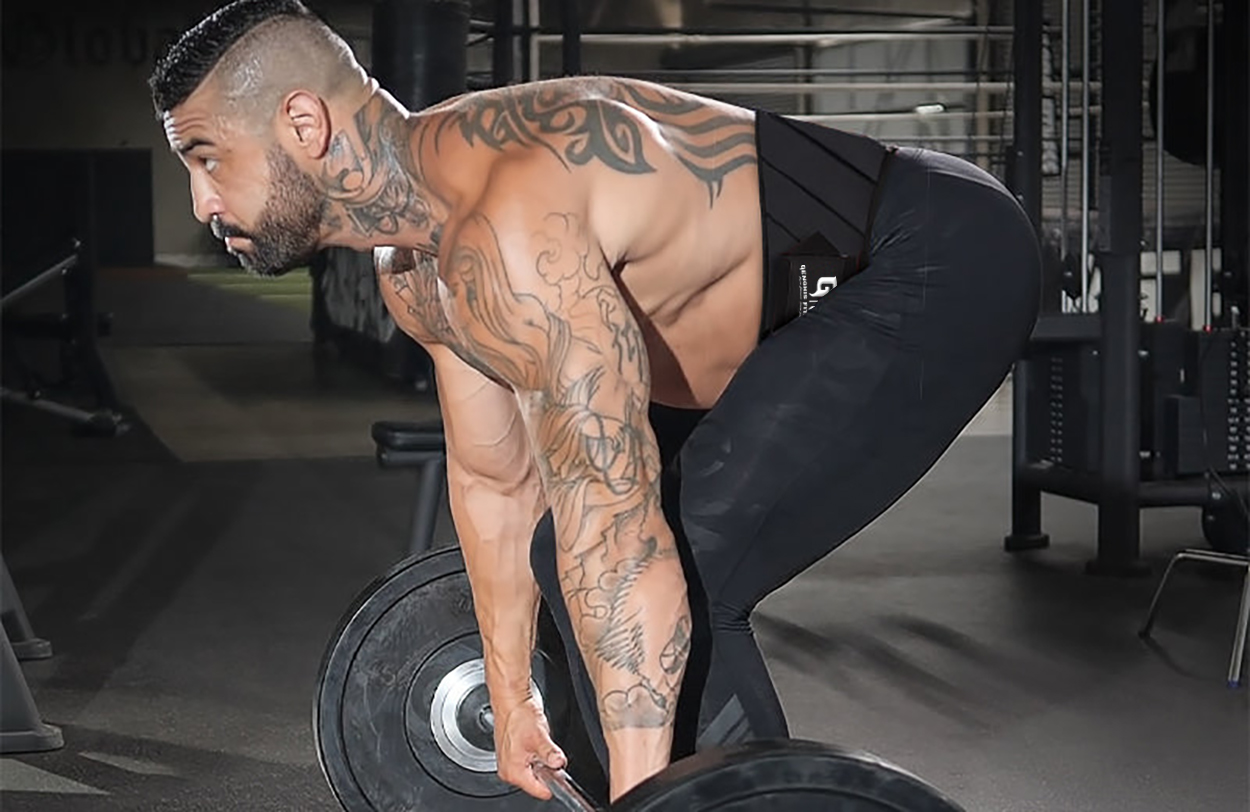
The Romanian deadlift trains the hamstrings and glutes through a hip hinge pattern that squats do not replicate. Starting from the standing position, hinge forward at the hips with a flat back and lower the bar along the front of the legs until a strong hamstring stretch is felt, then drive back to standing through hip extension. Four sets of 8 to 10 reps. Use leather lifting straps on working sets to ensure grip does not limit the posterior chain training stimulus.
Exercise 3: Barbell Lunge or Split Squat
Three sets of 10 reps per side of barbell lunges or split squats adds unilateral volume that addresses bilateral strength imbalances and develops the hip flexor mobility that bilateral squatting does not challenge. The barbell position demands more core stability than dumbbell alternatives, increasing the training stimulus for the stabilizing muscles alongside the primary quad and glute work.
Exercise 4: Leg Press
After the heavy barbell compound work, three sets of 15 to 20 reps on the leg press at a higher rep range adds additional quad and glute volume without the spinal loading of additional barbell squatting. The leg press allows heavier loading per set than barbell squats for most athletes and provides the constant compression stimulus that high-rep machine work delivers effectively. Feet high on the platform to emphasize glutes; feet low for more quad emphasis.
Exercise 5: Lying Leg Curl
Three sets of 12 to 15 reps of lying leg curls address the knee flexion function of the hamstrings that Romanian deadlifts do not train. Full range of motion, three-second eccentric on every rep, and genuine fatigue by the final two reps of each set. This isolation finisher ensures the hamstrings are trained through both their primary functions, hip extension and knee flexion, in the same session.
Programming the Barbell Leg Workout
This workout is most effective when performed twice per week with 72 hours of recovery between sessions. Session A can emphasize heavier squatting at lower reps while Session B uses slightly lighter squat loading for higher reps, providing both the maximal strength stimulus and the hypertrophy volume across the training week. Track every working set weight and rep count. Ensure each training block shows measurable progression in the squat and Romanian deadlift working weights, as these are the primary drivers of overall leg development. The accessory movements, lunges, leg press, and leg curl, progress in the background as the primary compound movements advance. Maintain equipment discipline: 10mm lever belt for every squat and deadlift working set, lifting straps for every Romanian deadlift working set, and knee sleeves from warm-up through the final accessory exercise.
Barbell Leg Workout Periodization: Cycling Through Training Phases
The most effective barbell leg training programs cycle through distinct phases rather than using the same rep ranges and loading patterns indefinitely. A strength phase of four to six weeks uses heavier loads of 80 to 90 percent of maximum at lower reps of 3 to 5, building the maximal strength base that subsequent hypertrophy phases convert into visible muscle mass. A hypertrophy phase of four to six weeks uses moderate loads of 65 to 75 percent at higher reps of 8 to 12, producing the metabolic stress and mechanical tension that drives muscle growth. A deload week between phases allows recovery and consolidation of the adaptations from the preceding phase before the next training block begins.
This periodization approach produces more long-term progress than staying at the same loading and rep range across months, because each phase produces a different type of adaptation that compounds with the preceding phase. The strength phase builds the neural efficiency and joint strength that allows heavier loading in the hypertrophy phase. The hypertrophy phase builds the muscle mass that provides the leverage advantage for stronger performance in the next strength phase. Applied consistently across training years, this cycling approach produces the progressive strength and size gains that plateau-prone same-rep-range training cannot sustain. Track squats and Romanian deadlift loads across phases, use a 10mm lever belt on every working set during both phases, and leather lifting straps on all Romanian deadlift and heavy pulling work. This combination of intelligent periodization and proper equipment support produces the barbell-trained legs that machine-only programs cannot approach.
Recovery Between Barbell Leg Sessions
Barbell leg workouts create the greatest systemic fatigue of any training modality because they load the largest muscle groups through the most demanding compound movements. Seventy-two hours of recovery between leg sessions is the minimum appropriate spacing for most athletes to allow tissue repair and neuromuscular recovery before the same movements are loaded again at working intensity. Active recovery practices including light hip circle band work, yoga hip sequences, and low-intensity walking on non-training days promote blood flow to the recovering tissues and maintain hip and ankle mobility between the heavy sessions. Seven to nine hours of sleep nightly is non-negotiable for the hormonal environment that makes heavy leg training productive rather than merely fatiguing. Treat recovery with the same seriousness as the training itself, and the barbell leg sessions will continue producing adaptation rather than accumulated fatigue that plateaus progress and increases injury risk.
FINAL WORDS
The barbell leg workout in this guide covers every major lower body development priority: bilateral quad and posterior chain strength from the squat, posterior chain hypertrophy from the Romanian deadlift, unilateral correction from the lunge, additional quad volume from the leg press, and knee flexion hamstring work from the leg curl. Train it twice weekly with progressive overload, protect the joints with Genghis Fitness knee sleeves and a quality lever belt, and build the barbell-trained legs that machine programs cannot match.
Certified strength and conditioning specialists with over 10 years of experience in powerlifting, nutrition, and evidence-based fitness content. Based in New York City.
LEG DAY GEAR THAT KEEPS YOU IN THE GYM
Ankle straps unlock every cable leg exercise. Knee sleeves give you joint support through every rep of every set.
Ankle Straps