Genghis Fitness · Equipment and Strength Training
Best Exercises with a Dip Belt: Weighted Dips, Pull-Ups, Hanging Core Work, Squats, and How to Build a Complete Programme Around the Belt
Updated 2026 | By Team Genghis Fitness | 22 min read
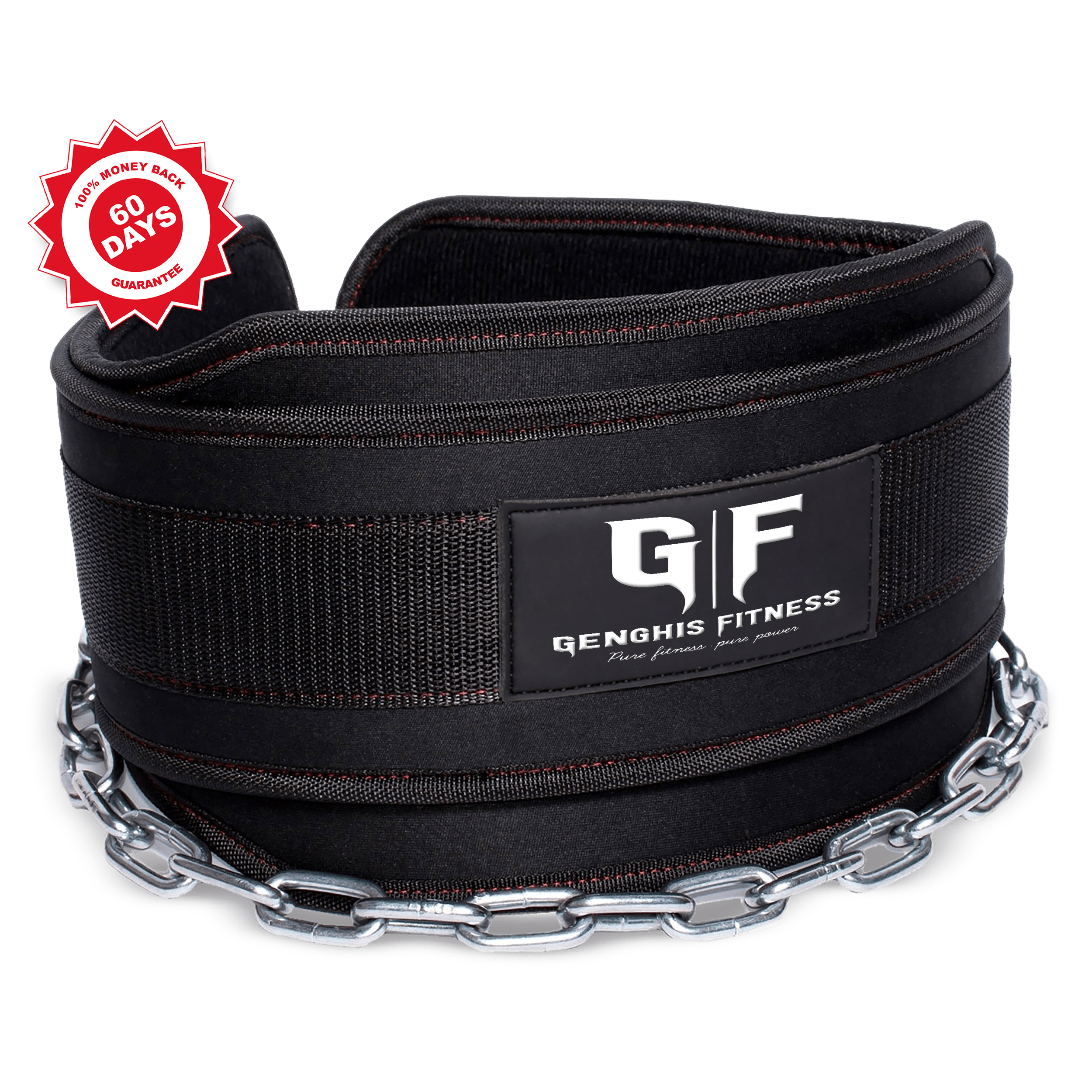
A dip belt is one of those pieces of equipment that looks simple but unlocks a disproportionately large range of exercises once you understand how to use it properly. Most athletes think of it as a dips and pull-ups tool, which it is primarily. But the hip-anchored chain load position also makes it suitable for hanging core work, squat variations, hip belt squats, and even farmer carry variations. Getting the most from a dip belt means knowing which exercises it is genuinely superior for, which it is adequate for, and which are better served by other equipment. This guide covers the best exercises for a dip belt with technique cues, programming recommendations, and how to build a strength routine that maximises the belt’s potential across multiple movement patterns.
Weighted Dips: The Primary Application
Weighted dips using a dip belt with chain are the gold standard upper body pressing exercise for athletes who have outgrown the challenge of bodyweight dips. The dip loads the pectoralis major, anterior deltoid, and tricep in a natural pressing plane, and the chest emphasis can be shifted by leaning the torso forward (more pec activation) or keeping the torso more upright (more tricep emphasis). Research published in the Journal of Strength and Conditioning Research confirmed that chest dips with forward lean produced pectoralis major EMG activation comparable to flat bench press at equivalent efforts, while tricep-focused upright dips produced higher tricep activation than close-grip bench press. This makes weighted dips one of the most versatile pressing exercises available, covering both chest and tricep development within a single movement pattern by adjusting torso angle.
Technique for weighted dips: Position the belt low at the hip crease. Start from a locked-out position at the top of the dip bars. Lower under control until the upper arm reaches parallel to the floor for most athletes (some hypermobile athletes can go lower safely, but going below parallel adds significant shoulder stress with minimal additional pec or tricep benefit). Drive back up to full extension. Keep elbows tracking 45 degrees from the torso throughout, not fully flared or fully tucked. Aim for 3 to 5 sets of 4 to 8 reps for strength focus, or 3 sets of 8 to 12 for hypertrophy.
Weighted Pull-Ups and Chin-Ups
Weighted pull-ups with a dip belt are the most direct route to elite-level back and bicep strength relative to bodyweight. Each kilogram of weight added to the pull-up increases the absolute demand on the latissimus dorsi, rhomboids, biceps, and scapular stabilisers proportionally. Chin-ups (supinated grip, shoulder-width) emphasise the bicep and lower lat more than overhand pull-ups (pronated grip, wider width), which emphasise the upper lat and teres major. Neutral grip pull-ups (parallel bars, shoulder-width) are typically the most shoulder-friendly variant and produce the highest lat and bicep co-activation of the three grip positions. Programming weighted pull-ups: add 2.5 to 5 kg per session when 3 sets of 6 clean reps can be completed. Use lifting straps for heavy weighted pull-up sets where grip fatigue would otherwise limit the back training stimulus before the target muscles are adequately fatigued.
Hip Belt Squat: A Spine-Friendly Leg Builder
The hip belt squat is a squat variation where the load hangs from a dip belt at the hips rather than being supported by the spine via a barbell. This makes it an excellent leg-building exercise for athletes with lower back or cervical spine injuries that prevent barbell squatting, and a valuable supplementary exercise for athletes who want additional quad and glute volume without additional spinal loading. To perform a hip belt squat, set up two boxes or plates to stand on with a gap between them for the weight to hang into. Attach plates to the dip belt chain, step onto the boxes, and squat down until the weights lightly touch the floor or until parallel depth is reached. Drive up through the heels. The hip belt squat loads the quads and glutes very similarly to a barbell squat but shifts essentially all the compressive and shear load off the spine, making it a genuinely different stimulus from the same movement. It complements barbell squatting and is not a direct substitute for athletes who can squat without pain, but it is a valuable addition for extra leg volume sessions.
Weighted Hanging Core Work
Hanging knee raises and leg raises with additional weight via a dip belt are among the most effective core and hip flexor strengthening exercises for advanced athletes. Bodyweight hanging leg raises become relatively easy for athletes who can already do 15 to 20 strict reps. Adding 5 to 20 kg via a dip belt dramatically increases the difficulty and training stimulus without requiring any additional equipment beyond the belt. Weighted hanging knee raises target the lower abdominals and hip flexors primarily, while weighted straight-leg raises add significant hamstring flexibility demands alongside the core and hip flexor load. Ankle weights can be added instead of a dip belt for lighter resistance, but the dip belt allows heavier progressive loading for athletes who need it. These exercises pair well with the compound pressing and pulling work to create a complete upper body training session.
Programming a Dip Belt Session
A complete dip belt upper body session for intermediate athletes: warm up with bodyweight pull-ups and dips (2 sets of 8 each), then progress to weighted dips 4 sets of 6 to 8 with added weight, weighted pull-ups 4 sets of 5 to 6, weighted hanging knee raises 3 sets of 10 to 12. This session hits chest, triceps, lats, biceps, and core in approximately 45 minutes with minimal equipment. Adding the hip belt squat as the first exercise in a leg day creates a spine-loading-free lower body foundation for athletes who want to manage back fatigue across a high-volume training week. The complete upper body and back training framework is in our muscle building guide.
Frequently Asked Questions
How Heavy Should You Go on Dip Belt Exercises?
There is no absolute target weight that applies to all athletes. The appropriate load is whatever allows 3 to 5 sets of the target rep range with technically sound form and full range of motion. For weighted dips and pull-ups, many intermediate athletes work in the 20 to 40 kg range; advanced athletes regularly use 60 to 80 kg or more. The relevant metric is relative strength: the ratio of added weight to bodyweight. An athlete who can perform clean weighted dips with 50 percent of their bodyweight attached is genuinely strong regardless of the absolute kilograms involved. Progress conservatively and prioritise range of motion over load.
Can You Use a Dip Belt Every Day?
The dip belt itself can be worn every day without issue, but the exercises performed with it follow the same recovery rules as any resistance training. Weighted dips and pull-ups are compound exercises that require 48 to 72 hours of recovery before the same session is repeated at full intensity. Training weighted dips and pull-ups 2 to 3 times per week with adequate recovery is the optimal frequency for most intermediate athletes pursuing hypertrophy or strength. Daily use is appropriate only if session volume is low enough that cumulative fatigue does not build, which typically means very light loads or technical skill practice rather than maximal strength work.
Load More. Build More. Dominate Every Rep.
When bodyweight is not enough, the belt takes you further.
Shop Dip Belt Shop Lifting StrapsCertified strength and conditioning specialists with over 10 years of experience in powerlifting, nutrition, and evidence-based fitness content. Based in New York City.
The complete weightlifting belt guides answers every belt question in one place: which type suits your training, how to size correctly, how to break in leather, and how to brace with a belt for maximum intra-abdominal pressure.
The full gym accessories guides covers how to load a dip belt, use an arm blaster correctly, and how hip circle bands fit into a lower body warm-up.