Booty Band Exercises: The Complete Movement Guide for Glute and Hip Development
Booty band exercises are among the most underrated tools in lower body training. The hip circle band placed above the knees creates a constant lateral resistance that activates the gluteus medius and hip external rotators in patterns that barbell-only programs consistently underload. The result, for athletes who program these exercises deliberately rather than treating them as optional warm-up filler, is better knee tracking, stronger lateral hip development, and a more complete glute training stimulus than compound lifts alone provide.
This guide covers the best booty band exercises organized by the muscle emphasis and movement pattern, how to perform each one correctly, and how to structure a complete session using them.
Hip Abductor Exercises
Lateral Band Walk
Place the band above the knees. Assume a quarter-squat stance with feet hip-width apart. Step laterally, maintaining tension on the band throughout. Do not let the feet come close enough together to release tension at any point in the step cycle. Take 12 to 15 steps in one direction, then return. Keep the torso upright throughout. This directly targets the gluteus medius through its primary function of hip abduction and is the most important booty band exercise for knee health and squat mechanics.
Clamshell
Lie on your side with the band above the knees, hips stacked, and knees bent to approximately 45 degrees. Keeping the feet together, rotate the top knee upward toward the ceiling through the full range of hip external rotation, then lower with control. Pause at the top for one second to maximize the gluteus medius contraction. Three sets of 15 to 20 repetitions per side. This is the most direct isolation exercise for the gluteus medius available without cable machine equipment.
Standing Hip Abduction
Stand with the band above the knees. Shift weight onto one leg and lift the other leg directly out to the side against the band’s resistance. Keep the torso upright. Do not lean away from the working leg to increase the range. Lower with control and repeat. Three sets of 15 repetitions per side. This trains the gluteus medius in a single-leg stability context that directly mimics the demands it faces during walking, running, and single-leg squat patterns.
Glute Maximus Exercises
Banded Hip Thrust
Set up with the upper back against a bench, feet flat on the floor, band above the knees. Push the knees out against the band throughout the full movement. Drive through the heels, extend the hips fully until the torso is parallel to the floor, and squeeze the glutes hard at the top for a full second. Lower with control. The band adds gluteus medius demand to the primary hip extension pattern. Four sets of 12 to 15 repetitions. This is the most effective band exercise for the gluteus maximus.
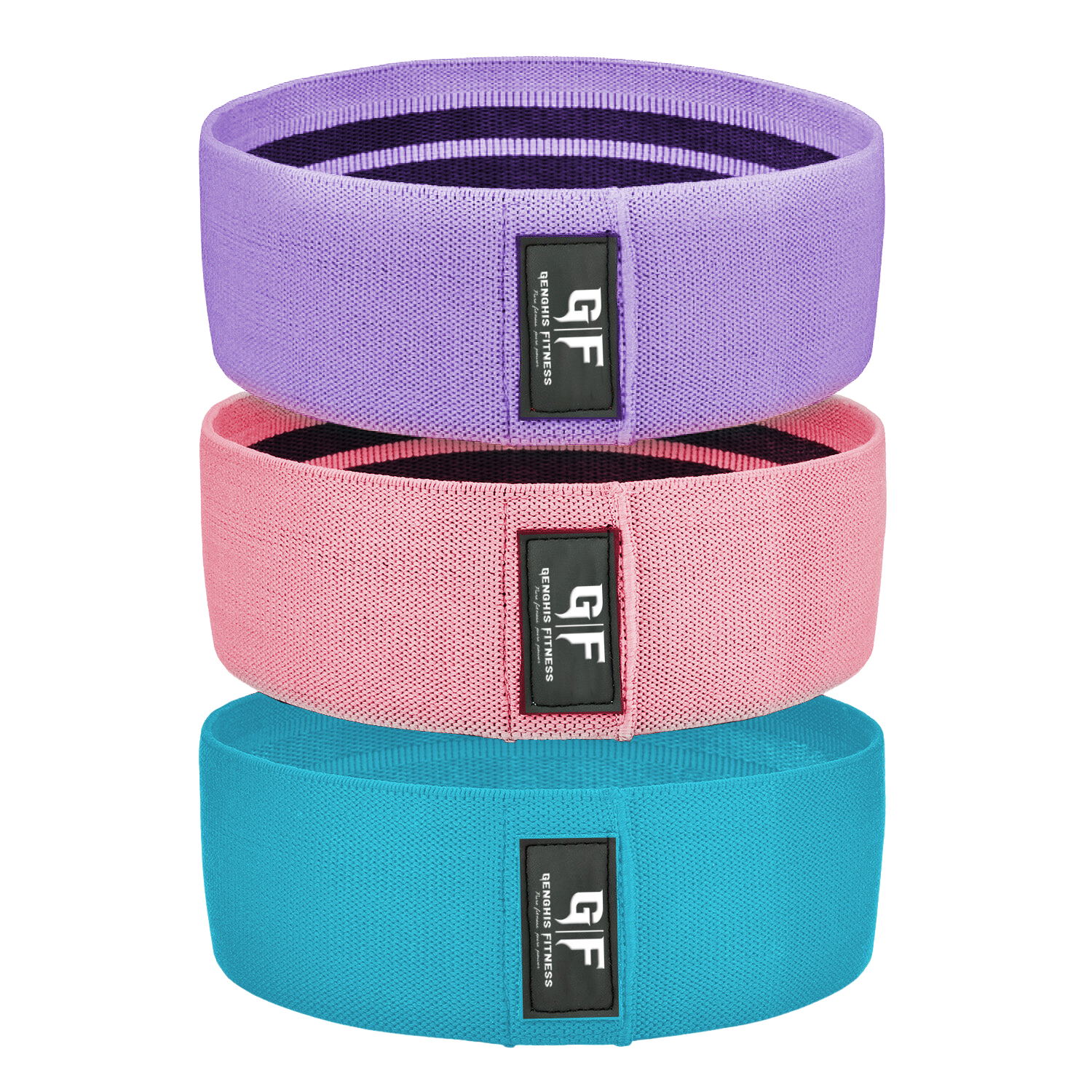
The hip circle bands are designed for this exercise. The wide hip circle design stays in position above the knees through the full hip extension range without rolling or bunching as flat resistance bands often do.
Banded Glute Bridge
The floor variation of the hip thrust. Lie on your back with the band above the knees, feet flat on the floor. Drive the hips upward by pushing through the heels, push the knees outward against the band, and squeeze at the top. For athletes who cannot use a bench for hip thrusts, the glute bridge provides the same primary stimulus from the floor. Progress to the hip thrust as strength and range of motion allow.
Donkey Kick with Band
On all fours, loop the band around one ankle and anchor the other end under the knee of the same side. Drive the banded leg backward and upward in a hip extension pattern, squeezing the glute at the top of the movement. Keep the hips level throughout. This isolates the gluteus maximus through hip extension without the quad and hamstring involvement present in squats and hip thrusts.
Hip Extension and Posterior Chain Exercises
Banded Romanian Deadlift
Stand on the center of the band with both feet, hold the ends in each hand, and hinge at the hip while maintaining a neutral spine. The band loads the hamstrings and gluteus maximus through hip extension with an accommodating resistance curve that increases as you return to standing. This replicates the loading pattern of the barbell Romanian deadlift for athletes training without a barbell.
Banded Squat
Place the band above the knees and perform a bodyweight squat, pushing the knees outward against the band’s resistance throughout the full range of motion. The band adds hip abductor demand to every rep and serves as a knee-tracking cue: if the knees collapse inward, the band is not being resisted. Three sets of 15 to 20 repetitions before loaded barbell squats activates the hip abductors and establishes the outward knee drive pattern for the working sets.
Activation and Warm-Up Exercises
Fire Hydrant
On all fours with the band above the knees, lift one knee out to the side in a hip abduction pattern while keeping the hip angle at approximately 90 degrees. The movement resembles a dog at a fire hydrant. This activates the gluteus medius and hip external rotators through a range of motion that is difficult to reach in standing exercises. Three sets of 15 per side.
Seated Hip Abduction
Sit upright on a bench or box with the band above the knees. Push the knees apart against the band’s resistance, hold for two seconds, and release. This is a low-intensity gluteus medius activation exercise appropriate at the very beginning of a session when more dynamic movements are premature. Two sets of 20 repetitions.
Programming Booty Band Exercises into a Training Session
The most effective structure uses band exercises for activation before loaded barbell training and for isolation after it. Before a heavy squat session: lateral band walks and banded squats to activate the hip abductors. After heavy barbell work: banded hip thrusts and clamshells to target the muscles that heavy compound lifts do not fully exhaust.
Apply the same progressive overload logic to band exercises that applies to any training tool. When all sets are completed cleanly with the current resistance and the target muscles are no longer challenged by the last few reps, move to a heavier band. Tracking which resistance level you use is as important for band exercises as logging the barbell weight for compound lifts.
For lower body sessions that follow this protocol, the knee sleeves go on for the loaded squatting work after the band activation is complete. The hip circle bands and knee sleeves work together across the full session, each addressing its specific role in lower body joint preparation and loading.