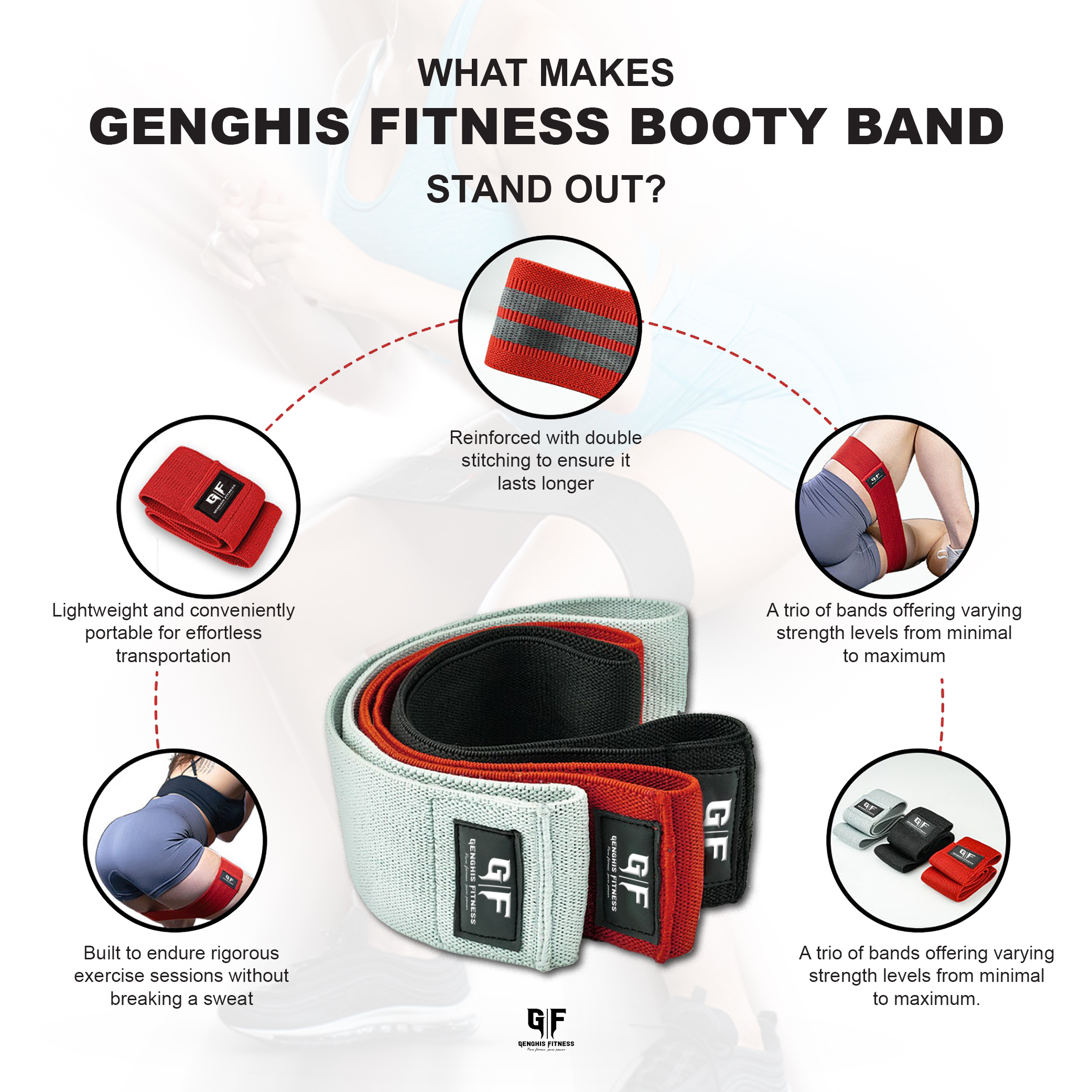
Booty Band FAQs: Every Common Question Answered Directly
Hip circle bands generate a consistent set of questions from athletes at every experience level. Most of the confusion comes from conflicting information online about resistance levels, placement, frequency, and whether bands actually work for building muscle or just for warming up. This guide answers the most common questions directly, based on the biomechanics of band training and the practical experience of athletes who have used bands as a structured part of their programming.
Do Booty Bands Actually Build Muscle
Yes, under the right conditions. Resistance bands build muscle when they provide sufficient resistance to create meaningful mechanical tension on the target muscles, when the training is progressive (resistance increases as strength develops), and when the training is consistent over enough time to drive adaptation. Bands that are too light to challenge the target muscles, bands used without progression, and sporadic training do not build muscle regardless of the equipment.
The hip abductors, specifically the gluteus medius and hip external rotators, are frequently undertrained in standard barbell programs. Research published in the NIH research database has documented that lateral band walks and clamshell variations produce hip abductor activation levels high enough to drive hypertrophic adaptation. The hip circle bands used consistently with progressive resistance build genuine gluteus medius strength and size.
How Often Should I Use Booty Bands
Three to five sessions per week produces optimal results for most athletes. Hip abductor muscles recover faster than larger prime movers like the quads and hamstrings, which allows higher training frequency. Using bands for activation before every lower body session and as isolation finishers after heavy barbell work is practical and effective. Rest days from band training should occur when significant muscle soreness or fatigue is present, not on a fixed calendar schedule.
Where Exactly Should the Band Sit on My Leg
The standard position is just above the kneecap on the lower thigh, approximately 2 to 3 inches above the top of the knee. At this position, the band creates lateral resistance that the hip abductors must work against to maintain knee alignment. For progression, placing the band just below the knee increases the moment arm and makes the same resistance harder for the hip abductors. For ankle-level exercises like standing hip abduction, the band moves to just above the ankle bone.
What Resistance Level Should I Start With
Start with a light band for all exercises and focus on technique. If you can complete the prescribed reps with correct form and no difficulty in the last few reps, move to a medium band. The correct starting resistance is one that challenges the target muscles enough that the last 3 to 5 reps of a set require genuine effort while still allowing perfect technique throughout.
Most athletes who have never done targeted hip abductor work will find even a light band challenging for lateral band walks and clamshells in the first session. Give the muscles time to adapt before moving to heavier resistance.
Why Does the Band Roll During Lateral Walks
Rolling is a property of flat latex loop bands, not of properly designed hip circle bands. Latex bands roll because the lateral tension during a lateral walk forces the band to fold and narrow rather than staying flat. Fabric hip circle bands, like the hip circle bands, use a woven exterior construction that prevents rolling by maintaining the band’s flat shape throughout dynamic movements. If your band rolls consistently, switching to a fabric hip circle band eliminates the problem.
Can I Use Booty Bands Before Barbell Squats
Yes, and this is one of the most effective applications of hip circle bands. Using bands for 2 to 3 sets of lateral walks and banded squats before loading the bar activates the gluteus medius and hip external rotators so they contribute to knee tracking from the first working set. Research on pre-activation protocols has shown that this preparation improves gluteus medius activation during subsequent squatting compared to squatting without prior activation work.
Should I Use Bands Even If I Already Squat Heavy
Especially if you already squat heavy. Heavy barbell squats primarily develop the gluteus maximus through hip extension. The gluteus medius receives relatively little direct stimulus from bilateral squatting movements because there is no lateral resistance to resist. Athletes who squat frequently and heavily often have significant strength imbalances between the gluteus maximus and the gluteus medius, contributing to knee valgus under load and reduced long-term hip health.
Band work before and after squatting sessions is the most direct way to address this imbalance. The knee sleeves go on for the loaded squatting work. The bands address the lateral hip development that squatting alone does not provide.
How Long Until I See Results
Neuromuscular improvements, better activation and more conscious control of the hip abductors, typically appear within 2 to 4 weeks of consistent band training. Observable strength improvements in exercises like lateral band walks, where you can handle a heavier band for the same reps, appear within 4 to 8 weeks. Visual changes in hip shape from gluteus medius hypertrophy require a longer timeframe, typically 12 to 16 weeks of consistent progressive training with adequate protein intake.
Can Men Use Booty Bands
Absolutely. The gluteus medius and hip external rotators are equally important in male athletes. Hip abductor weakness contributes to knee valgus, reduced squatting mechanics, and hip joint stress in male lifters the same way it does in female athletes. Many male powerlifters, sprinters, and team sport athletes include systematic hip circle band work as a standard part of their training programs.
Do I Need Bands If I Have a Cable Machine
Both have advantages. Bands provide accommodating resistance that peaks in the muscle’s strongest position. Cable machines provide adjustable constant resistance with a wider loading range as strength develops. The ankle straps for cable machine allow cable hip abduction and kickback exercises that progress beyond what any band set can provide at advanced strength levels. The practical approach is to use bands for activation and as the primary tool when cable machine access is limited, and to add cable work as a progression tool when band resistance becomes insufficient.
How Do I Know If the Band Resistance Is Right
The correct resistance level allows you to complete all prescribed reps with perfect form while producing meaningful muscle fatigue in the last few reps of each set. If you can complete all reps without any challenge and feel nothing in the target muscles, the band is too light. If your form breaks down before the final rep of the first set, the band is too heavy. Adjust band selection until you find the level where the movement is demanding but technically clean throughout.