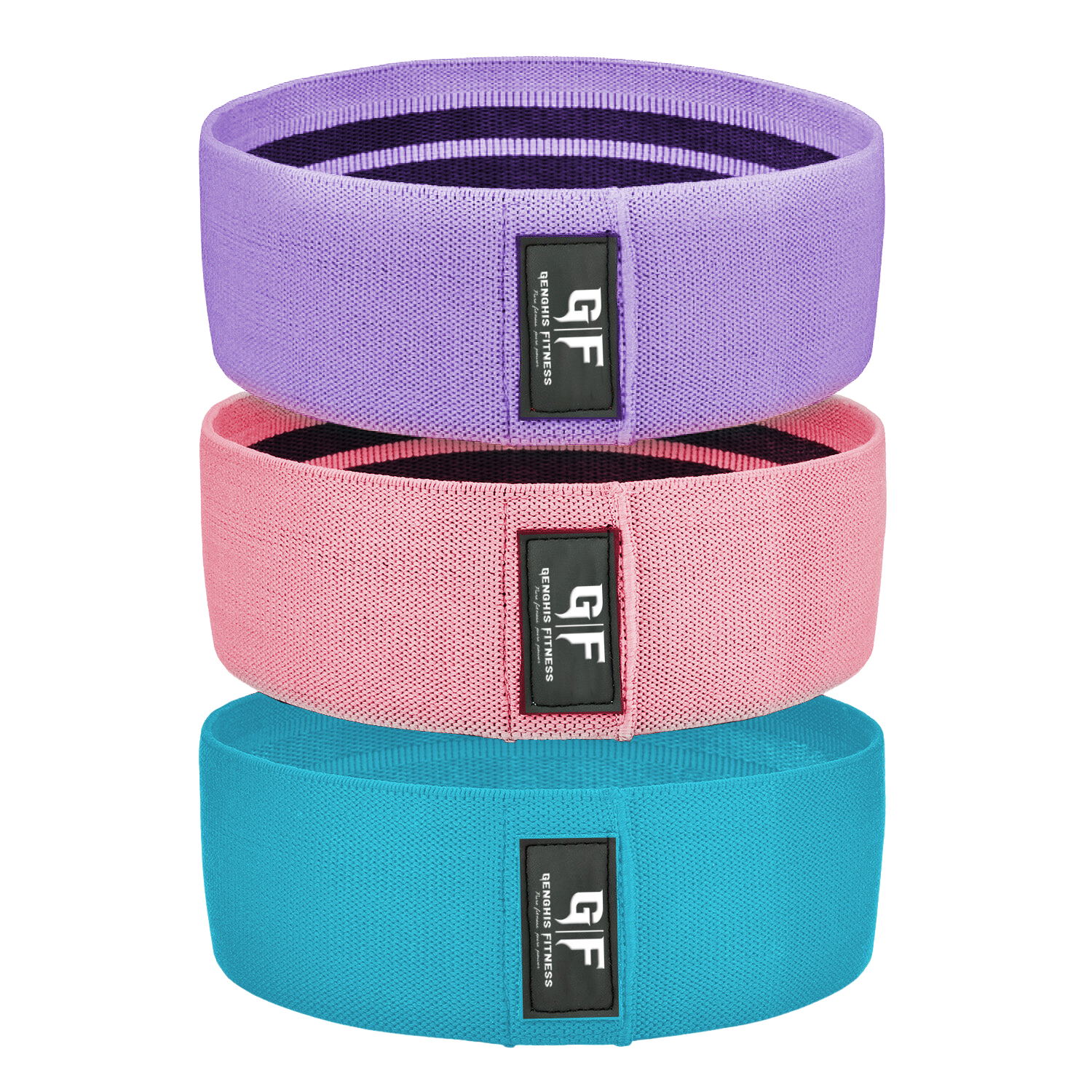
Booty Band Pilates Routines: Targeted Glute and Hip Work with Precision
Pilates training emphasizes precise muscular control, neutral spine maintenance, and the development of deep stabilizing musculature. These principles align naturally with hip circle band training, which also requires precise muscular control and builds the hip stabilizers that Pilates programming targets. Combining hip circle band resistance with Pilates movement quality develops both the strength and the motor control of the hip abductors and glutes in a way that neither approach achieves independently.
This guide covers Pilates-style exercises that work effectively with hip circle bands, how to maintain Pilates movement quality while working against band resistance, the classical Pilates principles applied to band work, and how to structure a complete session.
Pilates Principles Applied to Band Training
Centering means maintaining a stable core and neutral pelvis throughout every movement. In hip circle band exercises, this means the pelvis does not rotate, tilt, or shift during clamshells, fire hydrants, or hip circles. The movement originates at the hip, not the lower back. This is identical to the centering principle in Pilates and is the most important technique standard for both modalities.
Concentration means directing full attention to the target muscles rather than simply moving the limbs through the prescribed range. For band exercises, this means specifically feeling the gluteus medius contract at the top of a clamshell rather than simply completing repetitions mechanically.
Control means every movement is governed by muscular effort rather than momentum. In lateral band walks, each step is placed deliberately rather than bounced. In hip thrusts, the descent is controlled rather than dropped. Precision means the movement is performed exactly as intended, with the joint moving through the correct plane without deviation or compensation.
Pilates-Style Exercises with Hip Circle Bands
Side-Lying Hip Series
Lie on your side in a straight body line with the band above the knees. Perform each exercise for 10 repetitions before moving to the next, maintaining the straight alignment throughout the series.
- Hip abduction: lift the top leg straight upward to 45 degrees against the band, pause, lower with control.
- Hip circles: draw small controlled circles with the top leg, 5 forward and 5 backward, pelvis fixed.
- Clamshell: bend knees to 45 degrees, keep feet together, rotate the top knee upward with a 2-second hold at the top.
- Kick series: keeping the knee straight, kick the top leg forward then swing it past neutral backward. Maintain pelvis alignment.
- Bicycle: from bent knee position, extend the top knee forward as the bottom knee bends, alternating in a slow bicycle pattern.
Complete the full series on one side before switching. Two complete rounds per side. The discipline of maintaining the side-lying body alignment and neutral pelvis position through all five exercises is what makes this a Pilates-quality hip series rather than simply a list of exercises.
Quadruped Hip Extension Series
On all fours with a neutral spine, wrist under shoulder, knee under hip, and band above the knees, perform each movement for 10 repetitions per side maintaining spinal neutrality throughout.
- Donkey kick: extend one leg backward and upward through hip extension with the knee bent. Squeeze the glute at the top for 2 seconds.
- Fire hydrant: lift one knee out to the side in hip abduction with the knee bent. No spine rotation.
- Leg circle: extend the leg back and draw small circles, 5 each direction, maintaining neutral spine.
- Knee tap: lower one knee to tap the floor 2 inches forward of its natural position, return. This challenges anti-rotation stability specifically.
- Cross-body knee touch: from all fours, draw one knee toward the opposite elbow while maintaining neutral spine. 10 per side.
Bridge Pilates Variations
Lie on your back with the band above the knees, feet hip-width apart, spine in neutral. Press the knees outward against the band throughout all variations.
- Standard bridge: drive hips up to a straight line from shoulder to knee, 2-second hold, lower with spinal articulation rolling down one vertebra at a time. 12 repetitions.
- Single-leg bridge: from the top of a standard bridge, extend one leg straight and hold for 3 breaths per side, 4 rounds.
- Bridge march: from the top position, alternately lift each knee toward the chest maintaining level hips. 10 marches total.
- Bridge with shoulder touch: from top position, maintain the bridge while touching the floor with one hand, then the other. 8 touches per side.
Breath Patterns for Band-Enhanced Pilates
Pilates uses a lateral thoracic expansion breath pattern where the ribs expand outward rather than the belly rising. Inhale to prepare for the movement, exhale through the exertion phase. In the clamshell, inhale in the starting position and exhale as the knee rotates upward. In the bridge, inhale in the lowered position and exhale as the hips lift.
This breath pattern cues the transverse abdominis to engage on the exhale, contributing to the pelvic stability that allows precise hip movement without compensation. Athletes who connect the breath to the movement correctly find that the hip exercises become noticeably more controlled because the core is actively supporting the pelvis from within on every rep.
Structuring a Complete Band Pilates Session
A complete session of approximately 35 minutes: warm-up for 5 minutes with gentle hip mobility movements without bands. Side-lying hip series on both sides for approximately 12 minutes. Quadruped series on both sides for approximately 10 minutes. Bridge Pilates variations for approximately 8 minutes. Cool-down for 5 minutes in reclined butterfly and gentle hip rotation stretches.
Use light to medium resistance throughout. Pilates movement quality degrades under excessive resistance because precision becomes secondary to producing force against the band. The hip circle bands in light or medium resistance maintain the movement quality that makes Pilates hip work genuinely effective for developing both strength and motor control in the hip stabilizers.
Who Benefits Most from This Approach
Athletes who find standard band training repetitive or who have a background in Pilates often respond particularly well to this combined approach because the attention to precision and breath makes each repetition engaging rather than mechanical. The combination also benefits athletes recovering from hip or back injuries, where rebuilding precise motor control is as important as rebuilding strength, and athletes in early stages of training who benefit from learning to isolate the hip abductors before progressing to more dynamic loading.