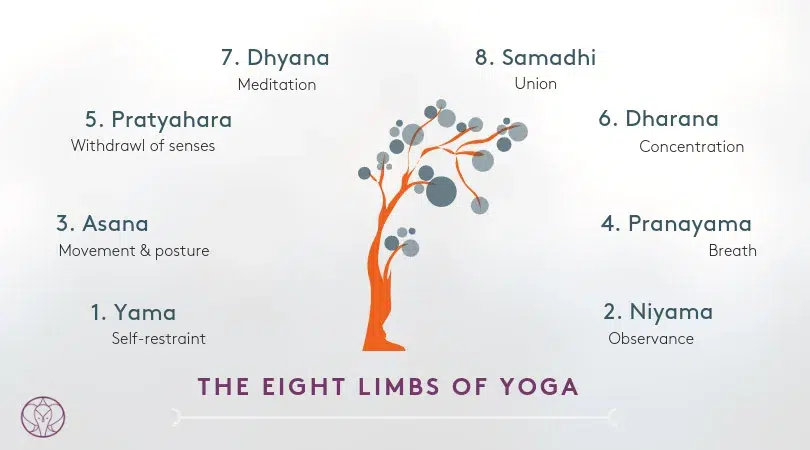
The Eight Limbs of Yoga: A Practical Framework for Athletes and Serious People
The eight limbs of yoga come from Patanjali’s Yoga Sutras, a foundational text of classical yoga philosophy compiled somewhere between 400 BCE and 400 CE. The term limbs refers to branches or components of a unified practice, not a sequential ladder where one must be mastered before the next is attempted. Together, the eight limbs describe a complete system for living and training the mind that extends well beyond the physical postures most people associate with yoga.
For athletes and people who approach their mental and physical development seriously, several of these limbs have immediate practical application. This guide explains each limb plainly, connects it to the concerns of a training-focused life, and strips away the cultural packaging to show what is practically useful regardless of your background or belief system.
The Eight Limbs: An Overview
The eight limbs in order are: Yama (ethical restraints), Niyama (personal observances), Asana (posture and physical practice), Pranayama (breath control), Pratyahara (withdrawal of the senses), Dharana (concentration), Dhyana (meditation), and Samadhi (absorption or complete integration). The first two describe how to relate to the world and to oneself. The next two address the body and breath. The final four address the progressively deepened states of mental focus that yoga considers the true goal of the practice.
Yama: The Five Ethical Restraints
The Yamas are five principles governing how a practitioner relates to others and the world. Ahimsa (non-harming) means acting without causing unnecessary harm to others or oneself, which in a training context includes not training through injuries that need rest, not using substances that harm the body, and not dismissing other people’s approaches. Satya (truthfulness) means honesty in self-assessment, including being honest about your actual fitness level, your real recovery status, and whether your current approach is working.
The remaining Yamas are Asteya (non-stealing), Brahmacharya (energy conservation and moderation, particularly relevant to rest and recovery management), and Aparigraha (non-grasping, or releasing attachment to specific outcomes). That last one is particularly relevant to athletes who measure their worth by performance metrics alone. Research indexed on PubMed on psychological flexibility in athletes confirms that non-attachment to outcomes actually improves competitive performance by reducing performance anxiety. Aparigraha in practice means competing and training with full effort while holding the result lightly.
Niyama: The Five Personal Observances
The Niyamas are five principles governing the relationship with oneself. Saucha (cleanliness and purity) applies to the body, diet, and training environment. Santosha (contentment) means finding satisfaction in the present state of your development rather than perpetual dissatisfaction with where you are relative to where you want to be. This does not mean abandoning ambition. It means not suffering needlessly in the gap between current reality and future goals.
Tapas (disciplined effort and heat) describes the willingness to endure the discomfort of consistent practice over time. In training terms, this is the discipline to show up on days you do not feel motivated and to do the necessary work rather than the convenient work. Svadhyaya (self-study) is the ongoing honest examination of your own patterns, habits, and reactions. Ishvara Pranidhana describes a quality of humility and dedication that athletes might recognize as the experience of being fully absorbed in a purpose beyond personal gain.
Asana and Pranayama: Body and Breath
Asana, which means seat or posture in Sanskrit, was originally a reference to the meditative sitting position rather than to the hundreds of physical postures practiced in modern yoga. Over centuries, the practice of asana expanded into a comprehensive physical preparation system designed to make the body a stable, healthy, and comfortable vehicle for the subtler practices of pranayama and meditation.
For contemporary athletes, asana practice directly addresses the physical costs of intensive training: accumulated muscle tension, restricted range of motion, imbalanced strength patterns, and the chronic postural adaptations that develop from years of heavy loading. Pranayama (breath control) modulates the autonomic nervous system directly through its effect on the vagus nerve and heart rate variability. A consistent combination of asana and pranayama two to three times per week serves as the physical and nervous system maintenance system that extends training longevity and reduces injury incidence. Pair it with the joint support of quality knee sleeves and elbow sleeves on your heavier training days.
Pratyahara: Sensory Withdrawal and Training Focus
Pratyahara is the withdrawal of sensory attention from external objects and the direction of awareness inward. In practical training terms, this is the ability to remain internally focused during a heavy session despite external distractions. The noisy gym, the people nearby, the phone notifications, none of these enter your awareness when you are genuinely practicing pratyahara. Your attention stays on the movement, your breath, the positioning of your body, and the effort quality of the set you are performing.
Developing pratyahara is not about forcing yourself to ignore distractions through gritted-teeth willpower. It is about cultivating a quality of inward attention through practice so that external stimuli simply fail to capture your awareness in the first place. Athletes who develop this quality during training are the same athletes who can compete in loud, high-pressure environments without being thrown off by crowd noise, competitor behavior, or unexpected circumstances.
Dharana Through Samadhi: Concentration to Complete Absorption
Dharana is concentrated attention on a single object, thought, or sensation. The ability to maintain complete concentration on the movement being performed for the duration of each set, without mental distraction, is an athletic application of dharana. Dhyana is the sustained flow of concentration without interruption, what athletes sometimes describe as being in the zone. Samadhi is the complete absorption where the sense of a separate self temporarily dissolves. Athletes who have experienced complete physical flow states have had glimpses of what this state describes.
These three inner limbs are not separate stages that are practiced in isolation. They are a continuum that develops naturally as the earlier limbs are cultivated. The discipline of the Yamas and Niyamas creates the psychological stability for sustained practice. Asana and pranayama prepare the body and nervous system. Pratyahara turns awareness inward. Dharana begins the focused concentration that, when sustained without interruption, becomes Dhyana and eventually Samadhi.
Applying the Eight Limbs to Your Training Life
You do not need to adopt a spiritual worldview to find value in the eight limbs framework. Read them as a practical taxonomy of self-development covering ethics, self-care, physical conditioning, breath training, attention management, concentration, meditative flow, and complete absorption. Each category contains practices and principles that have direct application to athletic development and to living a disciplined, self-aware life.
Start with the limbs that are most immediately applicable to your current situation. If physical restriction is your primary issue, asana is where to begin. If stress management and recovery quality are the challenge, pranayama and pratyahara offer the most direct tools. If inconsistency and self-deception are your patterns, the Yamas and Niyamas provide a clear framework for honest self-assessment. The lifting belt and lifting straps you use in training are tools for physical development. The eight limbs are tools for total development.
FINAL WORDS
The eight limbs of yoga describe a complete system for developing the body, the breath, and the mind that is thousands of years old and remains directly applicable to the concerns of anyone engaged in serious physical and personal development. The physical and physiological limbs, asana and pranayama, have the most immediate and well-documented value for athletes. The psychological limbs, from pratyahara through samadhi, describe the qualities of attention and absorption that underlie peak performance in any domain. Engage with this framework on its own terms and you will find tools for every aspect of your development.
Certified strength and conditioning specialists with over 10 years of experience in powerlifting, nutrition, and evidence-based fitness content. Based in New York City.