How to Use a Lifting Belt: The Complete Step-by-Step Guide
Knowing how to wear a lifting belt correctly separates athletes who get real benefit from it and athletes who spend money on leather and then wonder why their lifts did not improve. The belt is a tool. Like any tool, its effectiveness depends on using it the right way for the right job.
This guide covers everything you need to know: where to position the belt on your torso, how tight to wear it, how to brace correctly to activate the intra-abdominal pressure mechanism, when to put it on and take it off, and how to use it across different lifts.
Step 1: Position the Belt Correctly on Your Torso
The most common error with lifting belts is placement. Many athletes wear the belt too low, resting it on the hip bone. Others wear it too high, pushing it into the floating ribs. Neither position allows the belt to function correctly.
The belt belongs in the space between the top of the hip crest and the bottom of your lowest rib. Find this zone by placing one hand on your hip crest and the other on your bottom rib. The space between those two reference points is where the belt sits. For most people, this is roughly one to two inches above the navel.
The back panel of the belt should rest over the thick erector muscles of the lower back, not on the spine itself. The belt should make full contact with your torso all the way around. If there is a gap at the back when the front is cinched, the belt is too short or the positioning is off.
Step 2: Set the Correct Tightness
Belt tightness is one of the most debated topics in strength sport, and a large portion of the debate comes from athletes who have never been taught the basic biomechanics of intra-abdominal pressure.
The belt should be snug against your relaxed torso, tight enough that you cannot slide a flat hand between the belt and your skin. It should not be so tight that it prevents your abdominal wall from expanding outward. The expansion is the point. When you brace, your core pushes out in all directions. If the belt prevents that expansion, the pressure cannot build correctly.
A useful test: put the belt on and take a full breath into your belly without bracing. You should feel your abdomen push against the belt on all sides. If you feel significant resistance before you even try to brace, the belt is too tight. If there is no contact at all even when you breathe deeply, the belt is too loose.
Step 3: Learn the Correct Bracing Sequence
The belt does nothing by itself. You have to create the intra-abdominal pressure that makes it work. The sequence is specific and should be practiced until it is automatic.
- Step into position under or in front of the bar.
- Take a large breath into your belly, not your chest. Your chest should barely move. Your lower abdomen and the area just above your hip crest should expand outward.
- Hold that air. Do not exhale.
- Now brace hard, as if you are about to be punched in the stomach. Push your core out against the belt in all directions simultaneously. Front, back, and both sides.
- Maintain this bracing pressure through the entire rep.
- Exhale at the top of the rep or during the ascent, depending on the lift.
- Repeat the full breath and brace before the next rep.
The difference between a shallow brace and a maximal brace against a well-fitted belt is significant. Research in the NIH database has shown that intra-abdominal pressure with proper Valsalva bracing and a belt is meaningfully higher than without, which corresponds to reduced spinal compressive loading during the lift.
Step 4: Know When to Put the Belt On
The belt belongs on your heavy working sets, not your warm-up sets. A common and useful guideline is to train without the belt until you reach approximately 80 percent of your working weight for that session. This ensures your core musculature still receives training stimulus from unbelted sets, which is important for long-term development.
If your heavy work sets start at 80 percent, put the belt on two sets before your heaviest set. This gives you time to dial in the bracing feel before you are under maximum load. Do not put the belt on for the first time at your heaviest set of the day.
Step 5: Remove the Belt Between Sets
Between work sets you have two options: leave the belt on at full tension, or loosen it while you rest. Leaving it on at full tension maintains the warmth and position of the belt but can restrict breathing during rest periods. Loosening the buckle between sets lets you breathe more freely and may reduce the fatigue that comes from sustained compression.
The better practice depends on your rest period length. For 2 to 3 minute rest periods, leaving the belt on loosened or slightly backed off is fine. For 5-plus minute rest periods between true maximum efforts, removing and replacing the belt is reasonable. Do not remove and replace the belt so frequently that you are spending more time managing equipment than training.
How to Use a Lifting Belt for Squats
For the squat, the belt position described above applies directly. Position the belt between the hip crest and the bottom rib. Set it tight enough to brace against but not so tight you cannot expand.
The critical point for the squat is that the belt must not interfere with the hip crease breaking parallel. If the belt digs into your upper thigh or hip crease at the bottom of the squat, it is positioned too low. Adjust upward until you can reach full depth without the belt pushing into the joint.
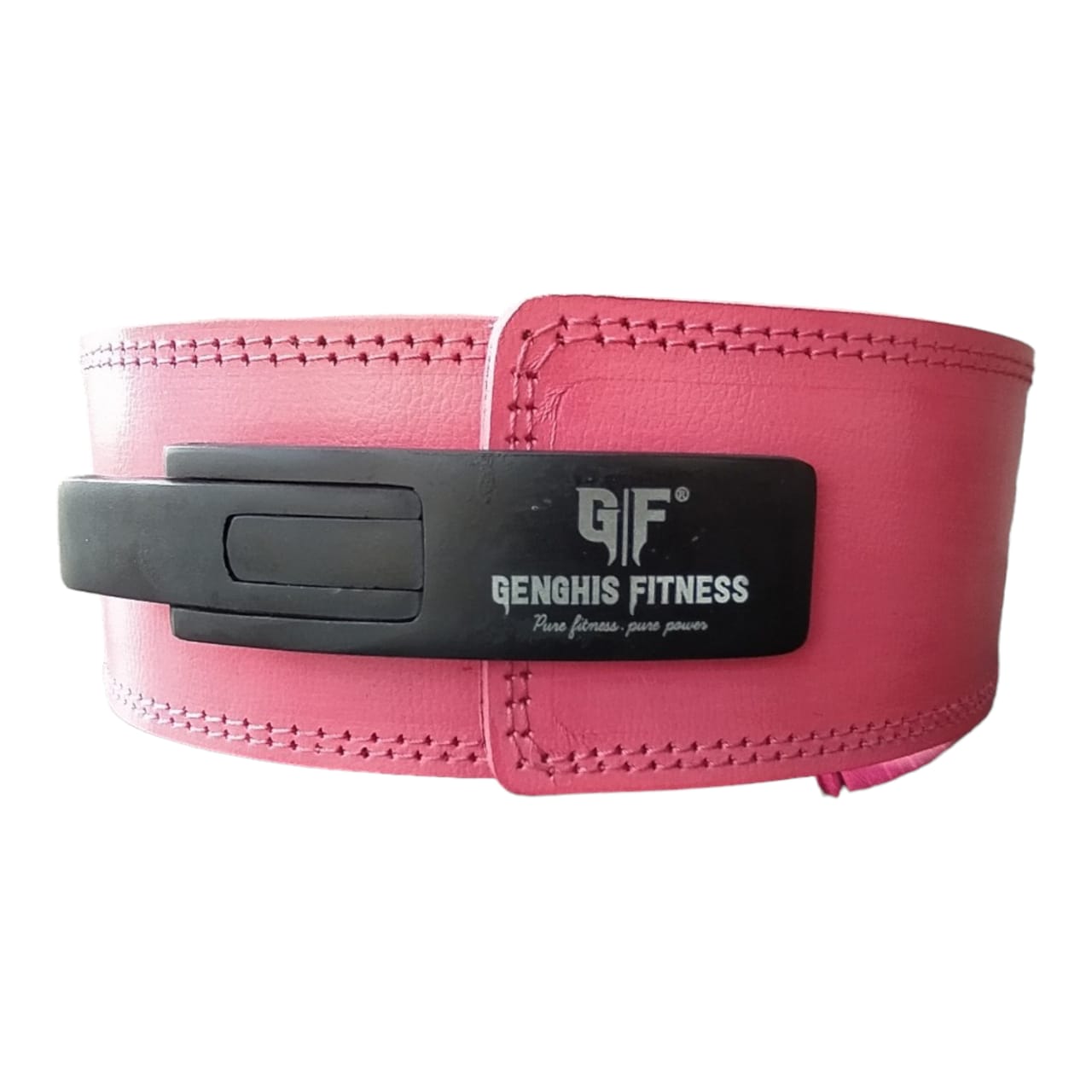
The Genghis Fitness 10mm lever belt is a popular choice for squat-focused training because the lever closure allows precise tension setting and fast adjustments between squats and the accessory work that follows.
How to Use a Lifting Belt for Deadlifts
Deadlift bracing is similar to the squat with one important distinction: many athletes find they need to wear the belt slightly higher for the deadlift than for the squat. This is because the pulling position requires more extension through the lower thoracic region, and a belt worn too low can dig into the hip at lockout.
Brace before you touch the bar. Establish your grip, set your hips, take your breath, brace hard, and then pull. Do not try to breathe or re-brace mid-rep on a heavy deadlift. The brace should be set and held for the full duration of the rep.
If you use lifting straps for heavy deadlifts, the Genghis Fitness leather weight lifting straps are a practical pairing with the belt for maximum load work where grip is a limiting factor.
How to Use a Lifting Belt for Overhead Press
The standing overhead press is a movement where a belt is underutilized. Many athletes skip the belt for pressing because it does not feel as essential as it does for squats and pulls. At heavy loads, however, the overhead press demands significant anti-extension bracing in the lower back and the belt does add meaningful support.
For the overhead press, position the belt the same way as for squats. The key is to brace before unracking the bar and maintain that brace through the full press. Do not allow the lower back to extend aggressively into the belt as a substitute for a proper overhead position. The belt supports the brace. It does not excuse poor shoulder mobility or excessive lumbar extension.
How to Use a Lifting Belt for Rows
Bent-over barbell rows are one of the most back-intensive pulling movements in the gym and one of the last exercises most athletes think to belt up for. At working weights above 60 percent of your deadlift, a belt on barbell rows is a legitimate choice. The hip-hinge isometric position held through every rep creates sustained lumbar loading that benefits from enhanced bracing.
The same belt position and bracing sequence applies. Set the belt, brace before the first rep, and maintain the brace through the set. This is particularly important on the eccentric phase of the row, where the tendency to relax the core is highest.
Common Mistakes to Correct Right Now
- Wearing the belt on every warm-up set from the first plate. This reduces unbelted core training stimulus.
- Cinching the belt so tight you cannot breathe into it. The expansion is the mechanism. Let it work.
- Forgetting to brace and assuming the belt does the work. The belt is passive hardware. You are the active element.
- Wearing the belt too low into the hip crease. Adjust upward until hip mobility is unrestricted.
- Holding your breath for multiple reps on moderate-weight sets. This is unnecessary at sub-maximal loads and can cause dizziness.
Final Notes on Consistent Use
The belt becomes most effective when using it is second nature. The bracing sequence should be so automatic that you execute it correctly every time without conscious thought. This level of automaticity only comes from consistent practice. Use the belt on your heavy sets every training session, execute the brace with intention every rep, and within a few months it will feel as natural as setting your grip.
For athletes just starting out with a belt, the Genghis Fitness 4-inch leather weightlifting belt is a reliable entry point that covers squats, deadlifts, and pressing without requiring the longer break-in period of a thicker 13mm competition belt.