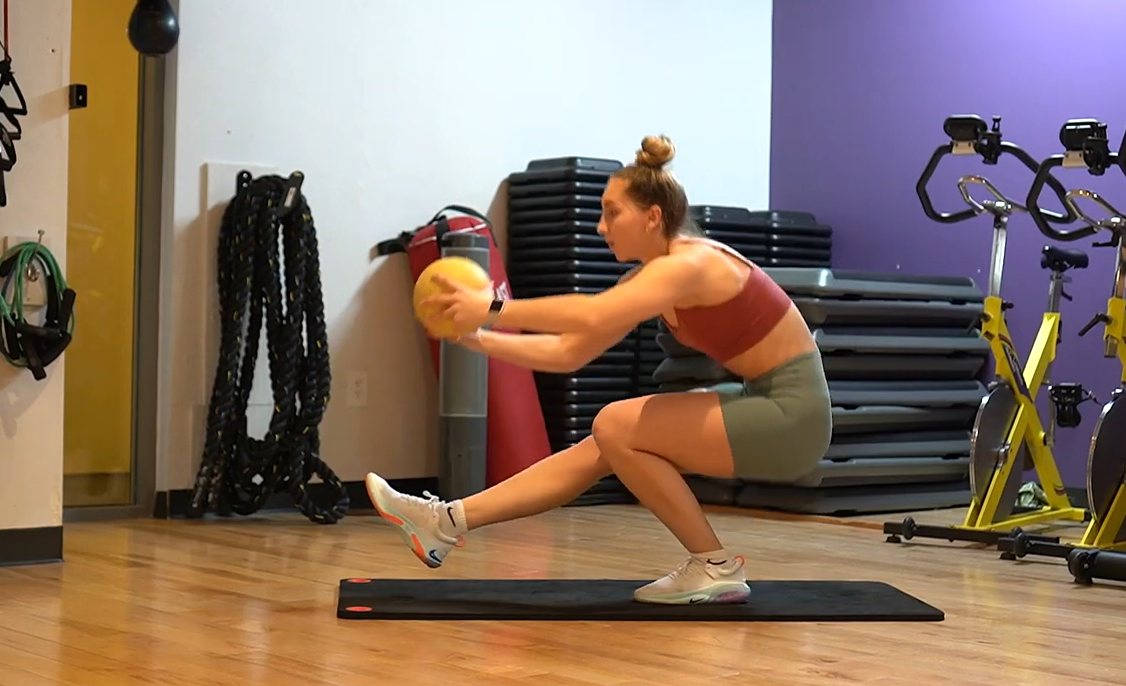
PISTOL SQUAT: THE COMPLETE GUIDE TO BUILDING THE PREREQUISITES AND ACHIEVING THE MOVEMENT
The pistol squat is a single-leg full-depth squat that demands more hip mobility, ankle dorsiflexion, and unilateral leg strength than any other commonly performed squat variation. Achieving a clean pistol squat from the floor without counterbalance requires the combination of adequate ankle mobility to maintain heel contact while the shin travels forward over the toes into deep flexion, sufficient hip flexor and hamstring flexibility to hold the free leg extended parallel to the floor, and the quad and glute strength to control the descent and drive the concentric from full depth on a single leg. Most athletes have at least one of these three requirements as their primary limiting factor, which is where targeted training must focus.
ANKLE DORSIFLEXION: THE MOST COMMON LIMITING FACTOR
Ankle dorsiflexion is the most common limiting factor in pistol squat development. Insufficient ankle dorsiflexion causes the heel to rise off the floor during the descent, disrupting balance and shifting the loading to the forefoot in a way that makes controlling the descent mechanically very difficult. Test ankle dorsiflexion by standing facing a wall and sliding the working foot forward until the knee just touches the wall with the heel flat: if the foot must be placed more than 10 to 12 centimeters from the wall to achieve this, ankle mobility is limiting the pistol. Research on ankle dorsiflexion and lower extremity movement quality confirms that restricted ankle mobility affects every squat variation that requires deep knee flexion and is directly trainable through targeted ankle stretching and mobility work.
HIP FLEXOR AND HAMSTRING FLEXIBILITY FOR THE FREE LEG
Hip flexor and hamstring flexibility determines whether the free leg can be held extended forward at hip height throughout the pistol descent without the compensatory movements that accompany insufficient flexibility. Athletes with tight hip flexors tend to allow the free leg to drift downward during the descent, shortening the balance challenge but also reducing the specificity of the movement to its intended form. Athletes with tight hamstrings find the extended free leg position difficult to maintain without the knee bending, which also drifts from the intended straight-leg form. Address hip flexor restriction with low lunge stretching and hip circle band mobility work, and hamstring restriction with standing forward fold and cable hamstring stretching with ankle straps.
PROGRESSIVE VARIATIONS: THE DEVELOPMENTAL PATHWAY TO FREESTANDING
Unilateral leg strength development follows a progression from assisted pistol variations to full freestanding pistols. Box pistols, where the depth is controlled by sitting to a box before standing back up, allow strength to develop at the partial range before the full depth range is required. TRX or suspension trainer-assisted pistols allow balance support while the mobility and strength develop together. Counterbalance pistols with a weight held at chest height shift the center of mass forward slightly, reducing the balance demand while maintaining the full depth requirement. Each of these variations is a legitimate developmental step rather than a permanent crutch, and progression through them toward the freestanding pistol is the standard training pathway.
BALANCE TRAINING: THE THIRD PREREQUISITE
The freestanding pistol squat requires specific balance training alongside the mobility and strength development. Practice single-leg balance with the free leg held forward at hip height, progressively increasing hold duration from 10 seconds toward 60 seconds before adding the squat component. Single-leg Romanian deadlifts develop the hip stability and proprioceptive awareness of the standing leg that the pistol demands during the descent. Research on single-leg stability and lower extremity proprioception confirms that targeted unilateral balance training produces the specific neuromuscular control adaptations that bilateral balance training does not develop to the same degree, making dedicated single-leg balance work the most efficient path toward the freestanding pistol.
PROGRAMMING THE PISTOL AS SKILL PRACTICE IN A STRENGTH SESSION
Programming the pistol squat in a strength training context works best when it is treated as a skill practice item early in sessions rather than a fatigue-based exercise at the end. The balance, mobility, and neural demands of the pistol are best addressed when the nervous system is fresh. Two to three sets of three to five reps per leg, performed early in the lower body training session before heavy bilateral squatting, develops the pistol pattern without the quality degradation that performing the skill under heavy fatigue from compound work produces. As the pistol becomes automatic and the primary challenge becomes strength rather than skill, it can be programmed with standard sets and rep ranges for strength and hypertrophy development.
LOADED PISTOL PROGRESSIONS FOR CONTINUED STRENGTH DEVELOPMENT
Loaded pistol squats with a dumbbell or barbell held at the chest provide the progressive overload that bodyweight pistols cap out of once the movement becomes technically consistent. Goblet pistols with a dumbbell allow natural counterbalance that helps maintain the forward lean required for the movement while adding external load. Barbell front rack pistols are the most advanced loaded variation, requiring all the mobility and balance of the bodyweight pistol plus the thoracic extension and front rack position of the front squat. Progress through these loaded variations systematically as each previous stage becomes technically reliable.
JOINT SUPPORT AND ACTIVATION FOR PISTOL SQUAT TRAINING
Wear knee sleeves during pistol squat training for joint warmth and proprioceptive support throughout the session. The deep knee flexion required by the pistol places the knee joint under sustained loading at its maximum range, making thermal support and proprioceptive compression from the sleeve specifically relevant for this movement. Perform hip circle band activation work before every pistol squat session to activate the gluteus medius that contributes to the knee tracking control that single-leg loading demands. A pistol squat performed with proper knee tracking over the fourth and fifth toes throughout the descent requires well-activated hip abductors that band activation specifically primes.
TRANSFER VALUE OF THE PISTOL SQUAT TO ATHLETIC PERFORMANCE
The pistol squat’s value in a strength training program extends beyond its status as a balance challenge. It develops unilateral quad and glute strength, single-leg stability, ankle and hip mobility, and the ability to control the body through a full range of single-leg motion under load. These qualities transfer directly to athletic performance in any sport requiring single-leg force production, and to the balance of strength and mobility between legs that bilateral training does not specifically address. Regular pistol squat training alongside bilateral compound lifts produces a more complete lower body development profile than either approach delivers alone.
FINAL WORDS
The pistol squat is achievable for most athletes who invest in the three specific prerequisites: ankle dorsiflexion through targeted mobility work, hip and hamstring flexibility through consistent stretching, and unilateral balance and strength through the progressive variations that build toward the freestanding movement. Address whichever of these prerequisites is the primary limiting factor first, work through the developmental variation progression systematically, and add load progressively once the freestanding pistol is technically consistent. Wear knee sleeves throughout every session, activate with hip circle bands before each practice set, and treat the pistol as the skilled strength exercise it is rather than a flexibility test that either passes or fails. Athletes who successfully develop a clean freestanding pistol squat from scratch consistently report that the process took six to twelve months of systematic prerequisite development and variation progression, and that the primary turning point was identifying and addressing their specific limiting factor rather than practicing the full movement at a quality level that the limiting factor prevented.
Certified strength and conditioning specialists with over 10 years of experience in powerlifting, nutrition, and evidence-based fitness content. Based in New York City.
GEAR UP FOR SQUATS
Protect your knees and brace your core harder with the right equipment.
10mm Lever Belt Knee Wraps