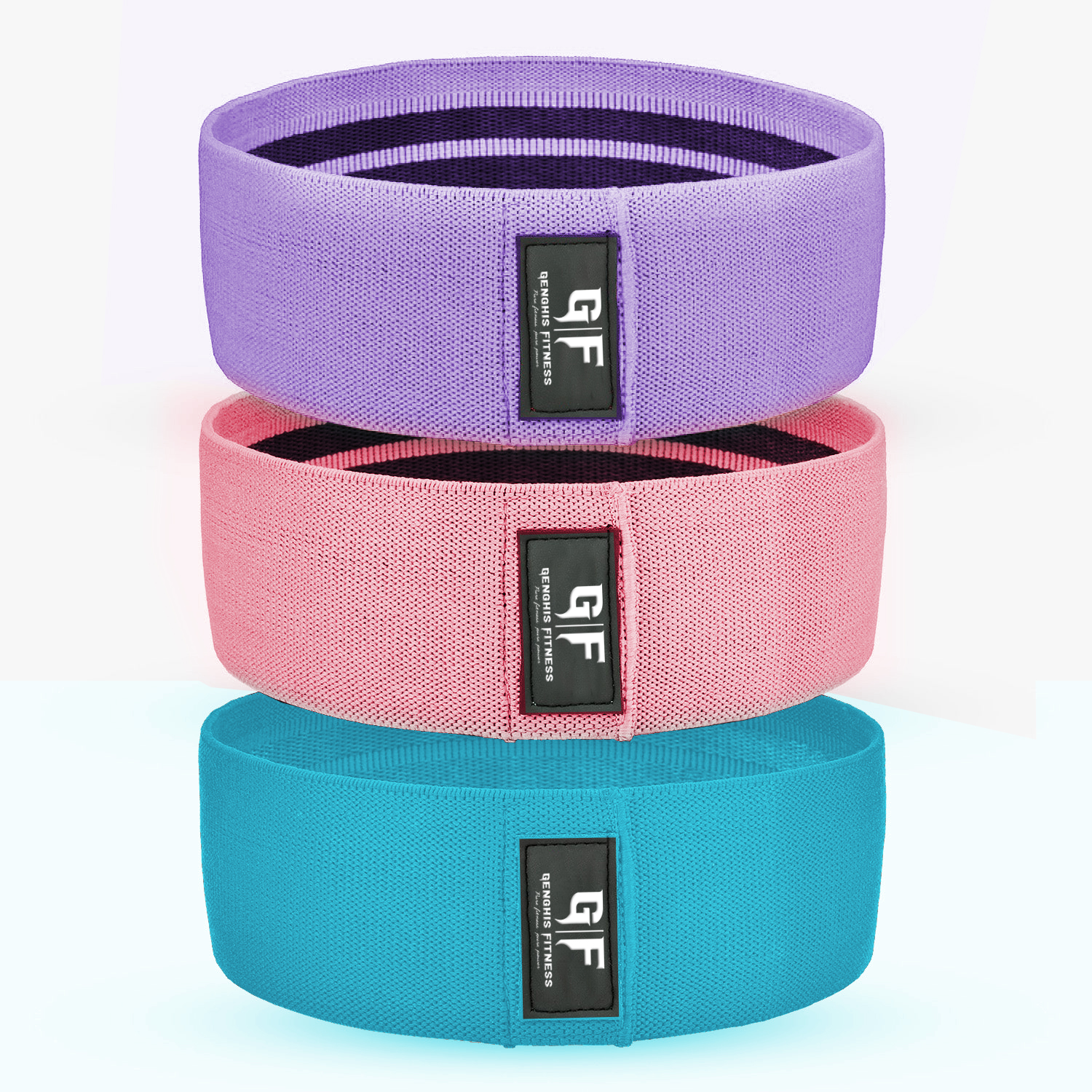
Types of Booty Bands: How to Choose the Right Design for Your Training
The category called booty bands or hip circle bands contains several distinct product types that behave differently in use and suit different training applications. Buying without understanding these distinctions often results in a band that rolls during lateral walks, snaps under moderate tension, or feels uncomfortable against the skin after a few sets. Knowing which type suits your specific needs prevents these outcomes and ensures the band you buy actually serves the training it is purchased for.
This guide covers the main types of bands used for hip and glute training, organized by material and design, with honest assessments of where each type excels and where it falls short.
Fabric Hip Circle Bands
Fabric hip circle bands are the current standard for serious hip abductor training. They consist of a woven polyester or cotton outer shell with elastic or latex strands running through the interior. The fabric exterior provides the properties that make hip circle bands effective for dynamic movements: it stays flat during lateral walks and banded squats, does not roll into a rope under lateral tension, grips clothing and skin without slipping, and is comfortable during extended wear.
The resistance in a fabric band comes from the internal elastic strands. Quality fabric bands use multiple strands of consistent thickness, producing a smooth resistance curve that increases gradually as the band stretches. Cheap fabric bands use fewer or inconsistently thick strands, creating a slack-then-snap feel that undermines the training quality.
The hip circle bands are built on this fabric-over-elastic construction principle. The hip circle design maintains its flat profile during the dynamic movements where band rolling is most common, addressing the primary failure mode of lower-quality band designs.
Best For
Lateral band walks, banded squats, clamshells, hip thrusts, and any exercise involving dynamic lower-body movement where a flat, non-rolling band is essential. Fabric hip circle bands are the right choice for athletes who want to use bands as a genuine training tool rather than casual warm-up equipment.
Limitations
Fabric bands are more expensive than standard latex loops and require more care in washing. They are not the best choice for upper body exercises where a simple flat band is sufficient, and their wider profile makes them less practical for wrist and ankle isolation work than a thin flat band.
Standard Latex Loop Bands
Standard latex loop bands are the most common resistance band type. They are made from a single layer of latex or rubber molded into a continuous loop. They are inexpensive, available everywhere, and work reasonably well for exercises where they remain stationary during the movement.
Their significant limitation for hip-level training is rolling. Under the lateral tension created during a lateral band walk or banded squat, latex loop bands fold and narrow into a rope shape rather than staying flat. This concentrates the resistance on a narrow line of pressure against the skin rather than distributing it across the band’s width, which reduces the exercise quality and can cause skin irritation during longer sets.
Best For
Ankle-level exercises where the band stays relatively stationary, such as standing hip abduction and fire hydrants. Upper body exercises including pull-apart warm-ups and shoulder external rotation. Exercises where the band does not need to travel across the skin during the movement.
Limitations
Rolling during lateral movements, skin irritation from concentrated pressure, and less comfortable for extended wear against bare skin or smooth clothing.
Flat Resistance Bands (Long Loop Bands)
Long flat resistance bands, sometimes called therapy bands or exercise bands, are wide flat strips of latex rather than loops. They can be cut to length, doubled for more resistance, and used in a much wider variety of exercise configurations than a fixed loop.
For hip circle work specifically, long flat bands can be tied into a loop around the thighs, but the knot creates a pressure point and the non-elastic section of the knot reduces the uniformity of the resistance around the loop. Pre-made hip circle bands eliminate these issues by providing a seamless, consistent circumference.
Best For
Highly variable exercise configurations where a fixed loop does not provide the correct geometry. Rehabilitation contexts where a physical therapist has specified a particular band tension and application method. Travel contexts where one long band can serve multiple exercises.
Mini Bands (Short Loop Bands)
Mini bands are short latex loop bands typically 4 to 6 inches wide. They are used around the ankles or just above the knees for a narrower contact area than a hip circle band provides. For hip abductor training, mini bands work best placed just above the ankle where the narrower profile does not cause as much skin contact discomfort as a wider band would.
Best For
Ankle-level exercises including lateral mini band walks, clamshells in a lower placement, and donkey kicks where the narrow band is looped around the ankle. Athletes who prefer a lower band placement for all hip exercises.
Limitations
Mini bands made from latex are subject to the same rolling problem as standard latex loops at the hip level. For hip-height placement, fabric construction is still preferable.
Tube Bands with Handles
Tube bands consist of a rubber or latex tube with plastic or rubber handles at each end. They are designed for upper body resistance training where a handle is needed for pulling or pushing exercises. They are not appropriate for hip circle work because the handle geometry prevents them from forming a useful loop around the legs.
Best For
Upper body exercises including rows, curls, chest presses, and shoulder work where a hand grip is required. Not relevant for lower body hip circle training.
How to Choose Based on Your Training
For primary hip abductor and glute training involving lateral movement exercises, fabric hip circle bands are the correct choice. For supplementary or travel use where simplicity is the priority over performance in dynamic exercises, standard latex loop bands work for stationary exercises.
Do not attempt to use standard latex loops as a substitute for fabric hip circle bands in lateral movement exercises. The rolling problem is not manageable through technique adjustments. It is a material property of latex under lateral tension, and it cannot be overcome without changing the band construction. The hip circle bands address this directly through fabric construction that maintains a flat profile throughout the full range of dynamic movement exercises.