WARRIOR POSE: THE STRENGTH AND MOBILITY EXERCISE EVERY SERIOUS LIFTER NEEDS IN THEIR ROUTINE
Why Athletes and Lifters Are Adding Warrior Pose to Their Training
Warrior pose is not just a yoga move reserved for studio classes on Sunday morning. It is a genuine mobility and strength building exercise that addresses the exact weaknesses most heavy lifters develop over years of training: tight hip flexors, limited thoracic rotation, weak single-leg stability, and poor ankle mobility. The three main warrior pose variations, Warrior I, Warrior II, and Warrior III, each target different aspects of athletic performance. When you add them to your warm-up or cooldown routine, you are directly addressing the mobility deficits that eventually turn into injury. Pair smart mobility work with solid supportive gear like knee sleeves for heavy lifting days and your body stays in the game longer.
The popularity of yoga-inspired mobility work among strength athletes has exploded in the past decade, and for good reason. A systematic review published in the Journal of Alternative and Complementary Medicine found that regular yoga practice significantly improved flexibility, balance, and muscular strength across populations ranging from recreational athletes to elite competitors. Warrior poses specifically challenge the hip flexors, glutes, quads, hamstrings, shoulders, and core simultaneously in positions that translate directly to better squat depth, deadlift lockout mechanics, and overhead stability.
Most gym goers spend their mobility work doing 30-second static stretches that barely scratch the surface. Warrior poses hold you in loaded positions under your own bodyweight for 30 seconds to a full minute, creating genuine tissue change over time. This is active stretching rather than passive stretching, and the research strongly supports active stretching as the superior method for lasting flexibility gains in athletes.
Warrior I: Building Hip Flexor Length and Overhead Stability
How to Set Up Warrior I
Start in a standing position. Step one foot back approximately three to four feet, keeping the back heel turned in at a 45 degree angle and the front foot pointing straight ahead. Bend the front knee to a 90 degree angle, making sure the knee tracks directly over the second toe and does not collapse inward. Square the hips forward as much as possible toward the front of your mat or space. Raise both arms overhead, palms facing each other, and reach toward the ceiling while keeping the shoulders down away from the ears. This is Warrior I.
The challenge in Warrior I is not the leg position, it is keeping the back hip flexor fully extended while maintaining the deep front knee bend. Most lifters who sit at desks or drive frequently will feel an intense stretch in the rear hip flexor and quad within ten seconds of holding this position. That is exactly what needs to stretch. Tight hip flexors from prolonged sitting anteriorly tilt the pelvis, which compresses the lumbar spine, reduces squat depth, and limits hip extension at the top of a deadlift. Regular Warrior I work directly corrects this pattern.
The Athletic Benefits of Warrior I
Warrior I builds length in the hip flexor and psoas complex while simultaneously strengthening the front leg glute, quad, and adductor. The overhead reach creates thoracic extension mobility, which is in short supply for most people who spend hours seated and hunched forward. Better thoracic extension means a better overhead press, a more upright squat posture, and reduced lower back strain during loaded carries. Hold Warrior I for 45 to 60 seconds per side, breathing steadily, and focus on sinking deeper into the front hip bend with each exhale.
Warrior II: Hip Abductor Strength and Lateral Stability
How to Set Up Warrior II
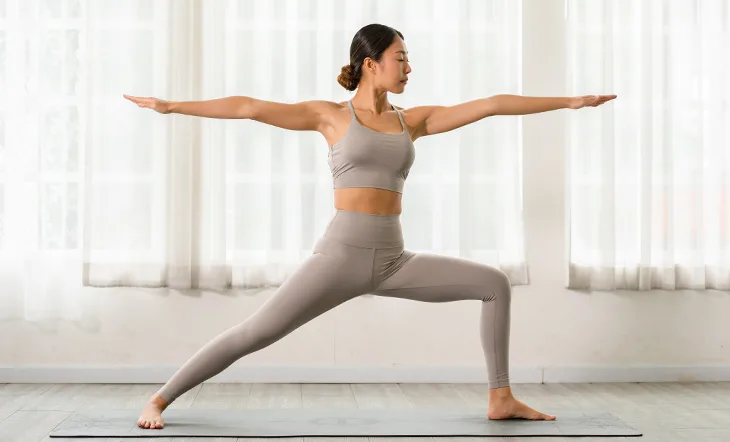
From a standing position, step the feet wide apart, roughly four feet depending on your height. Turn the front foot out 90 degrees and the back foot in slightly, about 15 degrees. Bend the front knee to 90 degrees, directly above the ankle. Extend both arms out to the sides parallel to the floor, reaching actively in both directions. Turn your gaze over the front hand. The hips in Warrior II are open to the side rather than squared forward as in Warrior I. This lateral hip opening position directly challenges the glute medius and hip abductors, the same muscles targeted by banded hip circle exercises.
Warrior II reveals hip abductor weakness quickly. The front knee will want to collapse inward as the glute medius fatigues, which is the same valgus collapse pattern that causes knee pain during squats and lunges. Actively pushing the front knee outward in alignment with the second toe throughout Warrior II is both a strength exercise for the hip abductor and a corrective drill for the knee tracking issue.
Why Warrior II Matters for Leg Day Performance
A wide-stance squat or sumo deadlift requires exactly the hip external rotation and abductor strength that Warrior II develops. Holding Warrior II for one minute per side, three to four times per week, creates real changes in hip mobility and lateral stability over six to eight weeks. Combine this with targeted hip abductor work using resistance bands and you address the same movement from multiple angles, producing faster and more durable results than either method alone.
Warrior III: Single-Leg Balance, Posterior Chain Strength, and Coordination
How to Perform Warrior III
Begin in a standing position with feet hip-width apart. Shift your weight into one foot and hinge forward at the hip, extending the opposite leg straight behind you as your torso lowers toward parallel with the floor. Extend the arms forward overhead or hold them at the sides for balance. The standing leg, the extended rear leg, and the torso should form a straight line from fingertips to heel. This is the most challenging of the three warrior variations because it demands single-leg balance, hip hinge mechanics, and posterior chain strength simultaneously.
Warrior III directly trains the hip hinge pattern that is foundational to the deadlift and Romanian deadlift. Athletes who struggle with balance during single-leg movements, or who lose their hinge pattern when fatigued, benefit enormously from consistent Warrior III practice. It teaches the nervous system to maintain a neutral spine under load during a hip hinge, which carries over directly to safer and stronger deadlift mechanics.
Building a Warrior Pose Sequence Into Your Training Week
Pre-Workout Mobility Circuit
A five to eight minute warrior pose circuit before a lower body training session prepares the hips, ankles, and thoracic spine for the demands of squatting and hinging. Start with Warrior I on each side for 45 seconds, transition to Warrior II on each side for 45 seconds, and finish with 30 seconds of Warrior III per leg. This sequence takes less than ten minutes and produces a measurable improvement in squat depth and hip mobility during the subsequent training session compared to skipping mobility work entirely.
Post-Workout Recovery Holds
After a hard lower body session, holding warrior poses for longer durations, 60 to 90 seconds per side, aids in flushing metabolic waste from the worked muscles and gently restores range of motion that heavy loading temporarily reduces. The static holds at these longer durations create the type of neurological relaxation response that accelerates recovery. This is distinct from the activation purpose of pre-workout mobility work and is arguably more valuable over the long term for athletes training frequently at high intensities.
Common Warrior Pose Mistakes That Kill the Benefits
The most common error in Warrior I is allowing the back heel to lift off the ground, which shortcuts the hip flexor stretch entirely. Keep that back heel planted and feel the stretch intensify. In Warrior II, the front knee caving inward defeats the purpose of the hip abductor challenge. Drive the knee out consistently throughout the hold. In Warrior III, arching the lower back as the leg lifts removes the hamstring and glute engagement and puts excessive strain on the lumbar spine. Maintain a neutral spine by thinking about lengthening through the crown of the head rather than lifting the leg as high as possible.
Progress matters too. New practitioners should hold each position for 20 to 30 seconds as they develop strength and proprioception. Experienced athletes can work up to 60 to 90 second holds and add loaded variations like a dumbbell in each hand during Warrior I or a resistance band around the thighs during Warrior II for additional challenge.
FINAL WORDS
Warrior poses are not soft training. They are a legitimate athletic tool that builds the hip mobility, single-leg stability, and posterior chain strength that direct gym work often neglects. Lifters who add a weekly warrior pose practice alongside their barbell training move better, recover faster, and stay injury-free longer. Start with five minutes after your next leg session and build the habit from there. Match your mobility practice with equipment that supports your training, including knee sleeves and hip circle bands, and you have both the preparation and the protection to train hard for years without breaking down.
Certified strength and conditioning specialists with over 10 years of experience in powerlifting, nutrition, and evidence-based fitness content. Based in New York City.