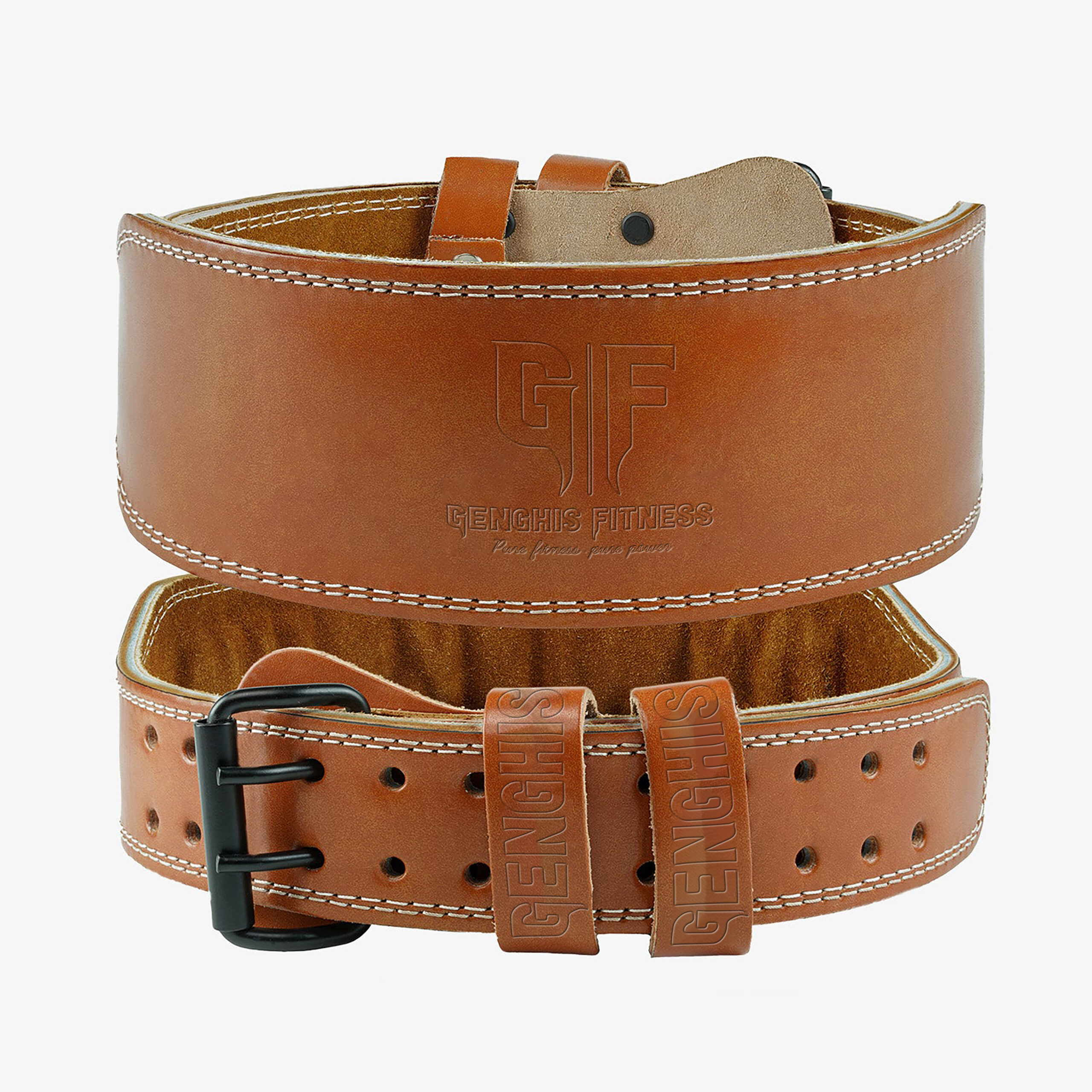
4-INCH WEIGHTLIFTING BELT BENEFITS: WHY FULL-WIDTH COVERAGE IS THE COMPETITION STANDARD
The 4-inch weightlifting belt is not the standard because it looks more impressive than a narrower option. It is the standard because 4 inches of leather covering your lumbar spine provides the largest possible surface area for intra-abdominal pressure support, the most uniform distribution of that pressure around the midsection, and the most contact between the belt and the back where spinal stability matters most. Every serious powerlifting federation in the US and Europe specifies a maximum of 4 inches precisely because this width has been shown through decades of competitive use to optimize the belt’s protective and performance functions simultaneously. Here is exactly what those 4 inches give you that narrower options do not.
BENEFIT 1: MAXIMUM LUMBAR CONTACT AREA
The lumbar spine, specifically the L3 through L5 vertebrae, is the primary stress concentration point during heavy squats and deadlifts. A belt that covers more of this zone provides more contact area against which intra-abdominal pressure can push, which translates to more uniform spinal support across the full vertebral column at risk. A 3-inch belt covers this zone adequately. A 4-inch belt covers it completely. For athletes training at loads that genuinely test the structural limits of the lumbar spine, the extra inch of coverage produces a measurably firmer, more complete brace.
Research on intra-abdominal pressure and spinal load reduction during resistance training, including studies cited through PubMed, supports the relationship between belt contact area and spinal compressive force reduction. More contact area distributes the generated pressure more effectively, which translates to better spinal protection per pound of weight lifted. This is not a marginal benefit. At competition-level loading, it is a meaningful safety and performance variable. Our 4-inch leather weightlifting belt is built to maximize this contact area with full-grain leather construction that maintains its geometry under maximum loading.
BENEFIT 2: MORE UNIFORM PRESSURE DISTRIBUTION
When you brace into a 4-inch belt, the pressure your core generates distributes across a wider band of contact. This prevents the concentrated pressure points that narrower belts can create, particularly at the top and bottom edges where a narrower belt transitions from belt to bare skin. Athletes who have trained in both widths consistently describe the 4-inch option as feeling more like a solid wall of support and less like a band pressing into specific points. This uniform contact also keeps the belt positioned more stably during a set, reducing the tendency for the belt to shift upward during a deep squat or creep during a deadlift.
BENEFIT 3: COMPETITION LEGALITY ACROSS ALL MAJOR FEDERATIONS
Every major powerlifting federation in the US and internationally, including the IPF, USAPL, USPA, British Powerlifting, and IPO, approves belts up to 4 inches wide for competition. A 4-inch belt meets this standard in every federation simultaneously, which means you never face an equipment check problem regardless of which federation’s events you enter. A belt wider than 4 inches would be disqualified at equipment check. A belt exactly at or below 4 inches is legal everywhere. Training in a 4-inch belt from early in your competitive career means your training equipment is always consistent with your competition equipment, eliminating any adjustment period around meet time.
BENEFIT 4: PROPRIOCEPTIVE FEEDBACK UNDER HEAVY LOADS
Proprioception, the nervous system’s sense of body position in space, is improved by the additional tactile feedback that a wider belt provides. A 4-inch belt creates contact with a larger portion of your torso, giving your nervous system more information about where your midsection is positioned during a heavy squat or deadlift. Under fatigue in the later sets of a heavy training session, when technique naturally begins to drift, this enhanced proprioceptive feedback helps maintain positional awareness that keeps mechanics more consistent. This is a subtle benefit but one that experienced lifters notice clearly when comparing training sessions with and without a properly fitted 4-inch belt.
WHEN A NARROWER BELT IS THE SMARTER CHOICE
The 4-inch belt is the optimal choice for most powerlifting-focused athletes, but it is not the universal correct answer. Athletes with shorter torsos, particularly women and lighter-weight competitors, may find that 4 inches contacts both the lower ribs and the top of the hip bone simultaneously, creating edge pressure that limits how tightly the belt can be worn comfortably. For these athletes, a 3-inch belt or a tapered belt that is wider at the back provides nearly equivalent lumbar support without the comfort compromise. The goal is always a belt that can be worn at its functional tightness without discomfort overriding the performance benefit.
For Olympic weightlifting and CrossFit, the wider 4-inch belt can restrict range of motion during deep hip hinge movements like cleans and snatches. Athletes in these disciplines typically do better with a 3-inch option or a tapered belt that narrows at the front to allow full hip flexion while maintaining rear lumbar coverage. The question is always which width serves the specific demands of the training, not which width is most impressive in a product photo.
Pair your 4-inch belt with the accessories that match its performance level. Knee wraps for equipped squat work, wrist wraps for heavy bench, and leather lifting straps for your heaviest deadlift and row training. Every component of a serious lifting kit should reflect the standard of the training it is supporting.
THE LONG-TERM CASE FOR A 4-INCH BELT AS YOUR PRIMARY TRAINING TOOL
For powerlifters and serious strength athletes who plan to compete or who simply want to train at the highest level their genetics and work ethic allow, choosing a 4-inch belt from the beginning of their serious training is the correct long-term decision. The break-in period is the same as any leather belt. The additional width adds no meaningful inconvenience to training once the belt is broken in and fitted correctly. And the cumulative benefit of training every qualifying heavy set with maximum lumbar contact area, uniform pressure distribution, and competition-legal equipment compounds across thousands of sessions into a training history built on gear that was always supporting the work correctly.
Athletes who start with a narrower belt and upgrade to 4 inches later consistently describe the transition as feeling like a meaningful step up, with more confidence under heavy loads and a more solid bracing experience. Making that transition earlier in your training career means benefiting from those advantages across more of your development rather than arriving at them after years of training with a less optimal tool. The 4-inch belt is not a premium upgrade for advanced athletes only. It is the correct choice for any athlete whose primary training is compound barbell lifting and whose torso geometry accommodates the width without discomfort. Evaluate your fit, choose accordingly, and build your training on equipment that is ready for wherever your strength takes you.
One practical consideration that often gets overlooked: a 4-inch belt requires slightly more deliberate positioning at the start of each set compared to a narrower option. Because it covers more of the torso, small errors in vertical placement are more noticeable and can affect comfort during the movement. Take five seconds at the start of each heavy set to confirm the belt is sitting at navel height, centered on the lumbar spine, with equal contact on the front, sides, and back before you close it. This positioning habit, which takes no meaningful time, ensures that all four of the benefits described above are fully activated on every rep rather than partially compromised by a belt that has shifted a half inch from its optimal position. Consistent positioning is how you extract the full performance value from a quality piece of gear, and a 4-inch belt rewards that consistency more than any other width.
Certified strength and conditioning specialists with over 10 years of experience in powerlifting, nutrition, and evidence-based fitness content. Based in New York City.
TRAIN WITH EQUIPMENT THAT MATCHES YOUR EFFORT
Serious strength training demands serious gear. A lever belt, quality straps, and knee sleeves are not accessories. They are tools.
10mm Lever Belt Lifting Straps Knee SleevesFor more on every type of weightlifting belt, sizing guide, and training recommendation, visit the weightlifting belt guides covering leather, lever, neoprene, and nylon options alongside how-to guides and care instructions.