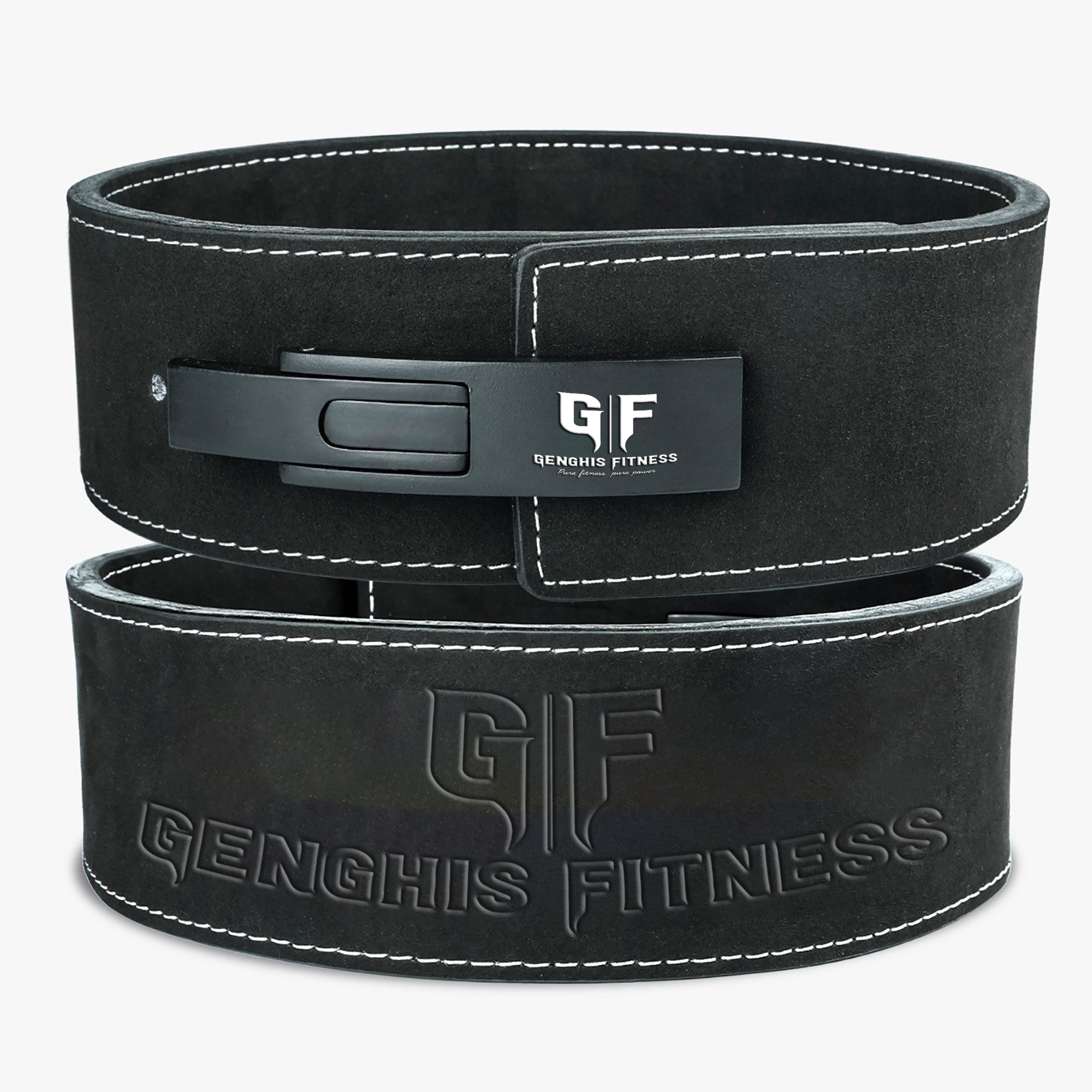
LEVER LIFTING BELT: WHY SERIOUS LIFTERS CHOOSE THE LEVER AND HOW TO USE IT RIGHT
The lever lifting belt is the choice of serious powerlifters and strength athletes worldwide, and the reason is purely practical: speed, consistency, and reliability. Every lever belt application is identical in tension, takes seconds rather than minutes, and removes the human error that prong belt threading introduces across a session with multiple heavy sets. The lever does not make a belt perform better than a comparable prong belt at equivalent tension. What it does is make the belt immediately accessible, consistently applied, and reliably released, which across a training career of hundreds of sessions and thousands of heavy sets is an enormous practical advantage.
HOW A LEVER BELT WORKS
A lever belt is a full-grain leather belt, typically 10mm thick, fitted with a lever mechanism at the closure point instead of a traditional prong buckle. The lever is a hinged metal plate that locks over a pin on the belt body when pressed closed. It clicks firmly into its locked position, producing an audible click that confirms secure closure at the preset tension level. The lever is released by pressing the release mechanism with a thumb, which disengages the lock and allows the belt to be opened and removed immediately. The tension position of the lever is adjusted by physically moving the lever attachment point along holes in the leather belt body, typically using a small screwdriver to release and reposition the lever hardware at the desired hole position.
Once set at the correct tension position for the individual athlete’s training requirements, the lever delivers exactly that tension on every single application without variation. This consistency is the primary performance advantage of lever over prong: a prong belt applied at slightly different hole engagement or with slightly different pull tension across sets introduces variation in the IAP support the belt provides. The lever eliminates this variable entirely, giving the lifter the same mechanical environment for every heavy set of every training session. Research on lifting belt mechanics and intra-abdominal pressure confirms that consistent belt tension is necessary for consistent IAP generation, making the lever’s primary practical advantage directly linked to the primary performance mechanism of belt use.
LEVER BELT ADVANTAGES OVER PRONG BELTS
SPEED OF APPLICATION
A lever belt closes in under five seconds from the moment the athlete picks it up. A prong belt requires threading the tail through the buckle, finding the correct hole, feeding the prong through the hole, and checking that the prong is fully engaged before lifting. Under the time pressure between heavy sets in a competition environment or in a training session where the athlete is managing rest periods precisely, the lever’s speed advantage is not merely a convenience. It is a training quality variable that ensures the belt is correctly applied on every set without rushing the application process in a way that produces inconsistent results.
TENSION CONSISTENCY
The lever mechanism applies the same closure force at the same leather position on every application. An athlete who sets their lever at the correct position for their training session has effectively eliminated belt tension as a variable for that session. This is particularly valuable during peak training phases and in competition warm-up rooms where conditions are often rushed and distractions are frequent. Prong belts require the athlete to consistently thread to the same hole with the same pull tension across applications, which introduces human variability that accumulates across a long training session.
RELIABILITY UNDER MAXIMAL LOADING
A quality lever mechanism locks into its position with a positive click and does not release under the bracing force of maximal loading. Prong belts rely on the friction of the prong in the hole plus the mechanical friction of the buckle to maintain closure during maximal bracing force. Under very high IAP, some prong belts can experience prong movement or buckle slippage that the lifter may not notice until mid-lift when the belt has already lost some of its tension. A properly functioning lever mechanism does not exhibit this failure mode, maintaining consistent tension through the full duration of even the most extreme IAP demands of maximal effort compound lifting.
HOW TO SET YOUR LEVER BELT CORRECTLY
Setting a lever belt requires finding the position on the belt body where the lever, when closed, produces the correct training tension around the torso. Put the belt on at the intended wearing position at the iliac crest or just above it. Adjust the lever attachment point along the belt holes until closing the lever produces a firm, snug compression that allows full expansion of the torso into the belt during a deep breath without being painfully restrictive. The correct tension allows the belt to contact the torso fully around its circumference when the core is actively braced, creating the bracing surface that produces the IAP amplification that makes belt use mechanically valuable.
Some athletes prefer slightly different tensions for squatting and deadlifting, with squat tensions typically slightly tighter than deadlift tensions to accommodate the more upright torso position and deeper flexion demands. If you need meaningfully different tensions for different lifts, a prong belt allows this adjustment more conveniently than a lever. If a single tension works for all your heavy compound movements, the lever is the more practical choice for all sessions.
CARING FOR YOUR LEVER BELT
A lever belt requires the same leather care as any full-grain leather belt plus attention to the lever mechanism itself. Wipe the belt body down with a dry cloth after every session to remove chalk and sweat before they penetrate the leather. Apply leather conditioner to both inner and outer surfaces every two to three months. Keep the lever mechanism clean by wiping the contact surfaces and pivot area with a dry cloth. Apply a single drop of machine oil to the pivot pin if the lever begins to feel stiff or gritty during operation. Store flat or hanging to prevent permanent leather curvature. A properly maintained Genghis Fitness 10mm lever belt provides a decade or more of reliable heavy training use from a single investment.
PAIRING YOUR LEVER BELT WITH A COMPLETE TRAINING SETUP
The lever belt performs best as part of a complete heavy training support system. On heavy squat days, pair it with knee sleeves for joint warmth and proprioceptive feedback and knee wraps for maximum effort sets when competition-specific elastic rebound assistance is warranted. On heavy deadlift days, lifting straps eliminate grip as the limiting variable so that the posterior chain determines when the set ends. On heavy pressing days, wrist wraps maintain wrist alignment under sustained pressing load. The lever belt’s speed advantage integrates naturally into this multi-equipment setup because it can be applied and removed in seconds, making transitions between exercises and between belted and unbelted work within a session practically seamless.
FINAL WORDS
The lever lifting belt is the most practical choice for serious athletes who train heavy at high frequency and want consistent, reliable, fast belt application that never varies across a training session. The Genghis Fitness 10mm lever belt is built from full-grain leather with hardware graded for the sustained tensile demands of competition-frequency heavy training. Set it once to your correct tension position. Click it closed in seconds before every heavy set. Brace actively against it with maximum deliberate force. Maintain it properly with periodic leather conditioning and lever mechanism care. This is the complete lever belt protocol that delivers the spinal protection and IAP amplification benefit that the research confirms and that elite athletes rely on.
Certified strength and conditioning specialists with over 10 years of experience in powerlifting, nutrition, and evidence-based fitness content. Based in New York City.
For more on every type of weightlifting belt, sizing guide, and training recommendation, visit the weightlifting belt guides covering leather, lever, neoprene, and nylon options alongside how-to guides and care instructions.