Weightlifting Hand Straps: Types, Uses, and How to Choose the Right One
Weightlifting hand straps are grip aids that attach the hand to the barbell to reduce the demand on forearm endurance during pulling exercises. They are one of the most commonly used accessories in the gym and one of the most frequently misused. Knowing which type suits which exercise, how to put them on correctly, and when to use them versus training bare-handed is the difference between a tool that improves training and one that masks a weakness.
This guide covers all the main strap types, their specific use cases, and how to integrate them intelligently into a pulling-focused training program.
Why Straps Exist and What They Solve
The fundamental mismatch in pulling-based strength training is that the forearm flexors and hand muscles that close the grip on the bar have significantly less strength and endurance capacity than the large muscles being trained. The latissimus dorsi in a heavy row, the hamstrings and glutes in a deadlift, and the trapezius in a heavy shrug all have far greater force output capacity than the finger flexors that hold the bar in place.
At moderate weights this gap does not matter. At heavy training weights, particularly across multiple sets with moderate rest periods, grip endurance becomes the first system to fail. The set ends not because the target muscle is exhausted but because the hand cannot hold on. Straps close this gap, allowing the target muscle to be trained to its actual capacity.
Loop Straps
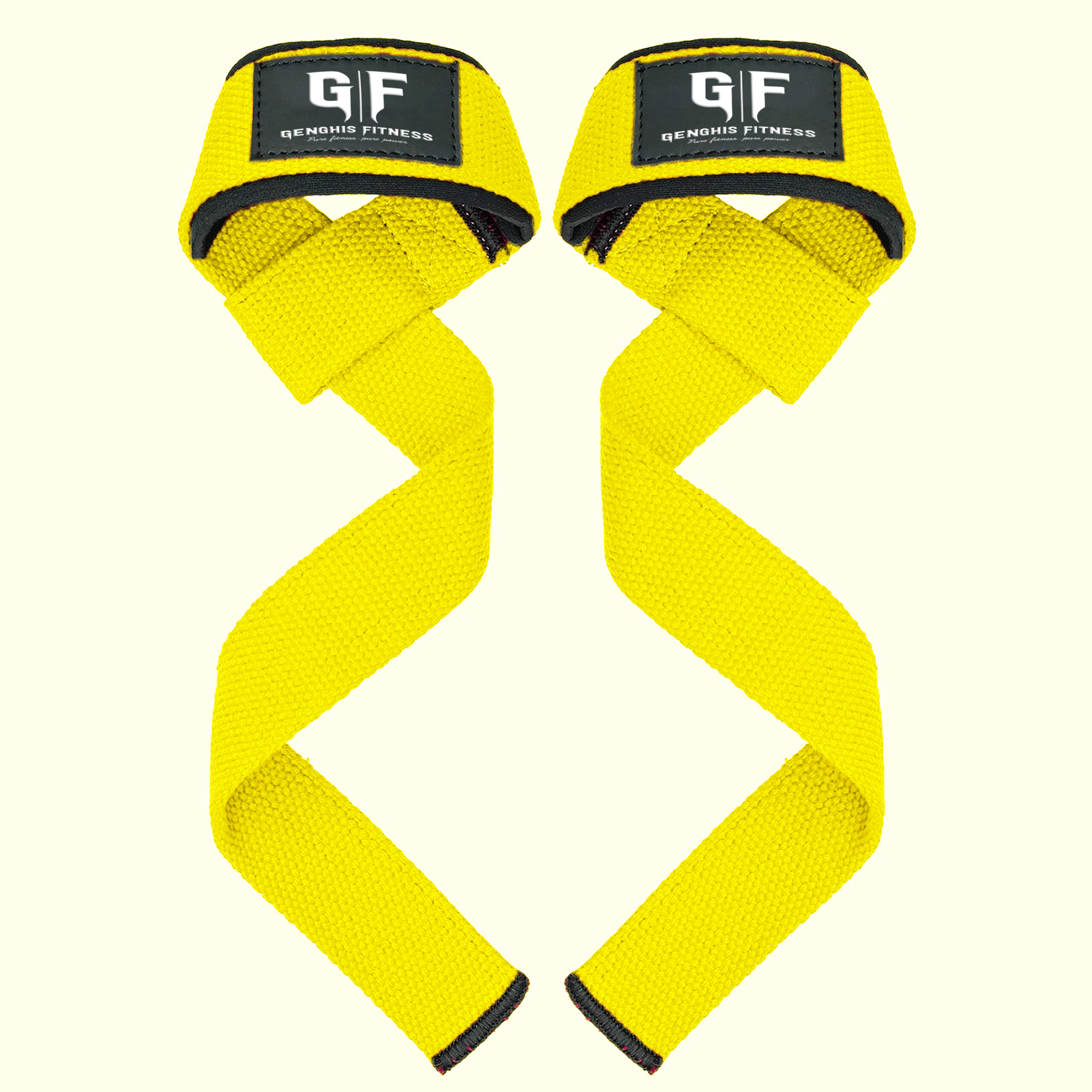
Loop straps are the most common and versatile strap design. A length of cotton or nylon forms a fixed loop at one end that goes around the wrist. The remaining length wraps one or more times around the bar and the grip closes over it. The friction of the wrapped material against the knurling holds the hand to the bar.
Loop straps work for deadlifts, Romanian deadlifts, barbell rows, lat pulldowns, cable rows, shrugs, and any pulling exercise where grip endurance is the limiting factor. They are fast to set up, easy to release, and available in a wide range of materials and lengths. The Genghis Fitness lifting straps are a reliable starting point for athletes new to strap use.
Lasso Straps
Lasso straps differ from fixed-loop straps by using an adjustable loop that threads back through itself, allowing the wrist attachment to be tightened or loosened. This creates a more secure wrist connection than a fixed loop at very heavy loads where the fixed loop can slide up the forearm under tension.
The extra security of a lasso design is most noticeable on deadlift sets at true training-max weights and above. For most working sets at 70 to 85 percent, the difference between fixed loop and lasso is minimal. If you regularly train at or near your maximum or use supramaximal loads in rack work, lasso straps provide a meaningfully more secure wrist attachment.
Leather Straps
Leather straps are more durable than cotton under consistent heavy use and develop a personalized feel as they conform to the hand over time. The Genghis Fitness leather weight lifting straps represent the premium end of the loop strap category. Leather holds its structural integrity across more training cycles than cotton, does not fray at the edges as aggressively, and develops the kind of character that cotton and nylon never acquire.
The trade-off with leather is the break-in period. New leather straps are stiff and do not conform to the bar or the hand immediately. Use them through several sessions at moderate weights before expecting the same pliability as broken-in cotton straps.
Figure-8 Straps
Figure-8 straps create a mechanical double-loop connection between the wrist and the bar that provides the most secure attachment of any strap type. Unlike loop straps that rely on friction, figure-8 straps form a physical lock that tightens under load. They are used for maximum-effort deadlifts, rack pulls, and heavy shrugs where absolute grip security matters more than the ability to release the bar quickly.
The Genghis Fitness figure-8 lifting straps are built for exactly this application. The important caveat is that figure-8 straps cannot be released quickly mid-set. Never use them for Olympic lifting movements like cleans and snatches where releasing the bar in the catch phase is essential for safety.
How to Wrap Straps Correctly
The direction of the wrap determines whether the strap tightens or loosens under load. The correct wrap direction is under the bar and back toward you, so that the closing of the hand and the tension of the lift tightens the strap around the bar rather than loosening it.
Feed the loose end of the strap under the bar from the far side and bring it back over the top toward you. Close your fingers over the strap and the bar simultaneously. As you pull, the tension tightens the wrap. Wrapping in the opposite direction creates a strap that loosens under load, which defeats the purpose.
One to two wraps is standard for most exercises. More wraps create a more secure connection but make the strap harder to release after the set. For deadlifts and rows where releasing quickly is not a concern, two wraps provide more security. For any exercise where you might need to release the bar quickly, keep it to one wrap.
When to Use Straps vs When to Train Bare-Handed
Training bare-handed develops grip strength as a direct consequence of the pulling work. Using straps on every set removes this stimulus and can result in grip strength lagging behind the other qualities being trained.
A practical protocol is to train all warm-up sets and early working sets without straps. Add straps when the load reaches approximately 80 percent of your working weight or when grip fatigue from earlier sets in the session is noticeably affecting performance. This preserves the grip development stimulus from lighter sets while using straps to extend the quality of training on the heaviest sets.
Exercises Where Straps Are Most Useful
- Conventional deadlift at working weights and above
- Sumo deadlift, same threshold
- Romanian deadlift across moderate to high rep ranges
- Barbell and dumbbell rows at heavy loads
- Rack pulls and partial deadlifts
- Heavy shrugs and trap bar shrugs
- Weighted pull-ups where grip fails before the lats
- Lat pulldowns and cable rows at maximum resistance
Exercises Where Straps Should Not Be Used
Olympic lifts, including clean, power clean, snatch, and their derivatives, require the ability to release the bar rapidly in the catch phase. Using any strap that prevents quick release on these movements is a safety issue. Train Olympic lifts bare-handed or with hook grip.
Exercises specifically designed to develop grip strength, including farmer’s carries, plate pinches, and dead hangs, should be performed without straps. The grip is the training variable in those movements.
Pairing Straps with a Lifting Belt
Heavy pulling sessions benefit from addressing both grip and lumbar bracing simultaneously. Straps for the hands, a belt for the core. The Genghis Fitness powerlifting leather belt paired with leather or figure-8 straps covers both performance ceilings on the heaviest sets of the training week.
Care and Lifespan
Cotton straps should be machine washed in cold water every few weeks and air dried. Nylon straps can be washed the same way and dry faster. Leather straps should be wiped clean and conditioned. Inspect the wrist loop seam on all strap types before heavy sessions. The seam at the loop is the point of maximum stress concentration and is where most strap failures begin. Replace straps at the first sign of seam separation or material thinning at the loop junction.