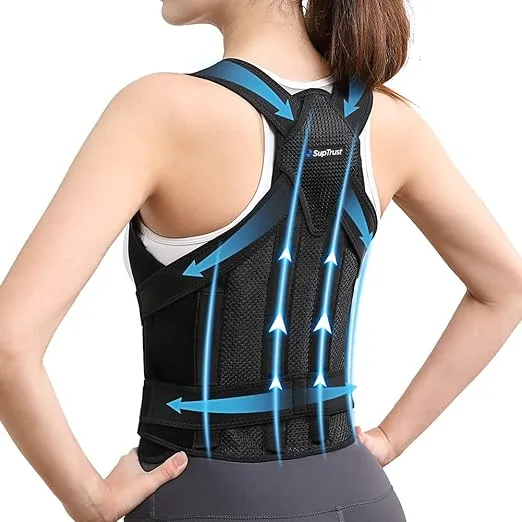
Lower Back Brace for Work: What It Actually Does and When to Use One
Lower back pain is one of the most common reasons people miss work across every industry. For workers who spend long hours lifting, bending, standing, or sitting in fixed positions, the appeal of a lower back brace as a protective measure is understandable. Strap something on, get pain relief, keep working. The reality is more nuanced than that.
This guide covers how back braces work in occupational settings, what the research actually says about their effectiveness for injury prevention, when a brace is genuinely useful, and when you are better served by building strength and improving movement mechanics instead.
How a Lower Back Brace Works
A lower back brace applies compressive pressure around the lumbar region, often with rigid stays or semi-rigid panels along the spine. The compression limits the range of motion in lumbar flexion and extension, provides mild warmth to the muscles of the lower back, and creates a sensory cue that reminds the wearer to maintain a more neutral spine position during movement.
The mechanism is passive. Unlike a weightlifting belt used with an active bracing technique, most occupational back braces do not require the wearer to generate intra-abdominal pressure intentionally. The brace provides external support rather than enhancing an internal mechanism. This distinction matters because it means the brace can temporarily reduce discomfort without addressing the underlying cause of the problem.
What the Research Says About Braces for Work Injury Prevention
The evidence on occupational back braces for injury prevention is mixed. Studies cited in the NIH research database have found that back braces do not consistently reduce the incidence of new lower back injuries in healthy workers compared to control groups. The American Council on Exercise has noted that prolonged reliance on external support can reduce the active engagement of the stabilizing muscles of the lumbar spine, potentially increasing vulnerability when the brace is removed.
Where braces show clearer benefit is in workers who already have a diagnosed lower back condition and who are returning to work under medical supervision. In that context, the brace functions as a transitional tool that manages loading on healing tissue while the worker reintegrates into physical demands. This is a therapeutic application, not a general injury prevention strategy.
Who Should Actually Use a Lower Back Brace for Work
Workers Returning from Injury
If you have been treated for a lumbar strain, herniated disc, or other diagnosed back condition and your physician or physical therapist has recommended a brace as part of your return-to-work protocol, wear it as prescribed. Follow the schedule your provider gives you and use the brace as a bridge back to full function, not a permanent fixture.
Workers with Specific High-Load Tasks
Workers who perform occasional maximum-effort lifts as part of their job, moving heavy equipment, loading freight, or handling materials, may benefit from a brace during those specific high-demand tasks. The brace provides a proprioceptive reminder to brace the core and can reduce the likelihood of a careless movement under load when fatigue is a factor.
Workers with Diagnosed Lumbar Instability
Some individuals have structural instability at specific vertebral segments, typically due to spondylolisthesis or post-surgical changes, where limiting movement at that segment is medically appropriate during weight-bearing tasks. In these cases, the brace serves a genuine mechanical purpose and is not simply symptom management.
When a Lifting Belt Is More Appropriate Than a Back Brace
If you are a physically active worker or an athlete who also trains in the gym, a weightlifting belt used with active intra-abdominal bracing is more appropriate for your strength training than a passive back brace. The belt is a performance tool that enhances what your core can already do. Used with the correct bracing technique, it reduces net compressive loading on the lumbar spine during heavy lifts.
The Genghis Fitness powerlifting leather belt and the neoprene weightlifting belt are both purpose-built for exactly this kind of training application. If your back pain is occurring in the gym rather than at a worksite, a lifting belt combined with corrected movement mechanics is the right tool.
Choosing a Lower Back Brace for Occupational Use
Rigid vs Soft-Shell Braces
Rigid braces with hard panels or stays along the spine provide the most movement restriction and are typically prescribed for post-surgical recovery or diagnosed instability. They are not practical for most continuous-use occupational settings because they limit mobility needed to perform the job.
Soft-shell braces with flexible stays and elastic compression panels are the most common occupational choice. They limit extreme range of motion while still allowing the movement needed for most physical work. Look for a design that allows full breathing and does not ride up during bending or squatting tasks.
Fit and Adjustability
A back brace that does not stay in position is not providing consistent support. The brace should sit over the lumbar region, not the mid-back or sacrum. It should be adjustable enough to stay positioned correctly across a full shift without constant repositioning. Dual closure systems, an inner layer for positioning and an outer layer for tension, maintain position better than single-band designs during physically demanding work.
Breathability
Workers wearing a brace for an 8 to 12 hour shift in warm environments need a breathable construction. Look for perforated neoprene, moisture-wicking nylon mesh, or hybrid panels with ventilation zones. A brace that traps heat and causes skin irritation will be abandoned before it can provide any benefit.
The Better Long-Term Solution: Building Core Strength
The best protection for the lower back at work is a strong posterior chain and well-trained core stabilizers. Glute strength, hamstring flexibility, hip mobility, and the endurance of the erector and multifidus muscles are all more reliable protections against occupational back injury than any external device.
Exercises that build this foundation include deadlifts, Romanian deadlifts, hip hinges, single-leg movements, planks, bird dogs, and loaded carries. A consistent strength training program pursued 2 to 3 times per week builds the structural resilience that passive braces can only simulate temporarily.
The National Strength and Conditioning Association recommends resistance training that addresses posterior chain strength as a primary strategy for reducing occupational low back injury risk in working populations.
How to Use a Lower Back Brace Correctly
Position the brace over the lumbar curve, with the center of the posterior panel over the L3 to L5 region. The bottom of the brace should not press into the sacrum when sitting. The top should not contact the lower thoracic ribs during normal movement.
Wear the brace snug but not so tight that it restricts breathing. If you feel numbness or tingling in the hips or legs while wearing the brace, loosen it immediately. Excessive compression can restrict blood flow to the lower extremities or interfere with the nerves of the lumbar plexus.
Remove the brace periodically during low-demand periods of your shift. Wearing it continuously for an entire shift reduces the active engagement of the core muscles. Intermittent use during high-demand tasks maintains the protective effect while preserving the training stimulus on the stabilizing musculature.
When to See a Doctor Instead
A lower back brace is not a substitute for medical evaluation of persistent or severe back pain. If you experience pain that does not resolve after 72 hours of rest and modified activity, pain that radiates into the glutes or legs, numbness or tingling in the lower extremities, weakness in the legs or feet, or loss of bladder or bowel control, seek immediate medical evaluation.
Bracing over an undiagnosed structural problem can mask symptoms while the underlying condition worsens. The goal is not to manage pain well enough to keep working. The goal is to understand and treat the source of the pain so you can work without restriction.
Summary
Lower back braces for work provide compressive support and proprioceptive feedback that can help workers with diagnosed conditions manage occupational physical demands during recovery. For healthy workers, consistent use does not reliably prevent injury and can reduce the active engagement of the muscles that protect the back long-term. Build posterior chain strength, use a lifting belt for gym training, and reserve the back brace for situations where a physician has recommended it as part of a specific treatment plan.