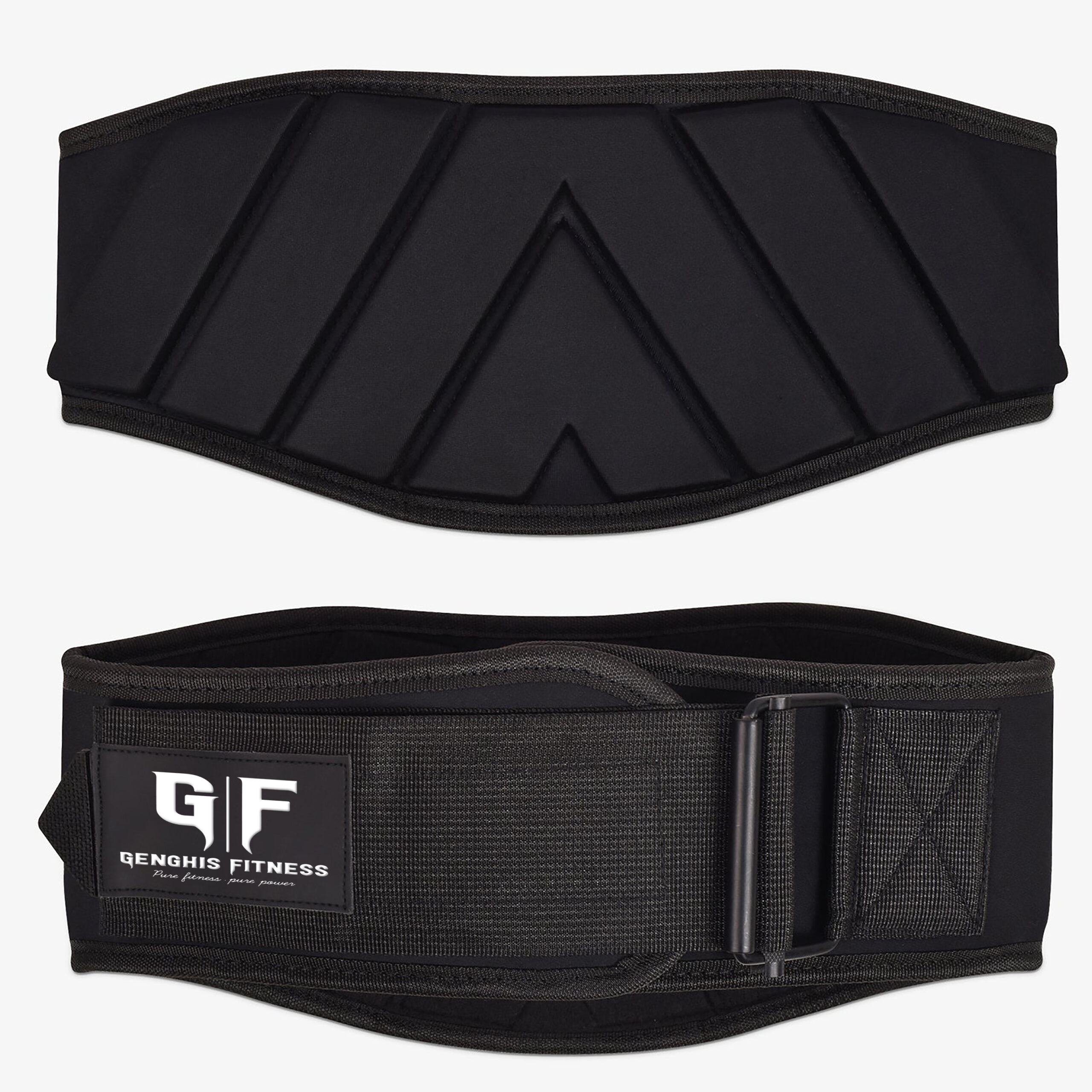
HEAVY DUTY NYLON LIFTING BELT: WHAT MAKES ONE ACTUALLY HEAVY DUTY
The term heavy-duty appears on more lifting belts than it can possibly accurately describe. In practice, most belts marketed as heavy-duty are standard nylon constructions with no meaningful difference in webbing grade, buckle specification, or stitching quality from the products they are implicitly contrasted against. Understanding what genuinely constitutes heavy-duty construction in a nylon lifting belt, and how to verify those construction claims before purchasing, is the knowledge that separates a belt that earns that description from one that simply uses it as a marketing label applied to a product built to standard specifications.
THE CONSTRUCTION ELEMENTS THAT DEFINE GENUINE HEAVY-DUTY QUALITY
WEBBING DENIER RATING
Denier is the fiber density measurement for textile materials, and it is the primary variable that separates heavy-duty nylon webbing from standard nylon webbing. Standard nylon belts typically use 500 to 800 denier webbing that provides adequate tensile strength for moderate loading but shows surface abrasion and edge fraying within months of regular contact with knurled barbells and chalk-laden training environments. Genuinely heavy-duty nylon belts use 1000 to 2000 denier webbing that maintains surface integrity and structural strength under the same contact stresses across years of training use rather than months. The higher denier rating also provides meaningfully greater resistance to the tensile forces generated during maximal bracing, which is where the structural difference between standard and heavy-duty webbing translates most directly into both belt performance and long-term training value.
BUCKLE AND LEVER HARDWARE SPECIFICATION
The buckle or lever mechanism handles the full tensile load of the bracing force on every set across the entire service life of the belt. A heavy-duty buckle uses hardware manufactured from adequately graded steel with sufficient wall thickness in the buckle frame to maintain its dimensional shape under sustained high-tension loading across thousands of training sessions over multiple years. Budget buckles use thinner-gauge frames that deform under the repeated tensile stress of heavy bracing, developing play and slippage within months of regular training at high intensities. Heavy-duty lever mechanisms apply the same grade considerations to the pivot pin and lever arm as well as the frame, ensuring that the clicking mechanism maintains its positive engagement across thousands of load cycles without developing the looseness that allows the lever to open partially under bracing force.
Research on mechanical performance of load-bearing equipment reinforces the foundational principle that hardware rated adequately above maximum expected loads maintains functional performance significantly longer than hardware specified at the minimum acceptable threshold. This principle applies directly to lifting belt buckle mechanisms, where the difference between adequate-grade and marginal-grade hardware becomes visible as functional failure within the first training year in athletes who train at competition-level intensity and frequency.
STITCHING DENSITY AND THREAD GRADE
The stitching at the buckle attachment point and along the belt edges is the secondary structural zone where heavy-duty construction distinguishes itself from standard construction. Heavy-duty bar-tack stitching at the buckle attachment uses a dense, multi-pass pattern with industrial-grade thread rated to tensile loads significantly above the maximum forces generated during heavy belt bracing. This dense stitching distributes the stress concentration at the attachment point across many thread contact zones rather than concentrating it in a small area that fails prematurely under repeated high-loading cycles. Standard belts use lower stitch density with lighter thread grade that begins showing thread separation at the attachment point within the first months of heavy use in athletes who train at high intensity multiple times per week across a full training year.
HOW HEAVY-DUTY CONSTRUCTION TRANSLATES TO TRAINING OUTCOMES
The practical training outcome difference between a heavy-duty nylon belt and a standard nylon belt becomes clearly apparent at six to twelve months of regular heavy training. At this point, the heavy-duty belt webbing surface is essentially unchanged from its initial state while the standard belt shows visible surface abrasion at the barbell contact zone and fraying at the fold points where the webbing repeatedly flexes under loading. The heavy-duty buckle mechanism maintains the same positive click and tension consistency as it produced in the first session, while the standard buckle may have developed slippage that requires readjustment between sets. The heavy-duty stitching at the attachment point is intact, while the standard belt may show early thread separation that signals approaching structural compromise.
For the Genghis Fitness nylon lifting belt, the webbing, hardware, and stitching specifications are built to the construction standards that produce this durability difference across extended training careers. This is not a marketing distinction but a functional one that appears in the training environment at the point where the cheaper alternative requires replacement and the quality alternative continues performing at its original specification without degradation of any functional variable including buckle tension consistency and webbing structural integrity.
VERIFYING HEAVY-DUTY CLAIMS BEFORE PURCHASING
Verifying heavy-duty construction claims before purchasing requires looking past product descriptions and examining the specific technical specifications the brand is willing to state. Does the brand specify webbing denier by number? Does it specify buckle frame material and gauge? Does it describe stitching technique and thread specification? Brands that build to genuine heavy-duty standards publish these details because they know their products will be favorably compared on objective construction criteria. Brands that use heavy-duty as a marketing descriptor without supporting technical specifics are typically not leading with specifications their products would hold up well to objective comparison against.
Extended-use reviews from athletes who have trained with the same belt for six months or more at high frequency are the most valuable pre-purchase research available. First-session reviews tell you how a belt feels when new. Six-month reviews tell you whether the webbing, buckle, and stitching hold up under the conditions that distinguish heavy-duty from standard construction. Seek reviews from athletes whose training intensity and frequency match your own, as a belt that holds up adequately for an athlete training twice per week at moderate loading may show early failure signs for an athlete training four times per week at near-maximum loading across a full annual training cycle.
COMPLETE EQUIPMENT SETUP AROUND YOUR HEAVY-DUTY NYLON BELT
A heavy-duty nylon belt performs best as part of a complete training support system. Pair it with knee sleeves for joint warmth and proprioceptive feedback throughout every session and knee wraps for maximum effort squat days when elastic assistance and additional joint compression are warranted. On heavy deadlift sessions, lifting straps eliminate grip as the limiting variable so that posterior chain capacity rather than forearm endurance determines when the set ends. For athletes whose training includes overhead pressing, wrist wraps maintain wrist alignment under sustained pressing load. A heavy-duty nylon belt chosen for genuine durability, paired with quality support gear at each other joint under load, creates the equipment foundation that supports consistent heavy training across years rather than months before requiring replacement.
FINAL WORDS
A genuinely heavy-duty nylon lifting belt is defined by specific, verifiable construction standards: high-denier webbing that resists abrasion and tensile stress under years of heavy training, hardware manufactured to tolerances that maintain functional performance across thousands of loading cycles, and stitching specification that distributes stress across many contact points rather than concentrating it at a small area that fails prematurely under heavy use. The Genghis Fitness nylon lifting belt is built to these standards. Verify construction claims before purchasing any belt marketed as heavy-duty, size it correctly based on your actual training waist measurement, and use it with deliberate active bracing on every heavy set where spinal protection matters for both performance and long-term training safety.
Certified strength and conditioning specialists with over 10 years of experience in powerlifting, nutrition, and evidence-based fitness content. Based in New York City.
TRAIN WITH EQUIPMENT THAT MATCHES YOUR EFFORT
Serious strength training demands serious gear. A lever belt, quality straps, and knee sleeves are not accessories. They are tools.
10mm Lever BeltThe complete weightlifting belt guides answers every belt question in one place: which type suits your training, how to size correctly, how to break in leather, and how to brace with a belt for maximum intra-abdominal pressure.