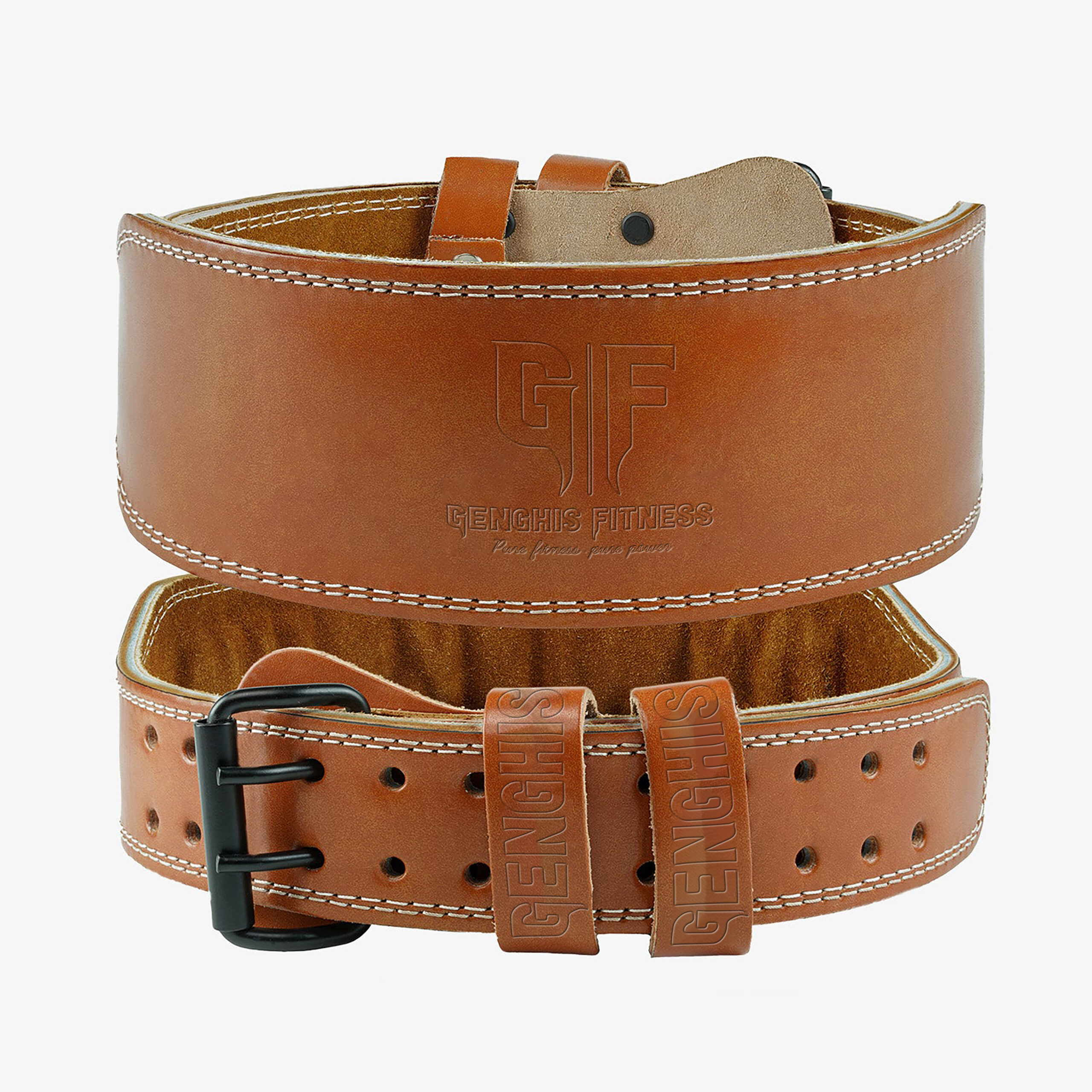
WEIGHTLIFTING BELT SAFETY TIPS: THE FOUR DIMENSIONS OF CORRECT AND SAFE BELT USE
Weightlifting belt safety tips address both the physical safety of wearing a belt correctly and the training safety of using a belt within the intensity and exercise protocols that produce its protective benefits without creating the issues that incorrect use can produce. A belt worn too tightly restricts breathing capacity and can limit the belly breath that generates the IAP mechanism. A belt worn at the wrong torso height covers the wrong spinal segments and reduces the lumbar protection benefit. A belt used at every intensity including light warm-up sets can create a learned dependency that reduces intrinsic core bracing quality over time. Each of these misuse patterns has a specific correction that makes belt use both safer and more effective.
TENSION SAFETY: THE BELLY BREATH TEST
The most important safety standard for belt tension is that a full belly breath must be possible with the belt closed. If the belt is so tight that full diaphragmatic breathing is restricted, it is too tight for safe use. The tension test: close the belt at what feels like training tension, then take the deepest belly breath possible. The belly should push outward against the belt noticeably. If the belly cannot expand at all against the belt, the tension is too high and must be reduced. Research on intra-abdominal pressure and optimal belt tension confirms that the IAP mechanism requires the athlete to be able to generate a full belly breath that creates the outward pressure the belt then amplifies, which is mechanically impossible if the belt prevents the belly from expanding.
POSITIONAL SAFETY: ILIAC CREST LEVEL FOR LUMBAR COVERAGE
Correct torso height is the positional safety standard that ensures the belt covers the lumbar vertebrae where compressive forces are highest during heavy compound lifting. The belt belongs at the iliac crest level, which is the bony prominence at the top of the pelvis. Wearing the belt at the natural waist, which is typically two to four inches higher than the iliac crest, leaves the critical lower lumbar segments uncovered by the belt’s posterior wall. The safety implication is that the segments experiencing the highest compressive forces during squats and deadlifts are not within the belt’s posterior coverage area, reducing the protective benefit the belt provides against the loading that creates the most injury risk.
CLOSURE SECURITY: VERIFYING ENGAGEMENT BEFORE EVERY SET
Belt closure security is a physical safety requirement that must be verified before every working set. A lever belt click that indicates secure closure prevents the lever from opening during the lift. A prong belt that is threaded through the buckle must have the prong fully seated in the hole rather than partially engaged. An incompletely secured belt that releases during a heavy set creates an acute safety incident as the sudden loss of IAP support can destabilize the spine at maximum loading. Check the closure by pulling the belt forward away from the body after application: a correctly secured belt should not move or loosen when pulled firmly.
PROTOCOL SAFETY: INTENSITY-APPROPRIATE BELT USE
Training at appropriate intensities is the protocol safety standard for belt use. The recommended protocol, wearing the belt on sets at 80 percent of maximum and above on compound lifts that load the lumbar spine, addresses two safety concerns simultaneously. First, it ensures the belt is present when the spinal loading is highest and the IAP benefit most significant. Second, it ensures that lighter training sets develop the intrinsic core stability that complements belt use at heavy intensities, rather than wearing the belt at all intensities and potentially reducing the neuromuscular stimulus for core strength development that lighter unbelted training provides.
OVERCORRECTION: THE OPPOSITE DIRECTION OF TOO-LOOSE
The overcorrection safety issue occurs when athletes tighten the belt so excessively that the resulting restriction impairs training quality in the opposite direction from too-loose belt use. Excessive tension at the anterior abdominal wall creates discomfort that distracts from technique focus, reduces the range of hip flexion available in the squat bottom position by compressing the lower abdominal tissue against the thighs, and creates discomfort at the iliac crest contact points under prolonged heavy loading. The correct tension, where the belly breath is possible and active bracing against the belt creates firm resistance, produces the maximum IAP benefit without the restriction that excessive tightening adds.
BREATHING SAFETY DURING MULTI-REP HEAVY SETS
Breathing safety during belt use requires exhaling between reps rather than holding the Valsalva maneuver continuously across multi-rep sets at high intensity. Sustained Valsalva on consecutive maximum-effort reps elevates blood pressure to levels that may be problematic for athletes with cardiovascular risk factors. The safe protocol for multi-rep sets is to exhale and rebrace between reps for working sets above 85 percent of maximum, and for sets where the cardiovascular strain of the Valsalva is apparent from lightheadedness or vision disturbance. For lighter intensity sets where the Valsalva strain is minimal, continuous bracing across the set is acceptable if the individual athlete’s cardiovascular profile is appropriate. Athletes with hypertension, cardiovascular disease, or any cardiovascular risk factors should consult with a physician before adopting sustained Valsalva technique during heavy compound training, and should follow the exhale-between-reps protocol for all training intensities rather than only at near-maximum loading.
SKIN IRRITATION PREVENTION FOR NEW BELT USERS
Skin irritation from belt contact is a common issue for new belt users, particularly at the anterior abdominal contact point where the belt’s lower edge contacts the skin during hip-hinged movements and at the iliac crest where the belt’s posterior edge sits. Wearing a moisture-wicking compression shirt underneath the belt reduces skin friction during extended wearing. Breaking in the belt gradually across several sessions before training at full session volume also reduces irritation, as new leather and nylon belts are stiffer at the contact points than the same belt after several weeks of regular use.
PRE-SESSION HARDWARE INSPECTION
Inspect the belt closure hardware before each session. Lever belts should be checked for lever pivot play, plate deformation at the closure point, and tooth or cam wear that reduces reliable closure engagement. Prong belts should be checked for prong bending that has altered the prong geometry from straight, making it less likely to seat cleanly in holes. Velcro closures should be cleaned of lint and debris before each session. A closure failure during a heavy set is the most acute safety risk associated with belt use, and pre-session inspection eliminates the hardware degradation causes of this risk.
FINAL WORDS
Weightlifting belt safety covers four distinct dimensions: physical safety from correct tension that allows belly breathing, positional safety from iliac crest level placement, closure security from pre-session hardware inspection and post-closure verification, and protocol safety from intensity-appropriate use that preserves intrinsic core development alongside belted IAP support. The lever belt, leather belt, and nylon belt each meet these safety standards when correctly sized, properly positioned, and used with deliberate active bracing on every heavy set. Pair with knee sleeves and lifting straps for the complete support system that allows heavy compound training to proceed safely across a full training career. Athletes who internalize all four safety dimensions and apply them consistently from early in their training career avoid the acute closure failures, positional errors, and tension misuse patterns that athletes who treat belt use as intuitive rather than learned encounter and must correct after experiencing their negative consequences.
Certified strength and conditioning specialists with over 10 years of experience in powerlifting, nutrition, and evidence-based fitness content. Based in New York City.
Related guides and comparisons are collected in the weightlifting belt guides, covering all belt materials, thicknesses, closure systems, and sport-specific recommendations in one location.