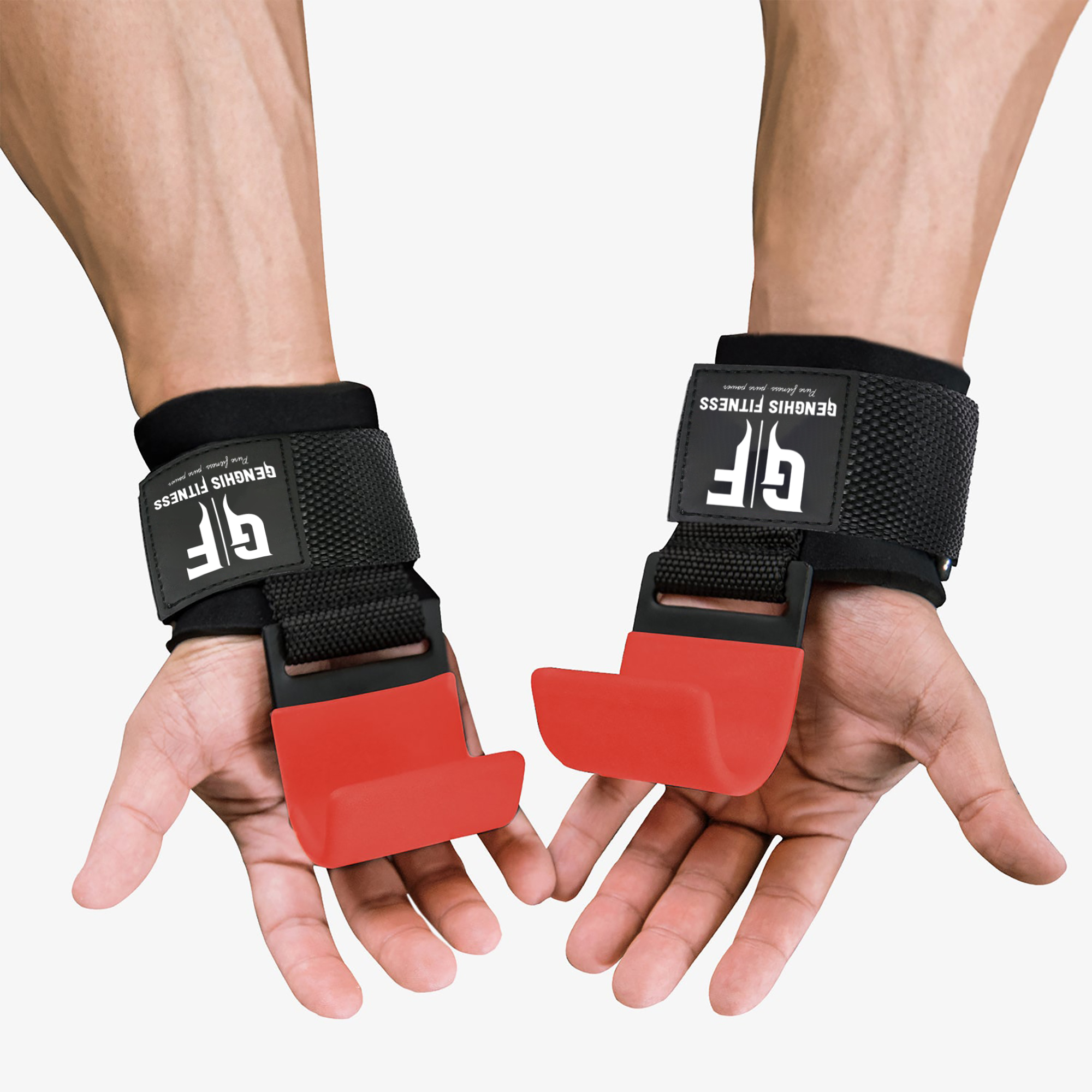
GRIP ENHANCEMENT HOOKS: HOW LIFTING HOOKS ELIMINATE GRIP FAILURE AND MAXIMIZE PULLING PERFORMANCE
What Grip Enhancement Hooks Are and How They Work
Grip enhancement hooks, more commonly called weightlifting hooks or lifting hooks, are wrist-worn devices that replace hand grip as the load-bearing connection between the athlete and the bar. A steel hook attached to a padded wrist strap engages over the top of the barbell when the athlete grips the bar, transferring the full load from the bar through the steel hook and into the wrist strap rather than through the fingers. The result is a mechanical grip connection that does not fatigue the way the finger flexors do, allowing the target muscles of the back, traps, and hamstrings to determine the end of a set rather than grip endurance. Genghis Fitness weightlifting hooks are built to handle the loads that serious athletes need this kind of assistance for, with solid steel hooks and padded wrist straps that distribute load across the forearm rather than concentrating it on the wrist bones.
The performance benefit of grip enhancement hooks is well-documented in training practice. Research in the Journal of Human Kinetics confirmed that grip fatigue significantly limits pulling exercise volume before the target muscles reach genuine failure, meaning that athletes training without grip assistance consistently leave back, trap, and hamstring development on the table in every pulling session. Hooks address this limitation more completely than straps because the steel hook creates a mechanical lock on the bar rather than relying on friction from a fabric wrap around the bar surface. At truly maximal loads, hooks provide a more secure connection than any strap type except figure-8 straps.
How Grip Enhancement Hooks Differ From Lifting Straps
Security of Connection
The fundamental difference between hooks and straps is the nature of the grip connection. Lifting straps wrap around the bar and rely on friction and wrap tension to maintain grip security. The more wraps, the more secure, but any strap can theoretically slip under sustained extreme loading if the wrap slips on the bar surface. A hook creates a mechanical engagement over the top of the bar that does not rely on friction. The bar sits inside the hook, and the hook geometry prevents the bar from rolling out of engagement under normal training loads. This mechanical advantage makes hooks the more secure option at extreme weights. For most practical training loads, both standard loop straps and hooks provide adequate security.
Speed and Convenience
Hooks attach to the wrist once and engage with the bar instantly by simply gripping the bar normally. Straps require wrapping one to three times around the bar before each set, which adds 15 to 20 seconds per set in a high-volume training session. Over the course of a full back workout with 15 to 20 working sets, hook-based training saves several minutes compared to strap-based training. For athletes who superset exercises or train with limited rest periods, this time savings is practically meaningful.
Bar Feel and Proximity
Straps allow the athlete to grip the bar directly with the strap layered between the palm and the bar, maintaining relatively close contact with the bar surface. Hooks position the hook hardware between the palm and the bar, creating a slightly more mechanical feel that some athletes find less intuitive than straps for exercises where bar feel matters, such as conventional deadlifts where technique feedback through the hands is important. For exercises like shrugs, rack pulls, and rows where technique is less sensitive to bar feel variation, the mechanical feel of hooks is not a meaningful drawback. Many serious athletes use leather straps for deadlifts and hooks for shrugs and rows specifically for this reason.
Best Exercises for Grip Enhancement Hooks
Heavy Shrugs and Trap Training
The shrug is the exercise where grip enhancement hooks produce the most dramatic performance improvement. At the loads required to genuinely challenge the trapezius muscles of an experienced athlete, 300 to 500 pounds for advanced lifters, bare grip fails within one to three reps. Hooks allow the full trap contraction to be trained through complete sets at actual working weight rather than truncating sets when grip gives out. Pair hooks with a 10mm lever belt for complete spinal support during extremely heavy shrug loading.
Rack Pulls and Block Pulls
Rack pulls and block pulls are overload movements performed at weights significantly above full deadlift maximums, used to build lockout strength and upper back thickness through supra-maximal loading. The grip demand of holding 120 to 150 percent of your deadlift maximum on a bar is beyond what any bare grip can sustain. Hooks make supra-maximal partial range pulls genuinely trainable. The steel hook handles the extreme downward load while the athlete focuses entirely on driving the hips through and locking the back flat through the movement.
High-Volume Back Rowing
When back training involves 20 or more sets of rowing variations across a session, grip fatigue accumulates progressively and impairs set quality in the final third of the workout. Hooks allow consistent set quality throughout the full session by removing grip as the variable that degrades across accumulated volume. Cable rows, barbell rows, chest-supported rows, and machine rows all benefit from hook-assisted grip during high-volume sessions. The back muscles dictate the end of every set rather than the forearms determining it after the third or fourth exercise.
Hook Features That Determine Real-World Performance
Hook Material and Gauge
The hook must be solid forged or machined steel, not cast. Cast steel hooks have internal voids that create stress concentration under repeated heavy loading and can fail at loads well below their rated capacity. Solid steel hooks are uniform throughout and rated reliably for the loads they are designed to handle. Inspect any hook for surface finish quality: a smooth, even surface without obvious casting seams or pitting indicates solid construction. The hook should show no visible flex when you apply direct manual pressure to the hook body.
Wrist Strap Width and Padding
A wider wrist strap, at least 2.5 to 3 inches across the wrist contact surface, distributes the downward load from the hook across a broader area of the wrist and forearm, reducing the peak pressure on the wrist bones and making heavy hook-based training comfortable across an entire session. Narrow straps that concentrate load on a small wrist area cause discomfort at heavy loads that limits how long the hooks can be used productively. Quality hooks use padded wrist straps that cushion the contact point and prevent the bruising that narrow, unpadded straps cause at high loads.
Caring for Lifting Hooks
Wipe the steel hook dry after every session to prevent surface rust from sweat exposure. Apply a light coat of machine oil to bare steel hooks every one to two months if training in humid environments. Hand wash the wrist strap portion in cool water with mild soap every two to three weeks and air dry completely. Inspect the stitching at the hook-to-strap attachment point before each session. The attachment point bears the full downward load of every pull and is the most critical structural junction in the hook assembly. Any fraying or separation here requires immediate replacement before the hooks are used under heavy load again. Complement your hooks with wrist wraps on heavy pressing days to maintain complete wrist support across all training movements.
FINAL WORDS
Grip enhancement hooks are a precision training tool that solves a specific and significant problem: grip failure before target muscles are genuinely fatigued during heavy pulling work. Used correctly on the right exercises at the right loads, they produce a measurable increase in back, trap, and hamstring training quality that accumulates into real strength and development gains over a training career. Invest in quality Genghis Fitness lifting hooks, use them strategically on your heaviest pulling work, and train the target muscles at the actual loads they need to grow.
Certified strength and conditioning specialists with over 10 years of experience in powerlifting, nutrition, and evidence-based fitness content. Based in New York City.