SIDE LATERAL RAISE: THE DEFINITIVE GUIDE TO BUILDING WIDER, STRONGER SHOULDERS
If you want shoulders that look wide from every angle and function powerfully in overhead movements, pressing variations, and sports, the side lateral raise is not optional. It is the primary exercise for developing the medial deltoid, the middle head of the three-part shoulder muscle, which is the structure most responsible for the width and roundness of the shoulder from a front-facing view. No other exercise isolates this muscle head as effectively, and no other exercise is more commonly performed with technique errors that waste the training stimulus entirely. This guide gives you the complete picture.
THE ANATOMY BEHIND THE SIDE LATERAL RAISE
The deltoid muscle has three distinct heads: anterior (front), medial (side), and posterior (rear). Most pressing movements, including bench press and overhead press, heavily recruit the anterior deltoid. Most rowing movements recruit the posterior deltoid. The medial deltoid is the most undertrained of the three in athletes who rely primarily on compound pressing and pulling without dedicated isolation work, because very few compound movements load the shoulder in the plane of pure abduction that maximally recruits the medial head. The side lateral raise fills that gap directly.
The medial deltoid originates on the lateral acromion of the scapula and inserts on the deltoid tuberosity of the humerus. Its primary function is shoulder abduction in the frontal plane, which is exactly the movement pattern the lateral raise trains. EMG research on deltoid activation confirms that the medial deltoid is maximally recruited during lateral raises with the arm traveling from the hip to shoulder height, with activation peaking around 70 to 90 degrees of abduction.
HOW TO PERFORM THE SIDE LATERAL RAISE CORRECTLY
STARTING POSITION AND GRIP
Stand with feet shoulder-width apart holding a dumbbell in each hand at your sides with palms facing your body. Keep a slight bend in the elbow throughout the movement, approximately 10 to 20 degrees, to reduce the lever arm stress on the elbow joint and keep the medial deltoid as the primary mover. Do not lock the elbows straight as this shifts load toward the supraspinatus tendon in the rotator cuff and increases impingement risk, particularly as load and fatigue accumulate over a set. Use wrist wraps for heavier lateral raise sets if you tend to flex the wrist under load, which alters the force vector and reduces deltoid recruitment.
THE LIFTING MOTION
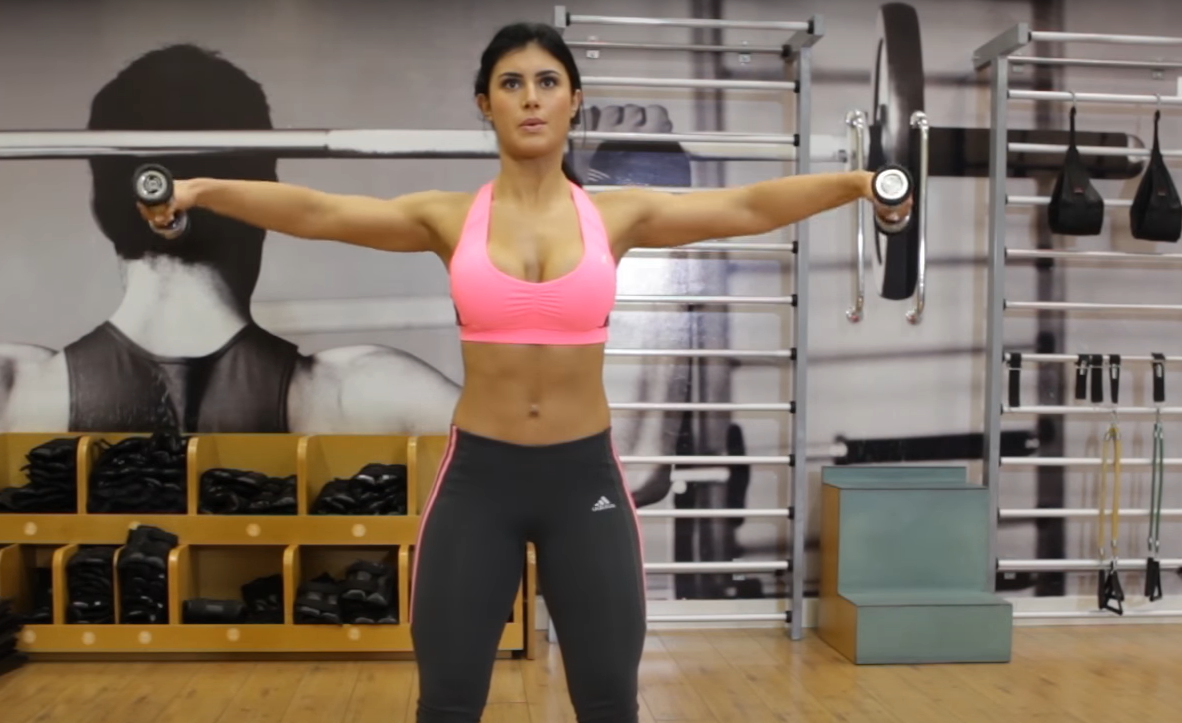
Raise both arms simultaneously outward and upward in the frontal plane, leading with the elbows rather than the hands. The slight forward tilt of the torso, approximately 10 to 15 degrees, naturally puts the medial deltoid in a better mechanical position to abduct the arm compared to a completely upright posture. As the arms rise, think about pouring water out of a jug: rotate the pinky side of the hand slightly upward at the top of the movement. This internal rotation of the shoulder maximally shortens the medial deltoid at the peak of contraction and produces a noticeably stronger muscle activation than raising with the thumbs up.
THE DESCENT AND TEMPO
Lower the dumbbells under control back to the starting position over 2 to 3 seconds. The eccentric (lowering) phase of lateral raises is commonly rushed, which throws away the training stimulus of the negative portion of the rep. Research on eccentric loading consistently shows it is a primary driver of muscle hypertrophy. A controlled 3-second descent on every rep of every set turns lateral raises into a significantly more productive exercise than the fast-up-fast-down approach most people default to.
THE MOST COMMON LATERAL RAISE MISTAKES AND HOW TO FIX THEM
USING TOO MUCH WEIGHT
Ego loading on lateral raises is one of the most counterproductive habits in shoulder training. When the weight is too heavy, the body compensates by recruiting the upper trapezius to shrug the shoulder into the raised position, by swinging the torso with momentum, and by reducing the range of motion. All three compensations shift load away from the medial deltoid and into structures that either do not benefit (momentum) or are already adequately trained by other exercises (traps from rowing). Most people need to cut their lateral raise weight by 30 to 50 percent from what they typically use and focus on strict technique before adding load back gradually.
RAISING ABOVE SHOULDER HEIGHT
The medial deltoid’s primary activation window is from the hip to shoulder height. Raising the arms significantly above shoulder height brings the upper trapezius and supraspinatus increasingly into play and can create subacromial impingement, particularly in athletes with pre-existing rotator cuff issues. Stop the movement when the arms reach parallel to the floor. Shoulder biomechanics research confirms that subacromial space narrows most significantly above 90 degrees of abduction, making the shoulder height ceiling a practical safety and efficacy guideline.
LEADING WITH THE HANDS INSTEAD OF ELBOWS
When the hands lead the movement upward rather than the elbows, the wrist and forearm become a significant part of the force production chain and the shoulder is no longer moving in clean frontal plane abduction. Keep a consistent mental cue throughout every set: push the elbows up and out, not the hands. This subtle difference in motor intention produces measurably better medial deltoid recruitment and is the correction most experienced coaches give to athletes who complain that lateral raises do not make their delts sore.
LATERAL RAISE VARIATIONS FOR COMPLETE MEDIAL DELTOID DEVELOPMENT
CABLE LATERAL RAISES
Cable lateral raises, using a low pulley with a single handle attachment, provide constant tension throughout the full range of motion that dumbbells cannot match. With a dumbbell, resistance is minimal at the bottom of the movement and maximal at the top. A cable maintains tension from the very start, maximizing the total time under tension across each rep. Ankle straps can be used on the low cable as a wrist attachment alternative for a slightly different feel. Cable laterals are particularly effective as a finisher after dumbbell lateral raises for a complete medial deltoid stimulus.
LEANING LATERAL RAISES
Stand next to a cable stack or pole and hold it with your non-working hand for support. Lean away from the anchor point so your torso is angled away from the direction of the raise. From this laterally tilted starting position, the working arm begins in an adducted position across the body, creating a significantly longer range of motion for the medial deltoid. This variation allows the muscle to work through a stretch position that the standard lateral raise bypasses, and the stretch position loading has strong evidence as a superior driver of muscle hypertrophy.
PLATE LATERAL RAISES
Holding a weight plate in each hand with arms straight (minimal elbow bend) is a variation that challenges the lateral deltoid differently due to the load distribution of the plate versus a dumbbell handle. The straight arm version also increases the lever arm challenge on the medial deltoid at heavier loads. Use lighter weight than dumbbell lateral raises and focus on a controlled tempo.
PROGRAMMING LATERAL RAISES FOR SHOULDER WIDTH
For medial deltoid hypertrophy, lateral raises are most effective in the moderate to high rep range of 12 to 20 reps per set, with 3 to 5 sets per session. The medial deltoid responds well to higher training volumes across a week, and lateral raises can be performed two to three times per week without significant recovery concerns given the relatively low systemic demand of the exercise. Include them after your primary compound pressing movements so the shoulder joint is warmed but the deltoids are not pre-fatigued enough to compromise pressing form and load.
Progressive overload applies to lateral raises just as it does to any other exercise, but progress in small increments. Moving from 15-pound to 20-pound dumbbells is a 33 percent load increase that will likely compromise technique significantly. Use microplates or 1.25-pound plate additions where available, or progress by adding reps before adding weight. Consistent lateral raise training two to three times per week for eight to twelve weeks produces visible shoulder width improvements that compound movements alone do not deliver. Protect the shoulder joint through heavier overhead and pressing sessions with elbow sleeves on pressing days to keep the joint healthy for the isolation work to pay off long-term.
FINAL WORDS
Side lateral raises are not a vanity exercise. They are the targeted solution to the medial deltoid development gap that almost every athlete has after years of training that prioritizes pressing and rowing. Do them with light weight and strict technique. Control the descent. Lead with the elbows, not the hands. Stop at shoulder height. Progress gradually and consistently. Add cable and leaning variations to cover the full strength curve of the muscle. Train them two to three times per week with adequate volume and you will see shoulder width changes within eight weeks that years of overhead pressing never produced. The medial deltoid responds predictably to the right stimulus. Give it that stimulus consistently.
Certified strength and conditioning specialists with over 10 years of experience in powerlifting, nutrition, and evidence-based fitness content. Based in New York City.