ADJUSTABLE WEIGHTLIFTING BELTS: HOW CLOSURE TYPES COMPARE AND WHEN TO CHOOSE ADJUSTABILITY
Adjustable weightlifting belts allow the tension to be modified at the closure mechanism to accommodate different training intensities, exercise types, and body composition changes across a training career without requiring a new belt. The adjustability feature is the primary practical advantage over fixed-position lever belts for athletes who train across a wide range of intensities in a single session, who train during periods of body composition change, or who share equipment across multiple athletes with different waist sizes. Understanding what adjustable closure types are available and what trade-offs each makes compared to the lever’s fixed-position consistency is the basis for choosing the right belt for a given training context.
PRONG BUCKLE: THE CLASSIC ADJUSTABLE CLOSURE
The prong buckle is the most common adjustable closure on leather and nylon lifting belts. A single-prong or double-prong buckle allows the tail of the belt to be threaded through the buckle and the prong to be inserted into the appropriate hole for the current training tension. The primary advantage is full adjustability: any hole position across the full belt length is available on any set. The primary disadvantage compared to the lever is application and removal speed: threading a prong belt takes 15 to 30 seconds per application versus five seconds for the lever. Research on belt tension and intra-abdominal pressure generation confirms that the IAP benefit of the belt comes from the tension at which it is closed, and prong belts can achieve equivalent tension to lever belts when correctly sized and properly tightened.
RATCHET AND VELCRO: FINER ADJUSTMENT, DIFFERENT TRADE-OFFS
Ratchet and velcro closures are the adjustable mechanisms most common on neoprene and softer fabric belts. Ratchet closures allow micro-adjustment of tension through a toothed mechanism that engages at any increment within its range, providing the fine tension control that neither prong nor lever belts offer. This makes ratchet-closure belts practical for functional fitness and CrossFit training where the belt is applied and removed across many different exercises within a single session at varying intensities. Velcro closures provide the most flexible tension range but the least consistent retention under sustained heavy loading, as velcro’s holding strength decreases under the peel force created by active core bracing against the belt during heavy compound lifts.
SIZING AN ADJUSTABLE BELT FOR MIDRANGE ENGAGEMENT
The correct sizing approach for adjustable belts differs from lever belt sizing because the prong or ratchet must engage at the middle of the available belt adjustment range at the correct training tension. If the belt is sized at the extreme of its adjustment range, the closure provides less adjustment capacity in the direction where body composition change or clothing variation might require additional tension modification. Measure the training waist at the iliac crest level and compare to the manufacturer’s sizing chart for the specific closure type, choosing the size that places the correct training tension at the midpoint of the available adjustment range.
THE NYLON ADJUSTABLE BELT FOR MULTI-INTENSITY SESSIONS
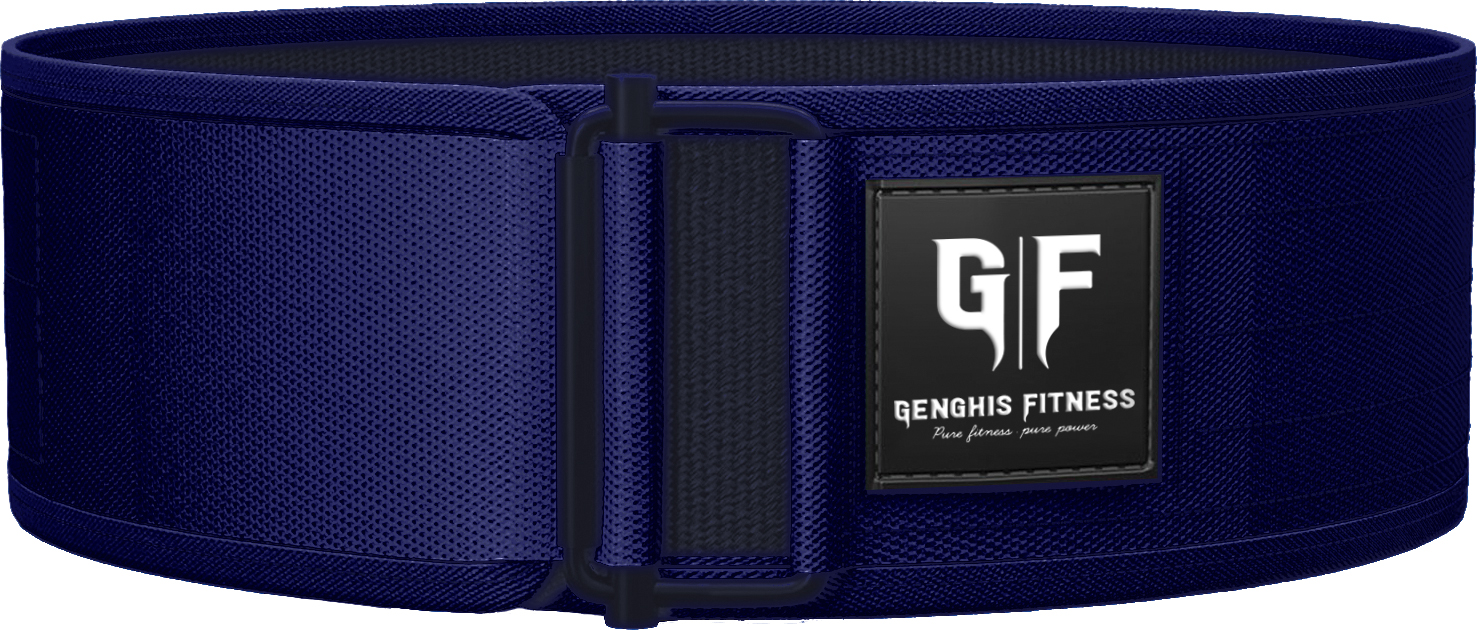
The Genghis Fitness nylon lifting belt uses a buckle closure that allows tension adjustment across the available belt hole positions, making it appropriate for athletes who want the convenience of tension modification without the session-to-session consistency of a lever closure. The nylon material provides breathability and immediate wearing comfort alongside the IAP support that makes belt use functionally beneficial. For athletes who train across a wide intensity range in a single session, from moderate-intensity accessory work to near-maximum compound lifts, the ability to adjust belt tension to match each exercise’s demands is a practical advantage over the lever’s single fixed tension.
WHEN THE LEVER CONSISTENCY ADVANTAGE OUTWEIGHS ADJUSTABILITY
Lever belts like the 10mm lever belt provide the consistency advantage that competitive and high-intensity training demands: the same tension on every set without the variation that prong threading or ratchet engagement can introduce between sets. For athletes whose training involves a narrow intensity range, typically heavy compound training above 80 percent of maximum where belt use is warranted, the lever’s consistency advantage over adjustable alternatives is meaningful for both spinal protection consistency and the reproducibility of the training stimulus from set to set across a training year.
BODY COMPOSITION CHANGE AND THE ADJUSTABILITY ADVANTAGE
Body composition change management is the use case where adjustable belts provide the most clear advantage over lever belts. An athlete in a significant mass gain phase, adding several inches to waist circumference over a training year, would need to have a lever belt repositioned or replaced as the circumference changes beyond the lever’s fixed-position range. An adjustable prong or ratchet belt accommodates this change through the available adjustment range without requiring replacement or hardware modification. Athletes in active body composition change phases benefit from adjustable closure types that accommodate the change without interrupting belt use. The same advantage applies in the reverse direction: athletes in a cut who are reducing waist circumference can continue using an adjustable belt through the full range of the cut without the lever position becoming incorrect, which would require the lever to be repositioned by a hardware professional or through the manufacturer.
MAINTENANCE FOR ADJUSTABLE CLOSURE MECHANISMS
Care and maintenance for adjustable leather and nylon belts follows the same principles as any belt of the respective material. Leather belts with prong closures require conditioning every four to eight weeks and the same post-session wiping protocol as any leather belt. Nylon belts with buckle or ratchet closures are more maintenance-tolerant: rinse after sessions where chalk and sweat accumulation is significant, air dry completely, and store flat. The adjustment hardware itself requires periodic inspection to confirm the prong is not bending under repeated use, the buckle teeth are not wearing to a rounded shape that causes slippage, or the ratchet mechanism is not developing play that reduces reliable engagement.
COMPLETE TRAINING SUPPORT ALONGSIDE AN ADJUSTABLE BELT
Pair any adjustable lifting belt with the complete lower body training support system for sessions that include both compound barbell work and accessory exercises. Knee sleeves throughout the full session for joint warmth. Lifting straps for heavy pulling work where grip management supports posterior chain training quality. The adjustable belt covers the lumbar spine protection across all exercises where the intensity and loading warrant it, with the advantage of matching the belt tension to each exercise’s specific demands when the training context benefits from this flexibility.
FINAL WORDS
Adjustable weightlifting belts offer the tension flexibility that fixed-position lever belts do not, making them the practical choice for athletes who train across wide intensity ranges in a single session, who are in active body composition change phases, or who share equipment across multiple athletes. The nylon belt with buckle closure, the neoprene belt with ratchet or velcro, and the leather belt with prong buckle each represent different points on the adjustability-consistency trade-off that the lever belt occupies at the consistency extreme. Choose the closure type that matches the primary training context and demands, size correctly at the iliac crest measurement, and use with deliberate active bracing on every heavy set where spinal protection is the reason for wearing it. The adjustability advantage is a practical equipment feature rather than a performance advantage over the lever at any given tension: at equivalent tension and bracing, an adjustable belt provides identical IAP benefit to a lever belt, and the choice between them is entirely a function of the session structure and life context in which the belt will be used across its training career.
Certified strength and conditioning specialists with over 10 years of experience in powerlifting, nutrition, and evidence-based fitness content. Based in New York City.
Explore the full weightlifting belt guides for lever belt comparisons, leather belt reviews, neoprene belt recommendations, sizing guides, and sport-specific belt selection across powerlifting, CrossFit, and Olympic lifting.