Ankle Straps for Cable Machine: How to Use Them and Which Exercises Work Best
An ankle strap for the cable machine is one of the most underutilized accessories in the gym. Most athletes walk past the cable stack for leg day and head straight to the squat rack, missing the fact that cable-loaded single-leg exercises provide a training stimulus the barbell simply cannot replicate. The constant tension of the cable through the full range of motion, the ability to work each leg independently, and the adjustability of resistance in small increments make cable ankle strap work genuinely complementary to any lower body program.
This guide covers how ankle straps work, the best exercises for glutes, hamstrings, hip abductors, and hip flexors, how to attach and position the strap correctly, and how to program cable ankle work alongside heavier compound training.
How Ankle Straps for Cable Machines Work
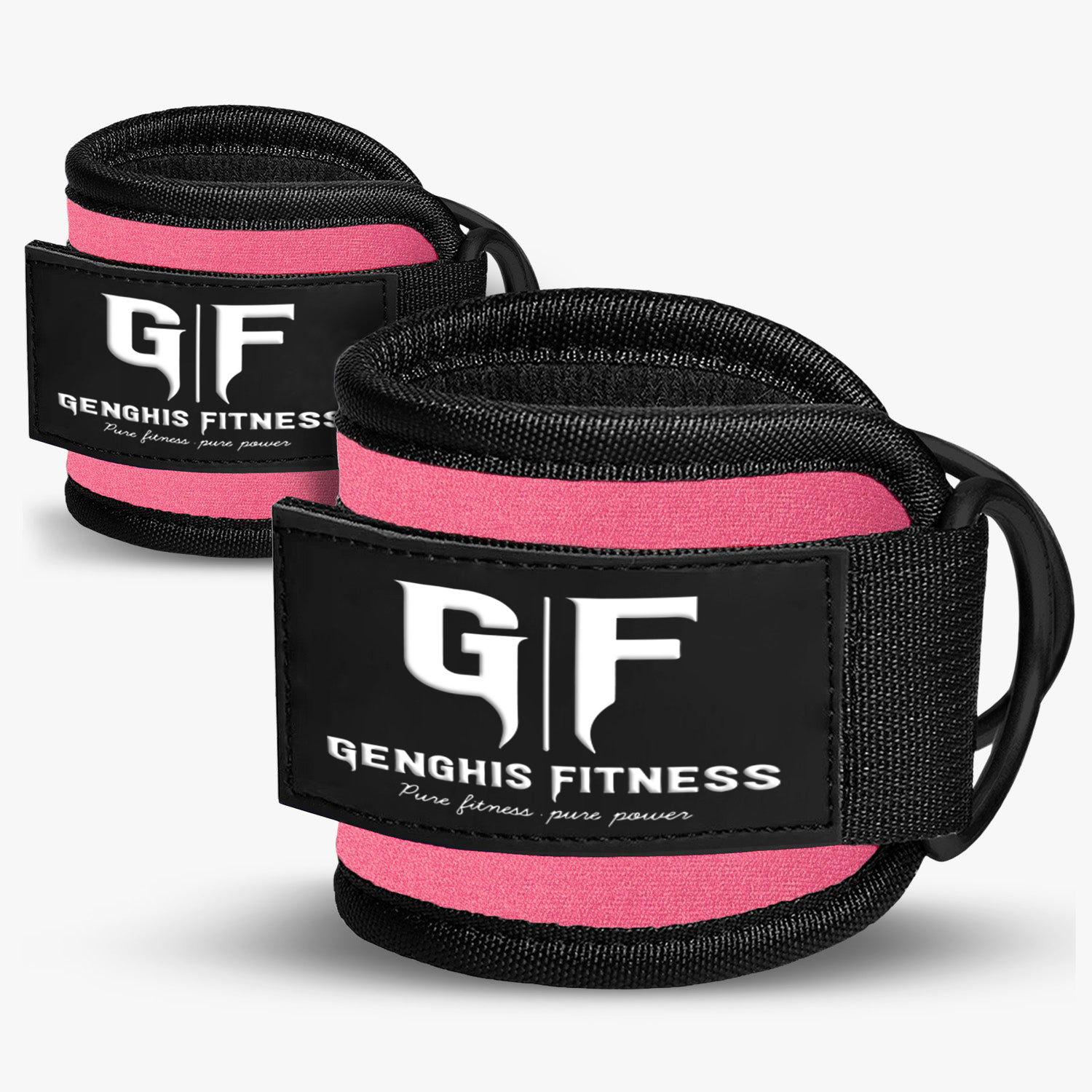
A cable ankle strap is a padded cuff that wraps around the ankle and attaches to the cable machine’s low pulley via a D-ring or carabiner. The padded cuff distributes the cable tension across the ankle and lower shin rather than concentrating it on a narrow band of skin. The attachment point on the strap aligns the cable pull direction with the intended line of resistance for each exercise.
The low pulley setting is used for most ankle strap exercises because it places the cable below the level of the working leg, creating the upward or outward resistance direction that loads hip extension, hip abduction, and hip flexion through a full range of motion. The Genghis Fitness ankle straps for cable machine are built with sufficient padding and a secure attachment to handle the loading demands of these exercises at working weights.
The Best Cable Ankle Strap Exercises
Cable Kickback
Stand facing the cable machine with the strap on one ankle and the cable attached to the low pulley. Hold the machine frame lightly for balance. Keeping a slight bend in the standing leg, drive the strapped leg back and upward, squeezing the glute hard at the top position. Control the return. The cable provides resistance through the full range of hip extension, including at the fully extended top position where free weight glute exercises lose tension. Three sets of 12 to 15 repetitions per leg.
Cable Hip Abduction
Stand sideways to the cable machine with the strap on the ankle of the leg farthest from the machine. Drive that leg directly out to the side against the cable’s resistance, keeping the torso upright and the standing leg slightly bent. Pause at the top and control the return. This directly trains the gluteus medius through hip abduction with a resistance level that can be adjusted precisely, unlike resistance bands where increments are limited to the available band colors. Three sets of 12 to 15 repetitions per side.
Cable Hip Adduction
Stand sideways to the cable with the strap on the ankle of the leg closest to the machine. Bring that leg across the midline of the body against the cable’s resistance, then return. This trains the hip adductors, which are frequently neglected in lower body programs despite being important for groin injury prevention and medial knee stability during squatting and lunging movements.
Cable Leg Curl
Attach the strap to one ankle and face the cable machine. Holding the frame lightly, curl the heel of the strapped leg toward the glute against the cable’s resistance while keeping the knee stationary. This isolates the hamstrings through knee flexion in the same pattern as a machine leg curl. The cable version allows unilateral training and a resistance curve that challenges the hamstrings through the full curl range rather than just the bottom half.
Cable Hip Flexion
Stand facing away from the cable machine with the strap on one ankle. Drive the knee of the strapped leg upward toward the chest against the cable’s resistance. This trains the hip flexors, primarily the iliopsoas and rectus femoris, which are important for sprinting speed, high knee running mechanics, and the recovery phase of the stride in athletic movements. Three sets of 12 to 15 repetitions per leg.
Cable Pull-Through
While not technically an ankle strap exercise, the cable pull-through using a rope attachment at the low pulley targets the glutes and hamstrings through a hip hinge pattern identical to the Romanian deadlift. Paired with ankle strap isolation work, it covers the full posterior chain in a cable-only lower body session.
How to Attach and Position the Ankle Strap
Wrap the strap around the ankle above the ankle bone, not across the joint itself. The padded section of the strap should cover the lower shin, and the D-ring attachment point should sit on the back or outside of the ankle depending on the exercise direction. For kickbacks and hip extensions, the ring faces backward. For abduction and adduction, the ring faces the cable machine.
Secure the velcro closure firmly. A strap that comes loose mid-set not only interrupts the exercise but can cause a sudden unloaded movement if the ankle detaches from the resistance abruptly. Check that the velcro is fully engaged before beginning each set.
The cable attachment should connect to the D-ring cleanly with the carabiner gate closed. Open carabiner gates under load can cause the attachment to release. Check the gate after every re-attachment.
Setting the Cable Height
Most cable ankle strap exercises use the lowest pulley setting. This positions the cable below the working leg and creates the upward or outward resistance direction that loads the target muscles correctly. For hip flexion exercises where the knee is being driven upward, the low pulley provides resistance against the upward movement correctly.
For more advanced variations, some athletes adjust the pulley height to change the angle of resistance. A mid-height pulley for cable kickbacks creates a more horizontal resistance direction that loads the glute differently through the range. Experiment with pulley heights once the basic exercises are established to find the angles that provide the best stimulus for your anatomy.
How to Program Ankle Strap Exercises
Cable ankle strap work fits best as accessory or finishing work after the main compound exercises of a lower body session. Heavy barbell squats and deadlifts train the primary movers at high loads. The ankle strap exercises then target the gluteus medius, hip flexors, and hamstrings in isolation at moderate resistance and higher rep ranges.
A sample lower body session structure: barbell squats with knee sleeves and a powerlifting leather belt for the main work, followed by Romanian deadlifts for hamstring volume, then cable kickbacks, cable hip abduction, and cable leg curls as isolation finishers. The compound work builds the primary strength. The cable isolation work addresses the smaller muscles that compound lifts underdevelop.
Pairing with Hip Circle Bands
Hip circle bands and cable ankle straps are complementary tools for the same muscle groups. The Genghis Fitness hip circle bands are used for bodyweight activation and warm-up exercises before loaded training. The ankle straps allow heavier loaded isolation work at the cable machine with precise resistance adjustment. Using both in the same lower body session covers the activation, warm-up, and loaded isolation phases comprehensively.
Choosing a Quality Ankle Strap
The ankle padding is the most important quality variable. Thin or stiff padding causes discomfort at the shin and ankle during exercises where the strap contacts the bone or joint directly. Look for straps with neoprene or foam padding that distributes the load across the contact area. The velcro closure should span the full width of the strap to hold position securely during dynamic movements.
The D-ring and its attachment stitching are the highest-stress components. A D-ring that rotates freely allows the strap to orient toward the cable direction naturally rather than pulling at an awkward angle. Stitching around the D-ring attachment should be reinforced with multiple passes or a bar-tack pattern to handle the loading of working sets across a long training career.