Genghis Fitness · Shoulder Training
Arnold Press Workout: Technique Breakdown, Deltoid Activation Research, How It Compares to Standard Overhead Press, and Programming
Updated 2026 | By Team Genghis Fitness | 22 min read
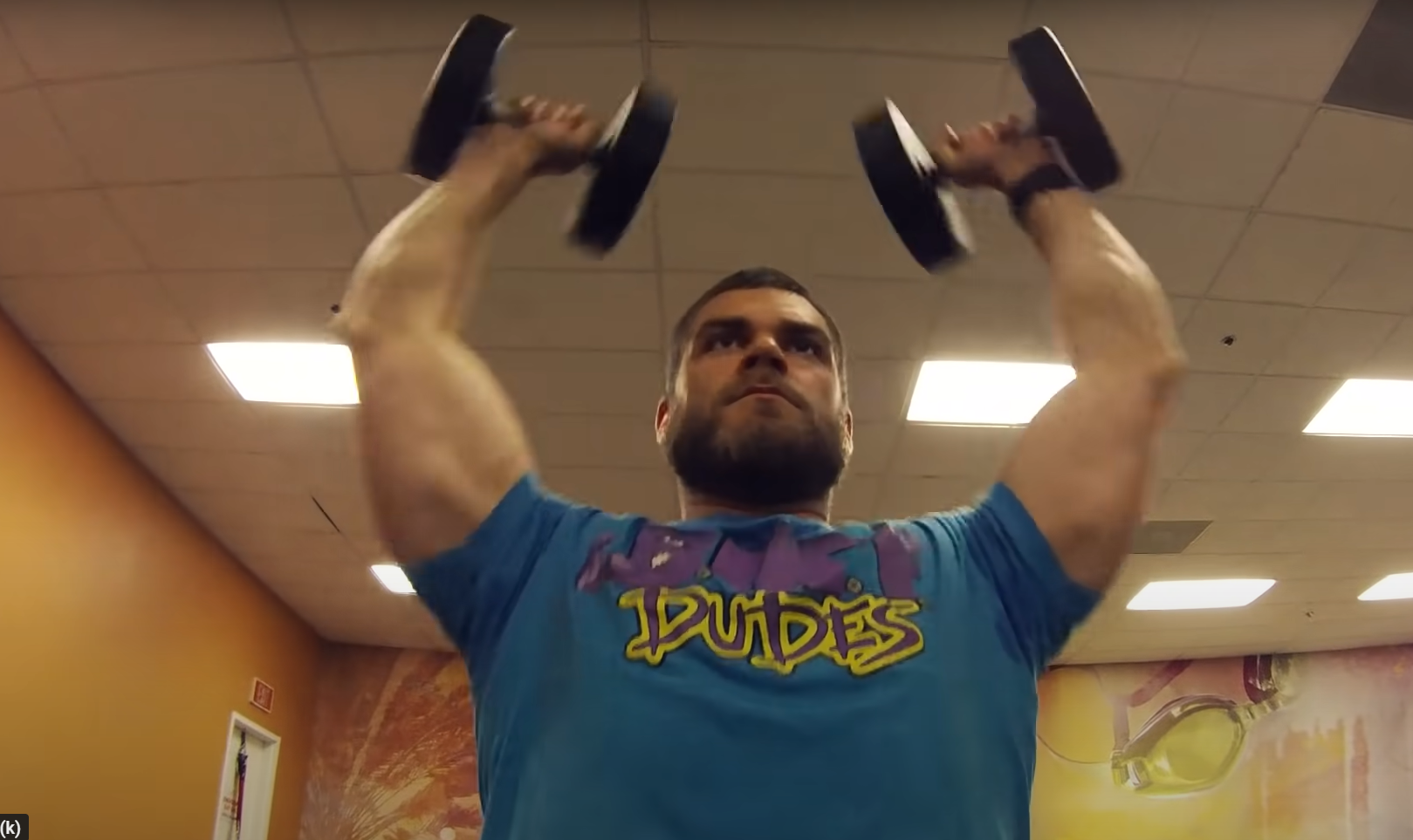
The Arnold press, created by and named after Arnold Schwarzenegger, is a dumbbell shoulder press variation that adds a rotational component to the standard overhead press: the dumbbells start in a palms-facing-you position at chin height (as if at the top of a bicep curl) and rotate to palms-facing-forward as they press overhead. This rotation extends the range of motion at the shoulder joint compared to a standard dumbbell press and claims to activate all three deltoid heads through the rotational arc. The claim is partially but not entirely supported by the research, and understanding exactly what the Arnold press does and does not do helps athletes decide whether it belongs in their shoulder training program.
The Rotation Mechanism and Deltoid Activation
The rotational component of the Arnold press produces internal-to-external rotation of the humerus as the dumbbell travels from the starting supinated (palms-in) position to the ending pronated (palms-forward) position. This rotation engages the infraspinatus and teres minor (external rotators of the shoulder) more than a standard overhead press where the rotation is absent. The starting position also places the anterior deltoid in a pre-stretched position with horizontal adduction, potentially increasing its stretch-mediated activation at the start of the press.
EMG research comparing the Arnold press to standard dumbbell overhead press, including studies published in the Journal of Strength and Conditioning Research on overhead pressing variations, shows that the Arnold press produces comparable anterior and lateral deltoid activation to the standard dumbbell press but with additional rotator cuff involvement during the rotation phase. The claim that the Arnold press uniquely trains all three deltoid heads is not as strongly supported as popular gym knowledge suggests; the posterior deltoid is best trained through horizontal pulling movements (face pulls, rear delt flies) rather than overhead pressing variations regardless of rotation.
Arnold Press vs Standard Overhead Press: Which Is Better?
For maximum shoulder strength development, the barbell or dumbbell overhead press produces the highest absolute loads and the strongest progressive overload stimulus. The Arnold press cannot be performed with the same loads as a standard press because the rotational component limits the loads that can be safely controlled through the full range. This makes the Arnold press a hypertrophy-oriented shoulder exercise rather than a maximum strength builder.
The Arnold press has advantages over the standard dumbbell press in two specific areas: greater time under tension from the longer range of motion (the rotational start adds approximately 20 to 30 degrees of additional shoulder movement), and the rotator cuff engagement during the rotation phase, which builds rotator cuff endurance that supports shoulder health. Athletes who have high-volume dumbbell pressing as their primary shoulder work can rotate between standard overhead press and Arnold press to provide variation in the stimulus while maintaining similar overall deltoid volume. Our complete shoulder training framework is in our shoulder workouts guide.
Correct Arnold Press Technique
Start: sit on a bench with back support, holding dumbbells at chin height with palms facing toward you, elbows bent and pointing forward. The starting position looks like the top of a bicep curl. Begin the press by simultaneously rotating the dumbbells outward (so palms rotate to face forward) while pressing overhead. At the top, palms face forward or slightly outward and arms are fully extended overhead. Lower by reversing the rotation, bringing the dumbbells back to the starting supinated position at chin height with control.
Critical technique point: the rotation should be smooth and continuous throughout the press rather than completing the rotation first and then pressing, or pressing first and then rotating. The simultaneous rotation and press is what creates the distinctive movement arc. Use wrist wraps for heavier Arnold press sets to maintain wrist stability through the rotational range.
Programming the Arnold Press
The Arnold press works best as a secondary shoulder exercise following a primary barbell or dumbbell overhead press rather than as the main shoulder movement. Sets of 10 to 15 reps at 60 to 70 percent of maximum dumbbell press weight allow the full rotational range to be completed with control on every rep. 3 to 4 sets twice per week provides adequate volume for shoulder development without exceeding recovery capacity. The slower tempo required for the rotation (2 to 3 seconds per rep) makes it more time-under-tension-intensive than equivalent sets of standard pressing, so slightly lower rep counts than standard pressing are appropriate.
Frequently Asked Questions
Is the Arnold Press Bad for the Shoulders?
The Arnold press is safe for athletes with healthy shoulders when performed with appropriate load and controlled technique. The rotation phase does increase rotator cuff demand, which is generally beneficial for rotator cuff strength and endurance. Athletes with existing rotator cuff injuries or shoulder impingement should have the Arnold press evaluated by a physiotherapist before including it, as the rotation under load may be contraindicated for specific pathologies. For healthy athletes, the Arnold press is a useful shoulder variation with a lower injury risk profile than many other shoulder exercises.
Can You Build Big Shoulders Using Only the Arnold Press?
Yes, the Arnold press provides sufficient stimulus for significant shoulder hypertrophy when programmed with adequate volume and progressive overload. However, most athletes who prioritise shoulder development will make faster progress by pairing the Arnold press with heavier barbell pressing (for maximum strength and overload stimulus) and targeted rear delt work (for posterior deltoid that the Arnold press does not optimally train). The Arnold press as the sole shoulder exercise will produce good results at moderate weights but limits the maximum load that can be progressively overloaded compared to barbell alternatives.
Press. Rotate. Build the Shoulders That Turn Heads.
Wrist wraps for heavy pressing in any variation. Built for the serious athlete.
Shop Wrist Wraps Shop Lifting BeltProgramming Arnold Press Frequency And Volume For Shoulder Growth
The Arnold press earns its place in a shoulder program by covering more of the deltoid through a single movement than any standard overhead press variation. The rotation from a palms-facing starting position to a palms-forward finish activates the anterior deltoid through a longer range of motion while also recruiting the medial deltoid during the rotation phase in a way that a standard dumbbell overhead press does not replicate. For athletes looking to develop visible shoulder roundness and size rather than purely overhead pressing strength, the Arnold press provides more complete stimulus per set than any single standard pressing variation.
Program Arnold presses as your primary overhead movement on a shoulder day or as a secondary movement after heavier barbell pressing. Sets of eight to twelve reps at a moderate load where the rotation remains controlled and the elbows track properly through the range of motion produces the most complete deltoid stimulus. Avoid going so heavy that the rotation becomes a momentum-driven half-rotation rather than a deliberate arc through the full range. The value of the movement is entirely in the controlled rotation, so if your working weight forces you to skip or rush that phase, reduce the load and prioritize mechanics. Three to four working sets twice per week, paired with rear delt work to balance the anterior emphasis, builds complete deltoid development that shows from every angle. Use wrist wraps on your heavier Arnold press sets to reduce wrist fatigue from the sustained load during the rotation phase.
Certified strength and conditioning specialists with over 10 years of experience in powerlifting, nutrition, and evidence-based fitness content. Based in New York City.
SHOULDER GEAR THAT PREVENTS BREAKDOWN
Wrist wraps eliminate wrist deviation under load. Elbow sleeves keep the joint warm and supported every rep.
Elbow Sleeves