BENEFITS OF WEIGHTLIFTING WRIST WRAPS: WHAT THEY DO AND WHY SERIOUS ATHLETES USE THEM
Weightlifting wrist wraps provide a specific and well-documented benefit for athletes who train with heavy loads in pressing, overhead, and curling exercises where wrist joint stress accumulates under sustained loading. The benefits extend beyond simple wrist protection into performance, technique consistency, and the ability to train heavy pressing volume at the frequencies that produce genuine strength development. Understanding exactly what wrist wraps do, the exercises where they provide the most meaningful benefit, and how to use them correctly for maximum effect is the basis for including them strategically rather than as a general accessory worn on every set of every pressing exercise regardless of whether the specific exercise and loading level warrant the support.
JOINT PROTECTION: HOW WRIST WRAPS PREVENT HYPEREXTENSION INJURY
The wrist joint must maintain a neutral or only slightly extended position to transmit pressing force from the forearm to the bar efficiently. When heavy loading causes the wrist to hyperextend beyond comfortable neutral, the stress concentrates in the posterior wrist capsule and the tendons and ligaments at the back of the wrist joint. Research on wrist joint mechanics during loaded pressing identifies wrist hyperextension as a primary mechanism of acute wrist injury and cumulative wrist joint degeneration in strength athletes. Wrist wraps applied at firm tension resist this hyperextension by providing circumferential support that limits how far the wrist can extend under pressing load, keeping the joint closer to the neutral alignment that protects the posterior structures and maintains the most efficient force transmission angle from forearm to bar.
PERFORMANCE BENEFIT: ELIMINATING NEURAL INHIBITION FROM WRIST INSTABILITY
The most significant performance benefit of wrist wraps is the confidence and stability they provide during maximum effort pressing. When the wrist is unstable under a near-maximum bench press or overhead press, the nervous system perceives this instability as a safety risk and reduces force output to protect the joint. This is the neural inhibition that prevents athletes from pressing their maximum capacity even when the primary muscles are capable of the effort. Wrist wraps eliminate the instability signal, allowing maximum neural drive to the pressing musculature without the protective inhibition that an unstable wrist generates. Athletes who begin using wrist wraps on their heaviest pressing sets frequently report immediate improvements in how heavy the top-end loads feel, not because the muscle strength has changed but because the neural inhibition from wrist instability has been removed.
THE EXERCISES WHERE WRIST WRAPS PROVIDE THE MOST BENEFIT
Exercises that most benefit from wrist wrap support include: heavy barbell bench press where the wrist bears the full barbell weight in a direct downward press; overhead press where the wrist must maintain alignment against both the pressing force and the tendency of the bar to travel backward; Olympic lifting receiving positions where the wrist must absorb significant impact force in the catch; arm blaster curls and heavy freestanding curls where the extended wrist position under heavy loading creates posterior wrist stress; and any pushing, pressing, or curling exercise where wrist discomfort during or after training indicates that the loading is exceeding comfortable wrist joint tolerance at current training weights.
WHEN TO USE WRAPS AND WHEN TO TRAIN WITHOUT THEM
Wrist wraps are not necessary or appropriate for every exercise in every session. Light to moderate pressing and pulling work below 70 percent of maximum is adequately handled by the wrist’s intrinsic stability mechanisms without external support. Lighter sets below this threshold are also an opportunity to maintain and develop the wrist intrinsic stability that makes wrap-supported heavy training most effective. Athletes who wrap on every set of every pressing exercise from warm-up to working sets may develop reduced intrinsic wrist stability over time, as the external support replaces rather than supplements the work that the intrinsic stabilizers would otherwise perform. The effective protocol: wraps on sets above 75 to 80 percent of pressing maximum, lighter sets without wraps.
WRIST WRAP CONSTRUCTION QUALITY AND SERVICE LIFE
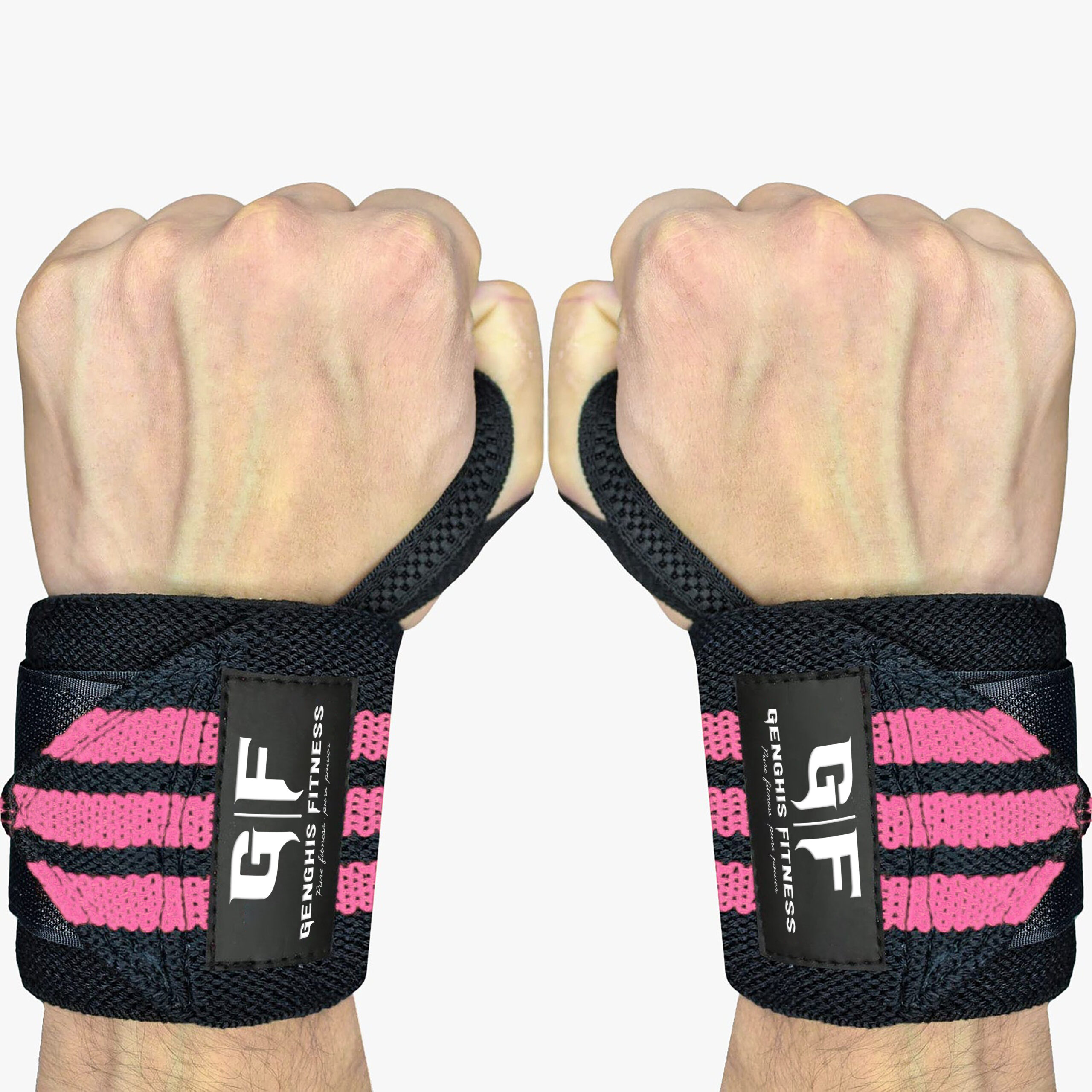
The Genghis Fitness wrist wraps are built from elastic-cotton blends that provide adjustable support tension through the velcro closure. Firm wrapping for maximum support during the heaviest pressing and Olympic lifting sets. Moderate tension for pressing accessory work at moderate loads. The wrap length allows two to three complete passes around the wrist for the compression that provides meaningful joint stability. Quality wrist wraps maintain their elastic tension across hundreds of application cycles, unlike budget wraps that lose their tension within months of regular use and provide decreasing support over the training year that makes them an increasingly inadequate investment.
PROPRIOCEPTIVE ENHANCEMENT FROM WRIST COMPRESSION
Research on wrist joint compression and proprioception during loaded movements identifies a second benefit of wrist wraps beyond direct joint support: the compression of the wrap activates mechanoreceptors in the wrist joint and surrounding tissue that improve proprioceptive feedback about wrist position during the pressing movement. This enhanced proprioceptive awareness improves the athlete’s ability to maintain correct wrist alignment during the press without conscious attention, allowing focus to remain on the primary technique elements of the movement rather than on wrist position management. Athletes who train without wraps and then begin using them sometimes report that their pressing form feels more stable and consistent, which partly reflects this proprioceptive enhancement alongside the direct joint support benefit.
HOW TO APPLY WRIST WRAPS CORRECTLY
Apply wrist wraps correctly for the full joint support benefit. Extend the wrist to the position you would use when pressing, not the fully neutral position at rest. Apply the wrap starting from the middle of the wrap length around the wrist at this extended position with firm, consistent tension. Do not wrap so tightly that sensation or circulation in the hand is reduced, which indicates the wrap is impeding blood flow. The wrap should feel firmly supportive around the joint without creating numbness or tingling in the fingers. Remove wraps between exercises and between heavy sets to allow normal circulation and to prevent the extended compression that would be appropriate only during the set itself from continuing unnecessarily during rest periods.
WRIST WRAPS IN A COMPLETE UPPER BODY SUPPORT SYSTEM
Wrist wraps work best as part of a complete upper body support system that addresses every joint under heavy loading in a pressing and pulling session. A quality lever belt for lumbar support during any heavy barbell work with significant spinal loading. Elbow sleeves for joint warmth throughout the session. The arm blaster for isolated bicep work with strict elbow positioning. Knee sleeves on any lower body session that accompanies or follows pressing work in a full-body training approach. Each tool addresses the specific joint stress of the exercises in its category. Together they create the comprehensive joint protection environment that allows consistent high-intensity training without the accumulated joint discomfort that prevents athletes from training at the frequencies that produce genuine long-term strength development.
FINAL WORDS
The benefits of weightlifting wrist wraps are real, specific, and well-supported by both research evidence and consistent practical application across decades of strength sports. Wrist joint protection through resisting hyperextension under heavy pressing load. Performance enhancement through elimination of neural inhibition from wrist instability at maximum pressing effort. Proprioceptive improvement through compression-activated joint awareness. Confidence increase from stable wrist feel during top-end training loads. The Genghis Fitness wrist wraps deliver these benefits through elastic construction that maintains tension across regular training use. Use them on the heaviest pressing sets. Apply with correct tension. Pair with complete joint support equipment for every session where heavy loading demands it.
Certified strength and conditioning specialists with over 10 years of experience in powerlifting, nutrition, and evidence-based fitness content. Based in New York City.
The complete knee sleeves, wraps and joint support guides answers every joint support question: when to use sleeves vs wraps and which compression suits powerlifting and CrossFit.