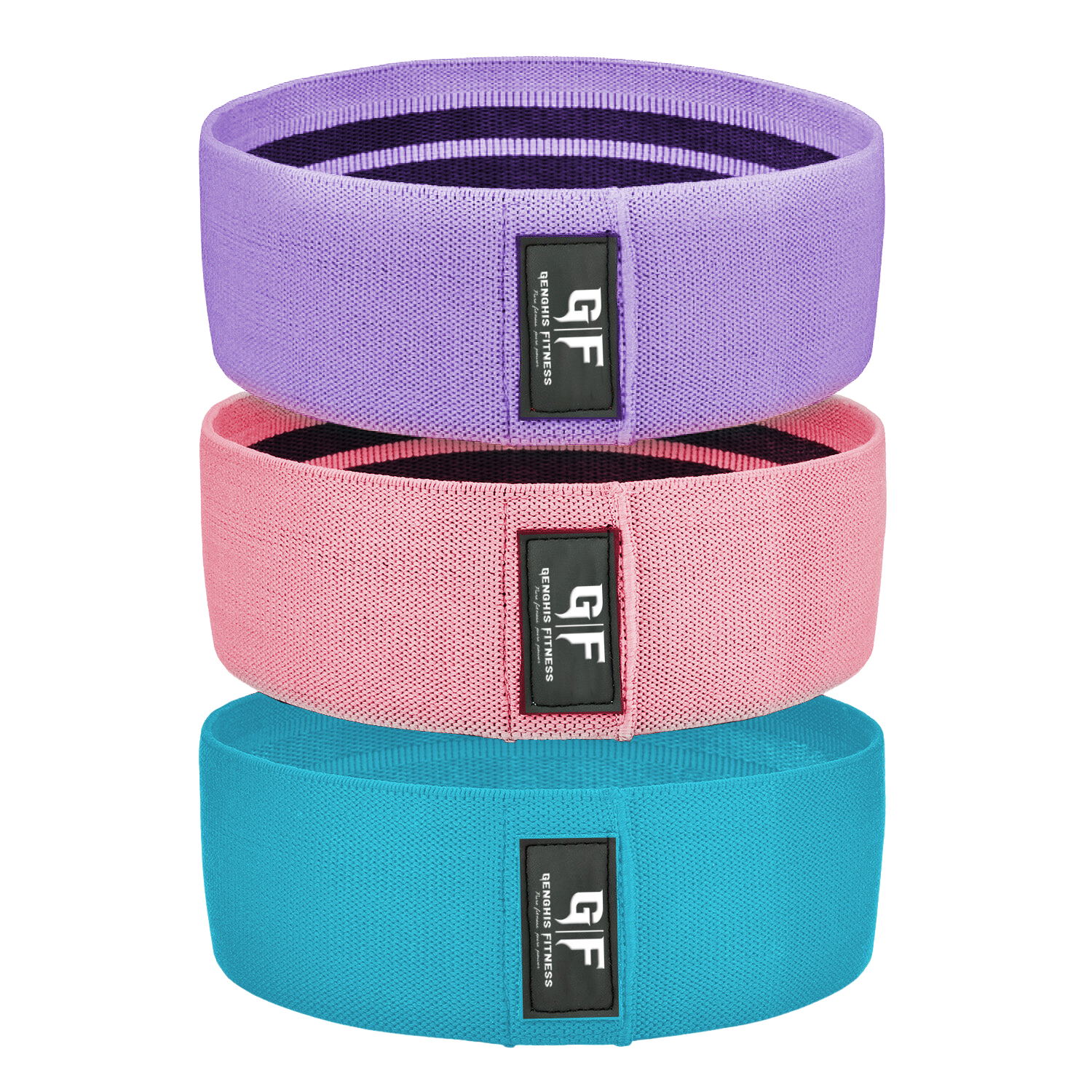
Fabric Workout Bands: Why They Beat Latex Loops and How to Use Them Effectively
Resistance bands split into two main categories at the material level: latex loops and fabric bands. For a long time, latex was the default because it was cheap to manufacture and provided good resistance. The problem with latex bands, especially in lower body and hip work, is that they roll, bunch, and dig into the skin during dynamic movements. Fabric workout bands solve all three of those problems. They stay flat, grip the skin or clothing without sliding, and are comfortable across high-rep sets and long training sessions.
This guide covers how fabric bands are constructed, where they outperform latex, the exercises they are best suited for, and how to choose the right resistance levels for a complete lower body and activation program.
How Fabric Bands Are Constructed
Fabric workout bands are typically made from a woven outer layer of polyester, cotton, or a blend, combined with latex or elastic rubber strands running through the interior of the band. The fabric exterior is what distinguishes them from standard latex loop bands. It provides the non-slip surface that stays in position during movement and the skin-friendly contact that makes them comfortable for direct skin contact or worn over clothing.
The resistance comes from the elastic strands inside the fabric shell. The number of strands, their thickness, and the material determine the resistance level of the band. Higher-quality fabric bands use more elastic strands and tighter weave construction to deliver consistent, smooth resistance across the full range of motion without the snap-or-slack feel of cheaper single-strand latex loops.
Where Fabric Bands Beat Latex
No Rolling or Bunching
The most common complaint about latex loop bands in lower body work is that they roll into a rope shape during lateral walks and squats, creating a narrow line of uncomfortable pressure against the skin or clothing rather than distributing the resistance across the band’s full width. The fabric construction prevents this. The woven exterior holds the band’s shape flat throughout the movement, maintaining even resistance distribution regardless of how the band twists or stretches.
Non-Slip Grip
The fabric surface grips clothing and bare skin without the slipping that latex produces when it contacts smooth fabric like compression tights or gym shorts. For exercises where the band needs to stay in one position, such as above the knee for squat activation or around the ankles for lateral walks, the non-slip property means the band stays where you put it without constant repositioning.
Skin Comfort
Latex bands on bare skin create friction that becomes genuinely unpleasant during high-rep sets. The fabric exterior of woven bands is soft against the skin and does not cause the same abrasion. This matters most for hip circle work above the knees, ankle band work, and any exercise where the band contacts skin rather than clothing for the full duration of a set.
The Best Exercises for Fabric Workout Bands
Squat and Hip Activation
Placing a fabric band above the knees for banded squats, lateral walks, clamshells, and glute bridges activates the hip abductors before loaded squatting. This is the most common use case for fabric bands in strength training. The non-slip property means the band stays above the knees through the full range of the lateral walk, including the hip drop at the end of each step that causes latex bands to slide down.
Glute and Hip Thrust Variations
Banded hip thrusts with a fabric band above the knees add hip abductor demand to the primary hip extension pattern. Push the knees out against the band throughout the full rep. The smooth resistance of a quality fabric band makes this more comfortable across a high-rep set than a latex band that digs into the quad above the knee at the contracted position.
Ankle Resistance Work
Some fabric bands are wide enough to use around the ankles for donkey kicks, fire hydrants, and standing hip abduction exercises. The non-slip fabric prevents the band from sliding down the ankle during the range of motion. The Genghis Fitness hip circle bands are designed for hip-level use, and pairing them with the ankle straps for cable machine covers both hip-level band work and ankle-attachment cable exercises in the same training session.
Upper Body Activation and Mobility
Fabric bands are effective for shoulder external rotation activation, pull-apart warm-up work, and rotator cuff exercises that use light resistance through a large range of motion. The fabric construction is comfortable for wrist and forearm contact during pull-aparts and face pulls performed with a band rather than a cable.
Choosing Resistance Levels
Fabric bands typically come in sets of three to five resistance levels. The naming conventions vary by brand, but a common system uses color coding from lightest to heaviest. Building a complete set gives you the flexibility to match resistance to the exercise and your current strength level for each movement.
- Light: appropriate for shoulder mobility work, upper body activation, and beginners starting hip activation work
- Medium: the workhorse for banded squats, lateral walks, and clamshells in intermediate training
- Heavy: appropriate for hip thrusts, glute bridges, and any exercise where the target muscle is strong enough that medium resistance no longer provides a training stimulus
- Extra heavy: used by advanced athletes for stationary exercises and by those working around the hip and glute area with highly developed strength in those patterns
When in doubt, start with a lighter band. Maintaining perfect mechanics with the correct band is more productive than fighting excessive resistance with compensated form.
Durability and What to Look For
Fabric band durability varies significantly by construction quality. The failure point in most fabric bands is the elastic interior strands, which can snap if the band is overstretched consistently or if the fabric exterior frays at the edges and exposes the interior to friction. Quality indicators include tight, even weave construction with no loose threads at the edges, smooth resistance curve without sudden tension changes mid-stretch, and stitching or hemming at the ends of the band where fraying begins.
Avoid bands where the fabric stretches more than the elastic interior allows, which creates a loose fabric outer shell that provides no additional support. The fabric and the elastic should stretch together so the band feels smooth and integrated throughout its full range.
Care Instructions
Machine wash fabric bands in cold water on a gentle cycle. Place them in a mesh laundry bag to prevent tangling and reduce abrasion against other items. Air dry flat. Do not tumble dry or expose to direct heat, as this degrades the elastic strands inside the fabric shell. Most fabric bands can be washed after every 3 to 5 sessions to maintain hygiene without degrading the material.
Pairing with Heavier Training Equipment
Fabric bands belong in the warm-up and activation phase of lower body sessions. After completing banded activation work, the Genghis Fitness knee sleeves go on for the loaded squatting sets and the Genghis Fitness powerlifting leather belt handles core bracing for the heaviest barbell work. The fabric band activates. The sleeves support. The belt braces. Each piece of equipment serves its specific role in the session.
Summary
Fabric workout bands are a genuine improvement over latex loops for lower body activation, hip work, and any exercise where the band contacts skin or smooth clothing. They stay flat, do not roll, and are comfortable across long sets. Used with the same progressive structure applied to other training tools, they build hip abductor strength that carries directly into better squat mechanics, more stable single-leg movements, and reduced knee valgus under load.