HEAVY DUTY WEIGHT LIFTING HOOKS: WHAT MAKES THEM DIFFERENT AND WHEN TO USE THEM
Heavy duty weight lifting hooks are hook designs rated for the highest loading ranges in accessory and moderate-intensity compound pulling training. The distinction between standard and heavy duty hooks is primarily in the steel grade and cross-sectional thickness of the hook hardware, which determines the maximum static and dynamic load the hook can sustain without the surface cracking, deformation at the bar contact curve, or strap attachment point failure that lower-grade hook hardware develops under sustained heavy loading. For athletes who train rows and shrugs at heavy loading across multiple sets per session, heavy duty hook construction is the specification that prevents the hardware degradation that standard hooks develop faster under high-frequency heavy use.
STEEL SPECIFICATION: THE PRIMARY HEAVY DUTY DISTINCTION
The steel specification determines the primary performance difference between standard and heavy duty lifting hooks. Standard hooks often use cast steel or soft alloy at grades that provide adequate performance for moderate loading but develop micro-fractures and surface deformation under the repeated dynamic loading of heavy barbell rows and shrugs across multiple sessions per week. Heavy duty hooks use higher-grade steel, either solid machined or forged, at thicknesses that distribute the dynamic loading of each rep across more material cross-section, reducing peak stress concentration at any single point in the hook geometry. Research on metal fatigue under cyclic loading conditions confirms that material grade and cross-section thickness are the primary determinants of fatigue life under repeated dynamic loading, directly supporting the heavy duty designation’s functional significance.
BAR CONTACT SURFACE: WIDTH AND CURVE RADIUS
The bar contact surface of heavy duty hooks should have adequate width and smooth curvature to distribute the bar loading across a meaningful contact area rather than concentrating it at a single point or edge. A hook curve that is too narrow concentrates the full bar weight at a small contact area that both damages the bar knurling and creates high stress concentration in the hook material at the contact point. A properly radiused hook curve of adequate width distributes the same load across several centimeters of contact area, reducing both the local stress in the hook and the force applied to the bar knurling per unit area.
WRIST STRAP RATING: THE CRITICAL WEAK LINK CHECK
The wrist strap of heavy duty hooks must be rated to match the hook hardware’s load capacity. A heavy duty steel hook attached to a wrist strap that frays or fails under the same loading that the hook hardware is designed to sustain creates a safety mismatch where the protection of the heavy duty specification is undermined by the weak link of an inadequately rated strap. Quality heavy duty hooks use reinforced neoprene or nylon webbing wrist straps with doubled stitching at the hook attachment point, rated for the loading range the hook hardware is designed to serve. Inspect the wrist strap attachment point specifically in heavy duty hook safety reviews, as this is where strap failure most commonly occurs under heavy loading.
THE GENGHIS FITNESS HOOKS: CONSTRUCTION ASSESSMENT
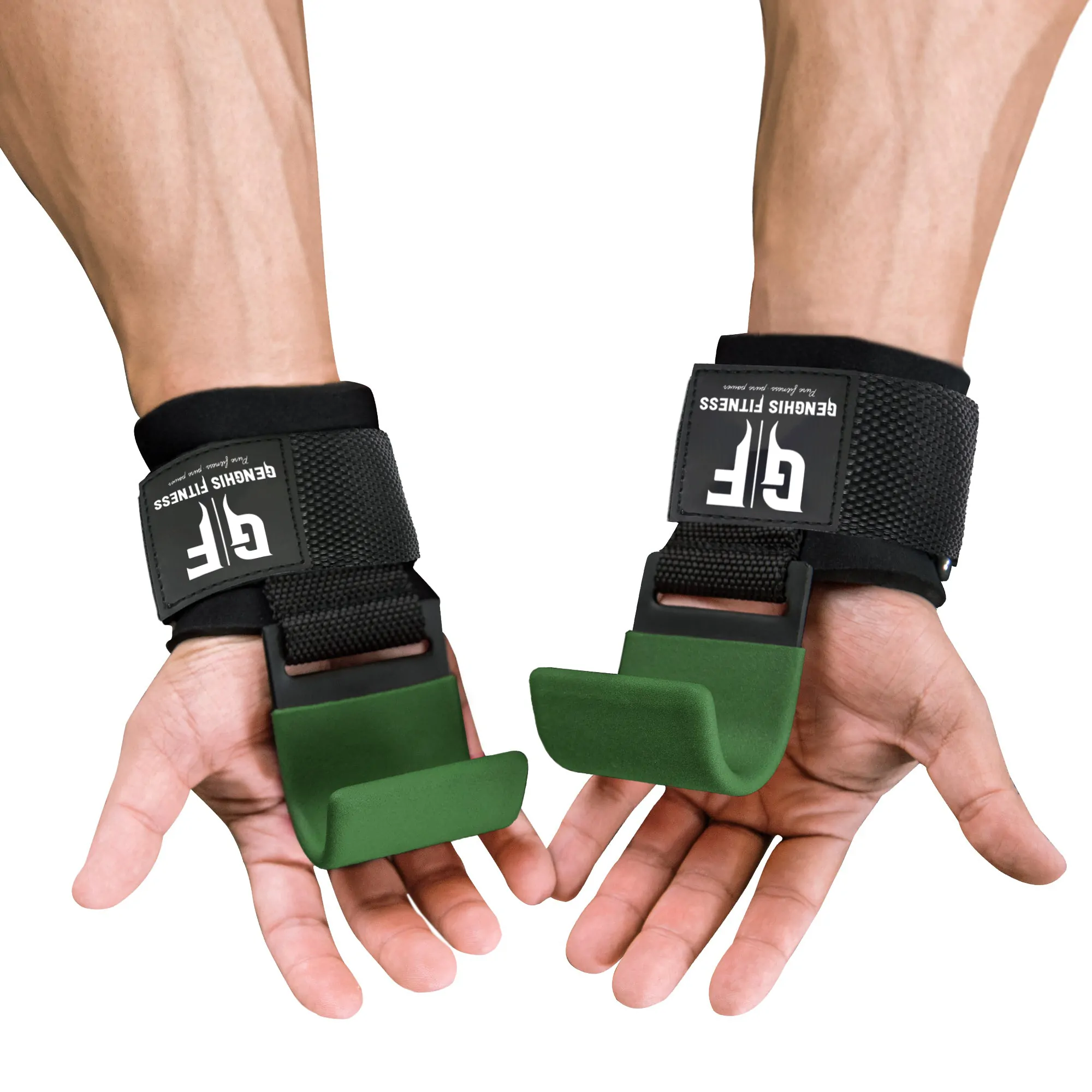
The Genghis Fitness weight lifting hooks use steel hook construction at the grade required for reliable performance across the loading range of serious training, with adjustable wrist strap closure that maintains consistent hook positioning across different wrist circumferences and exercise types. The hook profile provides the bar contact geometry that distributes loading across an appropriate contact area, and the steel thickness provides the structural redundancy that prevents the fatigue cracking that lower-specification alternatives develop under heavy use at competition-frequency training volumes.
THE BEST EXERCISES FOR HEAVY DUTY HOOKS
Heavy duty hooks serve their best application in rows, shrugs, and moderate-intensity rack pulls where the hook’s five-second application advantage over strap wrapping is most valuable and the loading does not exceed the hook’s optimal performance range. At near-maximum deadlift loading where the bar position during the pull is most critical and absolute mechanical security is required, figure 8 straps and loop straps remain the preferred tools because their mechanics provide more consistent bar position security than hook geometry does under maximum loading. The heavy duty hook’s advantage is in the moderate-to-heavy range where its speed advantage matters most.
APPLICATION TECHNIQUE FOR HEAVY DUTY HOOKS
The application technique for heavy duty hooks follows the same principles as any lifting hook: position the hook body at the metacarpal zone rather than the finger base, seat the bar in the deepest part of the hook curve rather than near the tip, and close the wrist strap at the tension that secures the hook position throughout the set without restricting circulation. The additional weight and rigidity of heavy duty hooks compared to lighter alternatives means the hook body may feel more substantial on the wrist, which some athletes find reassuring and others find more intrusive. The increased substantiality is the physical expression of the additional material that provides the heavy duty performance specification.
INSPECTION AND REPLACEMENT PROTOCOL
Inspect heavy duty lifting hooks before every session and replace at the first sign of material compromise. The specific inspection points are the hook curve surface for cracking or deformation, the strap attachment point for metal fatigue at the rivet or weld, and the wrist strap itself for stitching fraying or webbing wear. A hook that shows visible surface cracking on the curve should be retired regardless of how recent the purchase, because surface cracking indicates that cyclic loading has already begun the fatigue progression that will eventually produce structural failure under load. The consequence of hook failure during heavy loading is the sudden load release that can cause the athlete to fall backward.
COMPLETE HEAVY PULLING SUPPORT WITH HOOKS
Pair heavy duty hooks with the lever belt for the heavy row and shrug sessions where both spinal support and grip assistance are needed to train at genuine posterior chain capacity. Wrist wraps worn underneath the hook straps provide additional wrist joint support during extended heavy hook use sessions. Figure 8 straps and loop straps complete the grip tool kit for the loading contexts where heavy duty hooks provide less mechanical security than the closed-loop designs that near-maximum pulling demands.
FINAL WORDS
Heavy duty weight lifting hooks are the correct specification for athletes who train rows, shrugs, and rack pulls at heavy loading across multiple sessions per week and who need hook hardware that sustains this loading frequency without the fatigue degradation that standard hook specifications develop. The Genghis Fitness weight lifting hooks are built to the steel specification and hook geometry that provides reliable performance across the loading range of serious training. Inspect the hardware regularly, apply correctly with the hook body at the metacarpal zone, and use in combination with the loop and figure 8 straps that serve the loading contexts where hook design is not optimal. Heavy duty hooks in the right application are one of the most efficiently structured grip tools available for serious back training sessions. The investment in heavy duty over standard specification hooks is justified by the cost of replacement: a standard hook that develops fatigue cracking after six months of heavy training use at four sessions per week costs more in replacement frequency than the higher initial cost of heavy duty construction that sustains the same training frequency without degradation for two or more years.
Certified strength and conditioning specialists with over 10 years of experience in powerlifting, nutrition, and evidence-based fitness content. Based in New York City.
This guide is part of the Genghis Fitness gym accessories guides, where 80 articles cover dip belts, arm blasters, lifting hooks, ankle straps, and hip circle bands.