LATERAL RAISES: THE DEFINITIVE GUIDE TO BUILDING WIDE SHOULDERS WITH CORRECT TECHNIQUE AND SMART PROGRAMMING
Why Lateral Raises Are the Most Important Shoulder Isolation Exercise
The overhead press builds the anterior and medial deltoid through a compound pressing pattern. Pull-ups and rows develop the posterior deltoid as a secondary mover. But neither of these movements trains the medial deltoid, the lateral head of the shoulder that produces the width and roundness of a developed shoulder, through the specific movement pattern it is designed for: lateral arm elevation against resistance. The lateral raise is the only exercise that directly and specifically loads the medial deltoid through abduction in the frontal plane, which is why it is the essential shoulder isolation exercise for athletes who want width and three-dimensional shoulder development rather than just overhead pressing strength. Research published in the Journal of Physical Therapy Science confirmed that dumbbell lateral raises produce the highest medial deltoid activation of any single shoulder exercise. Use wrist wraps on heavier lateral raise sets to reduce the wrist extension loading that accumulates during high-volume shoulder isolation work.
Correct Lateral Raise Technique
The Setup
Stand with a dumbbell in each hand, arms at the sides with palms facing the body. A slight forward lean from the hips of 10 to 15 degrees positions the lateral deltoid more directly below the resistance at the start of the movement, which improves the loading angle for the medial deltoid throughout the range of motion. Keep a slight bend in the elbows throughout the movement to reduce the elbow joint stress of fully extended arm lateral raises.
The Raise
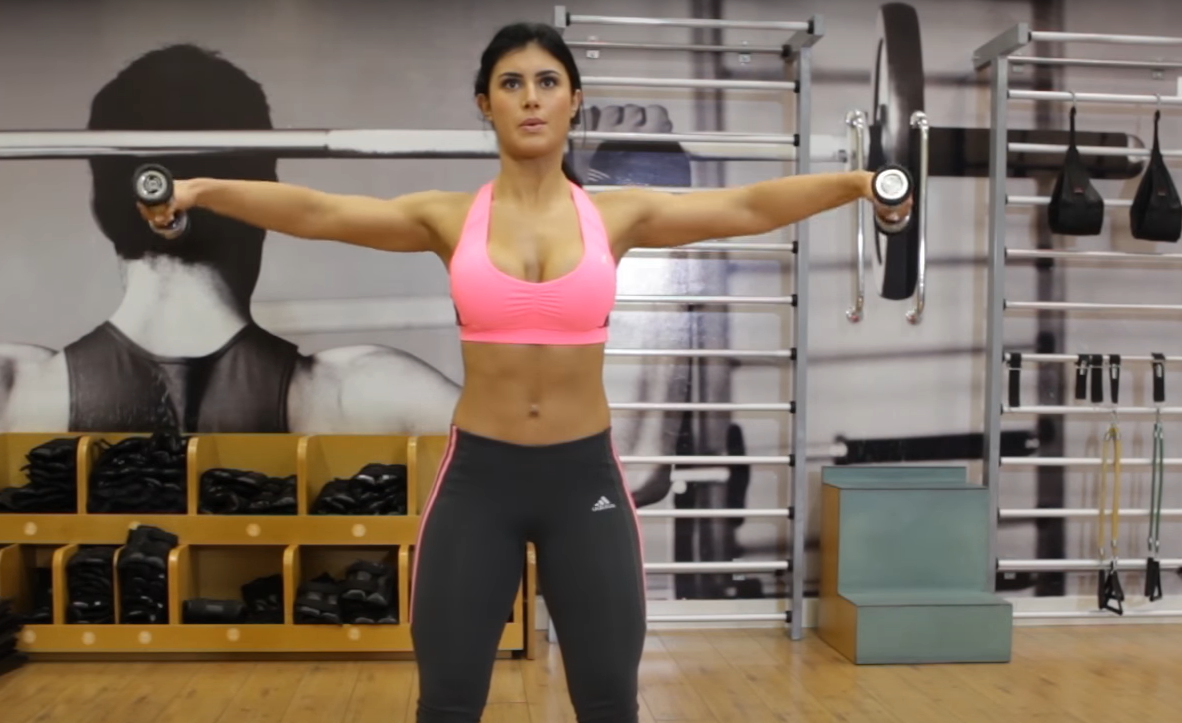
Raise both arms simultaneously to the sides until they are approximately parallel to the floor, moving in the frontal plane rather than in front of or behind the body. At the top position, the thumbs should be pointing slightly downward, which is the position that maximally engages the medial deltoid. Do not raise above parallel: going above parallel shifts the primary loading from the medial deltoid to the upper trapezius, which is not the target muscle for shoulder width development. Lower under control over two to three seconds.
The Most Common Form Errors
Using too much weight and compensating with body momentum is the single most common error in lateral raises. A lateral raise where the body rocks backward and the arms swing upward using momentum is primarily training the hip extensors and spinal erectors, not the medial deltoid. Use a weight where strict form through the full range is achievable for every rep of every set. Lateral raises at 15 to 20 pounds with perfect technique stimulate the medial deltoid far more effectively than 35 to 40 pounds with compensatory movement. The second common error is raising the arms in front of the body rather than directly to the sides. This forward shift activates the anterior deltoid rather than the medial deltoid, defeating the purpose of the exercise.
Lateral Raise Variations
Cable Lateral Raise
Set a cable to the lowest position and perform the lateral raise with a cable handle rather than a dumbbell. The cable provides constant tension throughout the full range of motion, including at the bottom of the movement where the dumbbell provides almost no resistance. This constant-tension stimulus produces a different loading profile than dumbbell raises and is particularly effective for the stretched position of the medial deltoid at the arm-hanging-at-side bottom position. Cable setups with low pulley attachments work well for single-arm cable lateral raises that allow each shoulder to be trained independently.
Seated Lateral Raise
Performing lateral raises seated on a bench eliminates the possibility of body momentum assistance entirely, forcing the deltoid to do all the work. The seated position also allows the torso to be braced against the back of the bench for stability, which reduces the stabilization demand from the core and allows more focus on the target muscle. For athletes who struggle with momentum in standing raises, the seated variation produces a cleaner training stimulus at a given load.
Behind-the-Back Cable Lateral Raise
With the cable set at the lowest position, hold the handle behind the back with the working arm crossing to the opposite side. This position places the medial deltoid in a slightly different pulling angle that some athletes find produces better peak contraction than standard lateral raises. It is a useful variation for creating novel stimulus when standard lateral raises plateau.
Programming Lateral Raises for Maximum Shoulder Width
Lateral raises respond best to moderate rep ranges of 12 to 20 reps per set at controlled tempo with genuine peak contraction at the top of each rep. The medial deltoid is a relatively small muscle that recovers quickly and tolerates higher training frequencies than large compound muscle groups. Two to three lateral raise sessions per week at three to four sets each, totaling 18 to 30 sets of direct medial deltoid work weekly, produces the volume needed for meaningful shoulder width development. Progressive overload for lateral raises comes primarily through adding small increments of load, 2.5-pound jumps when available, rather than the larger loading steps appropriate for compound exercises. The medial deltoid responds slowly to training stimulus compared to large muscle groups, so patience across months rather than weeks is the appropriate timeline for evaluating shoulder width progress.
Pair lateral raises with face pulls for posterior deltoid development and heavy compound pressing for anterior deltoid and overall shoulder strength. This three-pronged approach trains all three heads of the deltoid through the specific movements each responds best to, producing three-dimensional shoulder development that no single exercise can achieve alone. Support the shoulder through heavy pressing sessions with wrist wraps and elbow sleeves to maintain joint health through the full training volume required for genuine shoulder development.
Understanding Shoulder Anatomy for Better Lateral Raise Results
The deltoid muscle has three distinct heads: the anterior, medial, and posterior. Each head has a different origin and line of pull, which means each responds best to a different movement direction. The anterior deltoid is in front of the shoulder joint and is maximally loaded by forward arm flexion, which is why overhead pressing and front raises develop it. The posterior deltoid is behind the joint and responds best to horizontal pulling and rear delt fly movements. The medial deltoid is on the outside of the joint and is loaded maximally by lateral arm abduction in the frontal plane, which is the lateral raise movement. This anatomy explains why lateral raises cannot be replaced by pressing movements for shoulder width: pressing loads the anterior and upper medial deltoid through a pressing arc that does not maximally challenge the lateral head through its full abduction range. Only the lateral raise positions the medial deltoid directly below the resistance and loads it through its primary movement function.
Understanding this anatomy also explains the correct technique cue for lateral raises: the thumb-down position at the top of the raise is not an arbitrary styling preference but a shoulder position that internally rotates the humerus slightly, which repositions the medial deltoid to receive maximum tension at peak abduction. Athletes who raise with thumbs pointing upward are in a position that shifts more of the load to the supraspinatus tendon, which is both less effective for medial deltoid development and a contributing factor to the shoulder impingement that high-rep lateral raises can cause over time with incorrect technique. Thumbs slightly down at the top, elbows raised to shoulder height, is the biomechanically correct end position that maximizes medial deltoid stimulus while protecting the shoulder structures above it. Support the shoulder throughout demanding shoulder sessions with elbow sleeves and wrist wraps on pressing movements that precede or follow lateral raise work.
FINAL WORDS
Lateral raises are the irreplaceable shoulder width exercise. No compound movement trains the medial deltoid through its primary function as effectively, and no amount of overhead pressing produces the lateral shoulder development that consistent, technically correct lateral raise training builds over time. Use strict technique at appropriate loads, vary between dumbbell and cable versions, train two to three times per week, and give the medial deltoid the consistent, patient stimulus it needs to produce the shoulder width that distinguishes developed physiques from merely strong ones.
Certified strength and conditioning specialists with over 10 years of experience in powerlifting, nutrition, and evidence-based fitness content. Based in New York City.