Lifting Grip: Everything That Affects It and How to Improve It
Grip is the first point of contact between your body and every piece of equipment you touch in the gym. It is also one of the most frequently neglected physical qualities in training programs, treated as a given rather than a capacity that needs to be developed, maintained, and protected.
This guide covers the anatomy of a strong lifting grip, the main types of grip used across different exercises, the training and equipment strategies that develop and protect grip strength, and how to diagnose whether your grip is actually limiting your performance.
The Anatomy of Grip Strength
Grip strength involves multiple muscle groups working across two primary joints. The finger flexors, including the flexor digitorum superficialis and flexor digitorum profundus, are the primary force generators in closing the hand around a bar. The wrist flexors stabilize the wrist joint under load. The intrinsic muscles of the hand control fine positioning and maintain the shape of the grip through a set.
The forearm extensors play an opposing role, providing the balance that prevents the wrist from collapsing into extreme flexion under heavy loads. Strong grip requires both sides of this system to be developed. Athletes who focus only on flexion work often develop the crushing strength to close the hand powerfully but lack the wrist stability to maintain position through a long set.
Research published through the NIH has found strong correlations between grip strength and overall upper body pulling performance, making it both a training variable and a meaningful indicator of general muscular development.
Types of Grip in the Gym
Double Overhand
Both palms facing the lifter, both hands in the same orientation. This is the most natural grip and the starting point for all pulling work. It is also the first grip to fail under heavy loads because it places maximum demand on the finger flexors without any mechanical advantage.
Mixed Grip
One palm facing the lifter, one palm facing away. Standard for heavy deadlifts where double overhand fails. The opposing orientation of the hands prevents the bar from rolling out of the grip. The trade-off is asymmetric torque on the spine and, for the supinated arm, an increased stress on the bicep tendon. Mixed grip at maximum loads over long training careers has been associated with bicep tendon strains in some athletes.
Hook Grip
The thumb is wrapped around the bar first and then the fingers close over the thumb, pinning it against the bar. This creates a far more secure double-overhand position than standard double overhand because the thumb becomes a wedge. Hook grip is the standard in Olympic weightlifting and is increasingly used by powerlifters for deadlifts. It is painful during the break-in period as the thumb adapts to the compression. Most athletes need 4 to 6 weeks of consistent use before it becomes comfortable.
False Grip
The wrist sits on top of the bar or ring rather than the fingers gripping below it, allowing the wrist to transition to a pressing position without releasing the bar. Used in ring muscle-ups and some gymnastics movements. Not applicable to most barbell training.
Why Grip Fails Before the Target Muscle
In any heavy pulling exercise, the fingers close around a 1-inch or 2-inch diameter bar. The cross-sectional area of the forearm flexors is far smaller than the cross-sectional area of the latissimus dorsi, trapezius, or hamstrings. Simple anatomy means the small muscles of the hand and forearm will fatigue before the large muscles of the back and legs under heavy loading.
The practical consequence is that grip failure caps the training stimulus on the target muscles before they have been adequately challenged. A deadlift set that ends at 6 reps because the bar rolls out of the hands, when the glutes and hamstrings could have handled 10, is a set where grip limited the outcome rather than the muscles the exercise is designed to train.
Tools That Support Lifting Grip
Lifting Straps
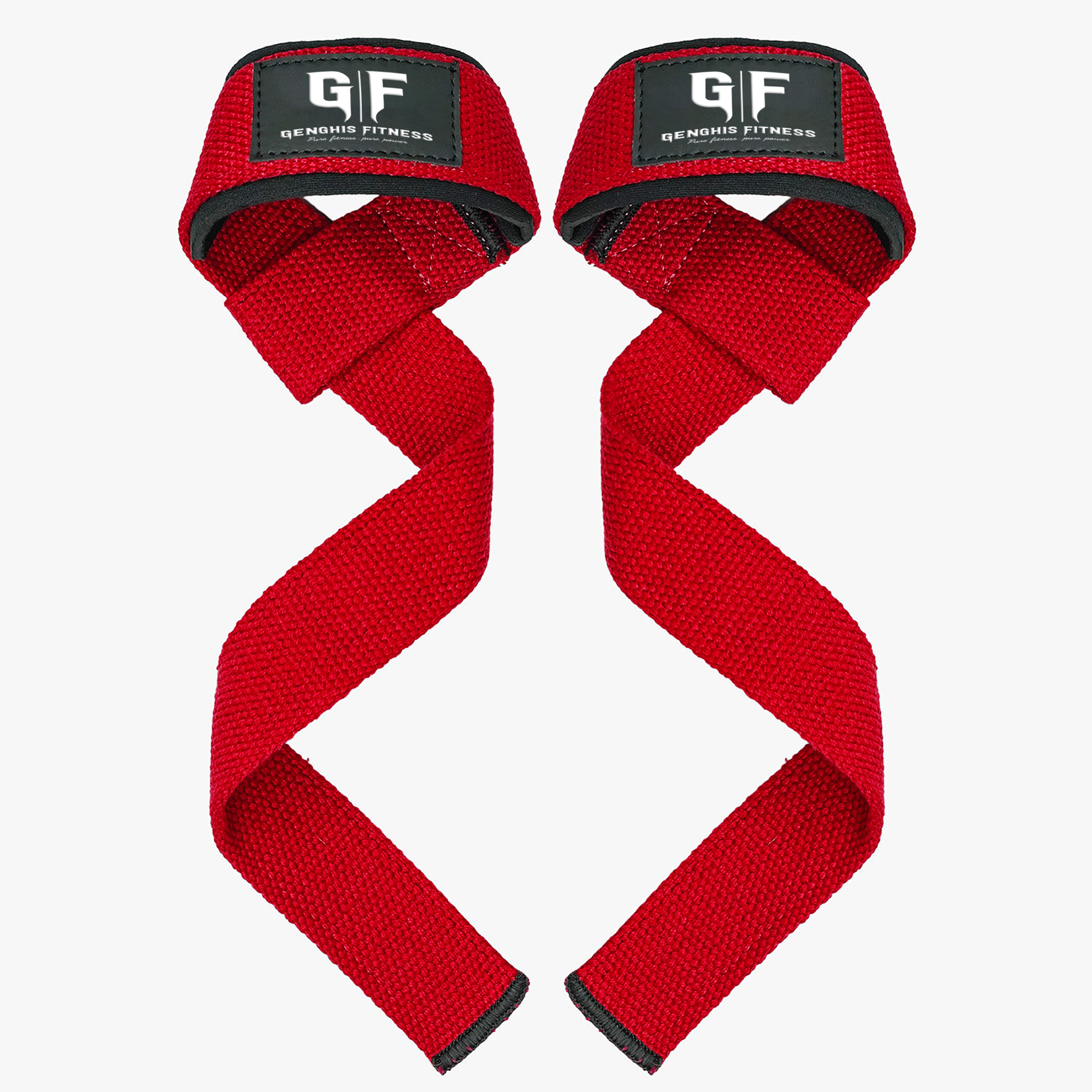
Lifting straps extend grip duration on heavy pulling exercises by transferring bar contact load from the hands to the wrists and forearms via the strap material. The Genghis Fitness lifting straps and leather weight lifting straps are the standard tools for this. Use straps for working sets on exercises where grip is consistently the limiting factor and the goal is to train the primary muscle, not the forearm.
Lifting Hooks
Lifting hooks attach to the wrist and hook over the bar, removing the grip equation almost entirely. The Genghis Fitness weight lifting hooks allow the pulling muscles to work independently of hand and forearm capacity. They are useful for athletes with grip limitations due to injury, for very high-rep accessory work, and for testing the pulling muscles at loads that exceed grip capacity by a wide margin.
Figure-8 Straps
For maximum-effort deadlifts and rack work, the Genghis Fitness figure-8 lifting straps create a mechanical connection between the wrist and the bar that does not depend on friction. These are the most secure grip aid available for static pulling movements.
Training the Lifting Grip Directly
Grip should be trained as a specific quality, not just developed as a byproduct of other lifting. Effective grip training exercises include farmer’s carries with heavy dumbbells or loaded handles, plate pinches where weight plates are held between thumb and fingers for timed holds, thick bar or towel pull-ups which increase the grip diameter and challenge the finger flexors more aggressively, and dead hangs from a pull-up bar for time.
The National Strength and Conditioning Association includes grip strength development in its programming recommendations for athletes across sports, recognizing it as a foundational quality that affects performance in nearly every upper body movement pattern.
Diagnosing Whether Grip Is Your Actual Limiter
The clearest test is comparison. If your performance on a pulling exercise improves significantly when you add straps compared to bare hands at the same weight, grip is limiting your performance. If performance is the same with or without straps at a given weight, grip is not the bottleneck at that load. Use this test periodically to track how your grip is developing relative to the primary muscles you are training.
Wrist Wraps and Grip
Wrist wraps stabilize the wrist joint during pressing movements and are sometimes used during pulling work as well. They do not directly improve grip strength but they reduce wrist fatigue during long training sessions, which indirectly preserves grip capacity for the sets that matter most. The Genghis Fitness wrist wraps are the right tool for wrist stability across heavy pressing and pulling sessions.
Common Grip Mistakes
- Using straps on every set including warm-ups. Train grip bare-handed at moderate weights. Use straps only when grip is genuinely the limiting factor.
- Neglecting direct grip training. Grip does not develop automatically to the level you need. Program it.
- Training exclusively with mixed grip without ever working hook grip. Mixed grip asymmetry compounds over time. Developing hook grip reduces this risk.
- Ignoring wrist stability. Strong finger flexors with weak wrist stabilizers is an incomplete grip development strategy.
- Using hooks as a replacement for straps on all pulling work. Hooks remove grip from the training equation. Straps reduce its demand. Use each appropriately.
Summary
A strong lifting grip requires developed finger flexors, wrist stability, and the tactical knowledge of when to use grip aids and when to train bare-handed. Build it deliberately, protect it with the right tools on the heaviest sets, and it will stop being the factor that limits your progress in every pulling exercise you train.