Genghis Fitness · Gear and Joint Support
Neoprene Knee Sleeve: Complete Buyer and Usage Guide for Athletes Who Need Reliable Joint Support
Updated 2026 | By Team Genghis Fitness | 18 min read
The neoprene knee sleeve is the most widely used joint support accessory in strength training and recreational sport. Its ubiquity reflects genuine utility: neoprene provides a unique combination of thermal insulation, compression, and proprioceptive feedback that no other sleeve material fully replicates at comparable price points. For athletes who train in climates with temperature variation, who squat heavy with any regularity, or who have knee history that makes joint warmth and feedback particularly important, a quality neoprene sleeve is not optional equipment but a foundational training tool.
Why Neoprene Specifically
Neoprene (polychloroprene) is a synthetic rubber with a closed-cell foam structure that provides excellent thermal insulation per unit of thickness. This insulating property maintains elevated knee joint temperature during training in ways that thinner elastic compression sleeves and thicker but less insulating nylon designs cannot match. Warm synovial fluid has lower viscosity, providing better lubrication at the articular cartilage surfaces. Warm connective tissue (tendons, ligaments) has better extensibility and is less susceptible to acute strain. The thermal benefit of neoprene is particularly meaningful for the first 15 to 20 minutes of training before the joint has warmed through exercise-generated heat.
A study published in the Journal of Athletic Training found that compressive knee support significantly improved proprioceptive acuity and joint position sense, confirming that the compression effect of neoprene sleeves provides measurable proprioceptive improvement beyond simple warmth. This proprioceptive benefit is highest during the warm-up phase of training and remains meaningful throughout for athletes with any degree of proprioceptive deficit from previous injury.
Choosing the Right Neoprene Sleeve
Thickness: 5mm neoprene is the optimal training thickness for most athletes, providing meaningful warmth and compression without restricting full squat depth. 3mm provides less thermal benefit but more comfort and range of motion freedom. 7mm approaches the rigidity of soft knee wraps and may limit deep knee flexion for some athletes. The science behind compression level selection for different training contexts is in our compression knee sleeves guide.
Sizing: Measure the circumference of the knee at the joint center (the center of the kneecap) when standing with the leg slightly bent. This measurement determines the sleeve size. Do not measure the thigh or calf and do not use clothing size as a proxy. A correctly sized sleeve requires some effort to pull on and feels snug but not circulation-restricting when worn. The complete sizing process is in our knee sleeves for squats guide.
Construction quality: Quality neoprene sleeves have consistent thickness throughout the sleeve body, smooth and non-chafing inner surfaces, and reinforced edges that do not roll or fray with repeated use. The upper and lower edges are the first failure points in budget sleeves: they begin rolling inward during squatting within months of regular use. A sleeve that stays flat and open at the edges throughout the working set is a quality indicator for training context.
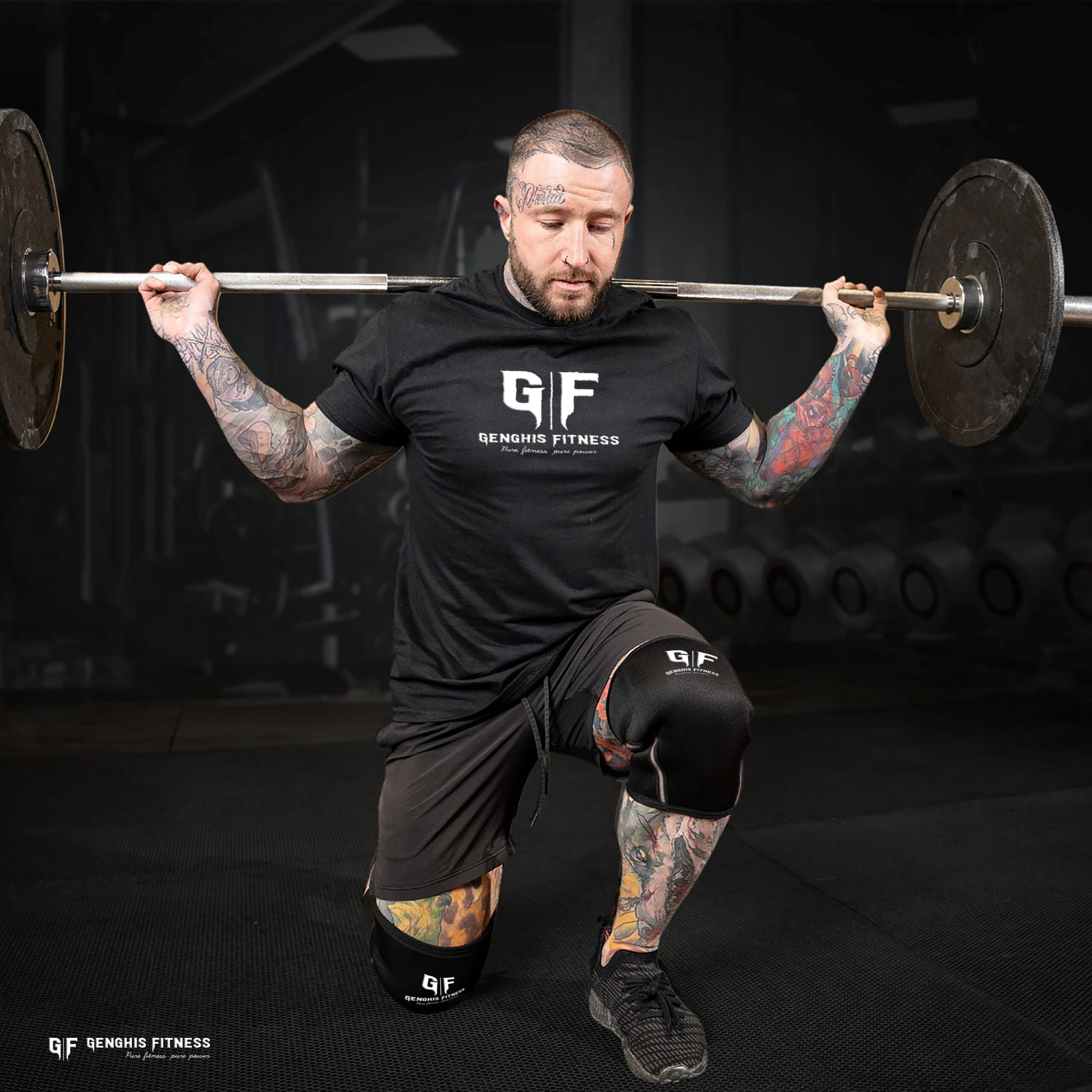
The Genghis Fitness knee sleeves use 5mm neoprene construction with reinforced edges specifically designed to prevent the rolling and edge compression that affects budget alternatives during deep squat movements.
How to Use Neoprene Knee Sleeves Effectively
Put sleeves on before warming up to capture the thermal benefit from the first set. Position the sleeve centered over the joint with the top edge approximately 5 to 7cm above the kneecap and the bottom edge 5 to 7cm below. This positioning ensures the kneecap is covered and the highest-stress area of the patellar tendon below the knee receives compression. Reposition if the sleeve migrates during the warm-up sets, as a correctly sized sleeve in the right position should not migrate significantly during training.
Remove sleeves between squat working sets if you find the accumulated heat uncomfortable. Removing and reapplying between sets is practical for most sleeve designs. Use the pull-on technique (fold the sleeve in thirds, place over the toes, and roll up the leg) rather than trying to drag the sleeve over the heel, which creates uncomfortable temporary pressure and can damage the sleeve edges.
Sleeve vs Wrap: The Fundamental Distinction
Neoprene sleeves and knee wraps are different tools for different purposes. Sleeves provide passive compression and warmth without meaningfully modifying squat mechanics. Wraps are actively wound elastic bands that store energy during the squat descent and release it to assist the concentric drive, providing carryover that increases maximum squat load. Athletes who want to train with full proprioception and without mechanical squat modification use sleeves. Athletes who want maximum squat carryover for competition use wraps. The complete comparison is in our knee wraps vs sleeves guide.
Frequently Asked Questions
Can Knee Sleeves Prevent Injury?
Knee sleeves reduce injury risk through two mechanisms: proprioceptive enhancement that improves joint position control and reduces the likelihood of mechanically disadvantaged movement patterns under load, and thermal maintenance that reduces the acute strain risk of cold connective tissue. They do not provide structural protection equivalent to a brace. Sound technique, appropriate progressive loading, and adequate warm-up are the primary injury prevention tools, with sleeves providing supplementary benefit within a program that addresses these fundamentals.
How Do You Wash Neoprene Knee Sleeves?
Hand wash in cool water with mild detergent after every 3 to 5 uses (more frequently if training is intense). Rinse thoroughly and air dry flat or hanging in a ventilated area. Do not machine wash (agitation stresses the neoprene seams) and do not machine dry (heat deforms neoprene and accelerates elasticity degradation). Washing after every session is not necessary if the sleeve is allowed to air dry completely between uses, but regular washing prevents the odor accumulation that occurs in neoprene from sweat exposure.
Warm. Supported. Proprioceptively Enhanced. Every Set.
5mm neoprene knee sleeves built for serious squat volume. Reinforced edges that stay flat through every rep.
Shop Knee Sleeves Shop Knee WrapsSleeve Thickness, Compression Level, And Recovery Benefits
Neoprene knee sleeves come in different thicknesses that correspond to different levels of compression and warmth. The most common options are 5mm and 7mm, with 3mm available for lighter activity and 9mm for maximum compression in competitive powerlifting. Thicker neoprene provides more compression and retains more heat around the joint, which increases synovial fluid production and keeps the surrounding musculature warmer through a training session. This thermal effect is particularly valuable for athletes with a history of knee discomfort during cold-weather training or during the early ramp-up sets of a squat session.
The compression from a properly sized sleeve also provides proprioceptive feedback, which is the sense of where your joint is in space during a movement. Lifters frequently report that wearing knee sleeves improves their squat mechanics because the compression makes them more aware of knee tracking and alignment in real time. This feedback benefit applies even at lighter training weights where the structural support from the sleeve is minimal. The Genghis Fitness knee sleeves use 7mm neoprene construction that balances compression and flexibility to support both heavy squatting and high-rep accessory work without restricting range of motion at the bottom of the movement.
When To Wear Sleeves And When To Train Without Them
Wearing knee sleeves on every single set of every training session is counterproductive. The compression that makes sleeves useful for heavy working sets also reduces the demand on your supporting musculature, tendons, and connective tissue to stabilize the joint independently. Reserve sleeves for your heaviest working sets, typically anything above 75 to 80 percent of your training maximum, and complete warm-up sets and lighter accessory work without them. This approach builds the raw joint stability that makes your heavy sets safer while still providing the thermal and proprioceptive benefits of sleeve use when loads are high enough to justify it. Pairing knee sleeve use with knee wraps for maximal singles and heavy top sets adds elastic rebound support that sleeves alone cannot provide.
Certified strength and conditioning specialists with over 10 years of experience in powerlifting, nutrition, and evidence-based fitness content. Based in New York City.
This guide is part of the Genghis Fitness knee sleeves, wraps and joint support guides, where 68 articles cover every joint support type across knee, wrist, and elbow applications.