Resistance Bands for Legs and Glutes: How to Build Lower Body Strength with Bands
Resistance bands are more effective for lower body training than most athletes give them credit for. The common assumption is that bands are beginner equipment or rehabilitation tools that get left behind when serious barbell training begins. That assumption misses how bands create tension through a range of motion that free weights cannot, and how that tension directly addresses the strength gaps that make squats, deadlifts, and single-leg movements weaker than they should be.
This guide covers the specific mechanical advantage that bands provide for legs and glutes, the best exercises for each muscle group, how to combine band work with barbell training for maximum results, and how to progress the resistance over time.
Why Bands Create a Different Training Stimulus Than Free Weights
Barbells and dumbbells provide constant load throughout the range of motion. A 100-pound barbell is 100 pounds at the bottom of the squat and 100 pounds at the top. The resistance curve does not change with joint angle.
Bands provide accommodating resistance. Resistance increases as the band stretches further. In a squat, the band offers less resistance at the bottom of the movement where the muscles are mechanically disadvantaged, and more resistance at the top where the muscles are in a stronger position. This matches the strength curve of the squat more closely than a constant-load barbell and provides a stronger stimulus at the lockout position where barbell squats often feel easiest.
For glute training specifically, the band’s peak resistance at full hip extension is the most valuable property. The gluteus maximus is strongest in the shortened position at the top of a hip thrust or bridge, which is exactly where band resistance is highest. This means the muscle is being maximally challenged at the point where it is capable of the most force output.
Best Resistance Band Exercises for Quads
Banded Squat
A band anchored under the feet and looped over the shoulders provides resistance throughout the squat that peaks at the top position. This is the standard banded squat used by powerlifters as a supplementary exercise to overload the lockout. For athletes training without barbells, a strong enough band provides genuine quad training stimulus across multiple sets.
Banded Leg Extension
Anchor a band behind you, loop it around the ankle, and extend the knee against the band’s resistance while seated on a bench. This isolates the quadriceps through knee extension in the same movement pattern as the leg extension machine. Three sets of 15 to 20 repetitions per leg with a resistance that produces a burn in the quad by the end of each set.
Banded Wall Sit
Loop a band above the knees and hold a wall sit position while pushing the knees out against the band. This adds hip abductor demand to the standard isometric quad hold, training both the quads through sustained contraction and the gluteus medius through sustained abduction resistance.
Best Resistance Band Exercises for Hamstrings
Banded Romanian Deadlift
Stand on the middle of the band with both feet, hold the ends in each hand, and hinge at the hip while maintaining a neutral spine. The band creates tension from the floor upward, loading the hamstrings through the full range of the hip hinge. Pause at the bottom with a strong hamstring stretch and drive back to standing by pushing the hips forward.
This replicates the loading pattern of the barbell Romanian deadlift without the bar. Three sets of 12 to 15 repetitions with a band that requires genuine effort to complete the full range is an effective hamstring stimulus.
Banded Leg Curl
Anchor a band at ankle height, loop it around one ankle, and curl the heel toward the glute against the band’s resistance while standing or lying prone. This isolates the hamstrings through knee flexion the same way a machine leg curl does. The band version provides better resistance at the shortened position, which is where machine leg curls are typically easiest, making the banded version a complementary stimulus.
Best Resistance Band Exercises for Glutes
Banded Hip Thrust
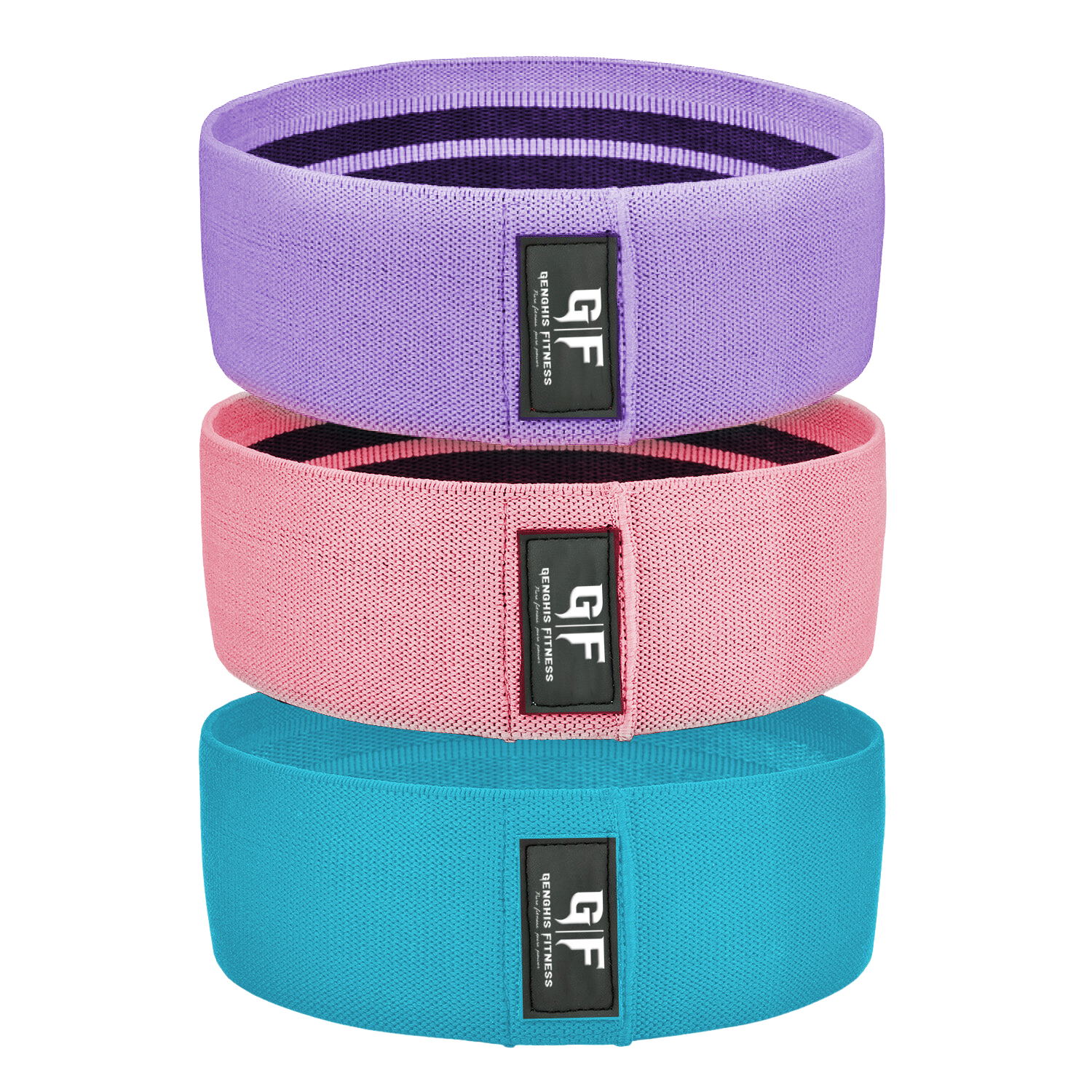
The most effective glute exercise available with a band. The Genghis Fitness hip circle bands above the knees during hip thrusts adds gluteus medius demand to the primary hip extension pattern. Drive through the heels, squeeze hard at the top, and control the descent. Four sets of 12 to 15 repetitions with adequate band resistance to challenge the glutes at the top position.
Banded Lateral Walk
Band above the knees, quarter-squat position, controlled lateral steps with constant tension on the band. This is the best exercise for the gluteus medius and the most commonly underprogrammed movement in lower body training. Three sets of 12 to 15 steps each direction, every lower body session.
Banded Clamshell
Band above the knees, lying on the side, rotating the top knee upward through its full range. Direct gluteus medius isolation in the external rotation pattern. Three sets of 15 to 20 repetitions per side.
How to Combine Bands with Barbell Training
The most effective use of resistance bands for legs and glutes in the context of serious strength training is as activation and warm-up work before barbell sessions, and as isolation finishers after barbell work to target muscles that the main lifts do not fully exhaust.
Before heavy squats: 2 sets of banded lateral walks and banded squats above the knee activate the hip abductors. Then the Genghis Fitness knee sleeves go on and the barbell work begins. After heavy deadlifts: 3 sets of banded hip thrusts and clamshells finish the glutes and hip abductors that the deadlift pattern does not directly target.
For the barbell work itself, the Genghis Fitness powerlifting leather belt handles lumbar bracing. The bands serve activation and isolation. Each tool has a specific role in the session.
Programming Bands for Consistent Progress
Treat band exercises as real training with progression targets rather than informal filler. Record the resistance level and rep count for each band exercise. Progress the resistance level when all working sets are completed cleanly and the target muscles are no longer challenged by the last few reps. Maintain a 2 to 4 week minimum at each resistance level before progressing to allow the muscles to adapt before the demand increases.
For athletes using bands as their primary lower body training without access to barbells, three sessions per week covering all three glute heads and both quad and hamstring patterns provides sufficient stimulus for consistent strength and size development over the first 12 to 18 months of training. Beyond that, barbells or cable machines become necessary to continue progression.
Ankle Straps for Cable Work as a Band Complement
Athletes who have cable machine access can significantly extend the effectiveness of their band work by adding cable-loaded single-leg exercises. The Genghis Fitness ankle straps for cable machine allow cable kickbacks, cable hip abductions, and cable leg curls with adjustable resistance that progresses beyond what most band sets can provide. Pairing band activation work with cable strength work covers the full range of lower body development needs.
Summary
Resistance bands for legs and glutes provide accommodating resistance that matches the strength curve of hip extension and knee flexion movements better than constant-load free weights at the same relative resistance. Used with structure and progressive overload, they build meaningful leg and glute strength as standalone tools or as complements to heavier barbell and cable training.