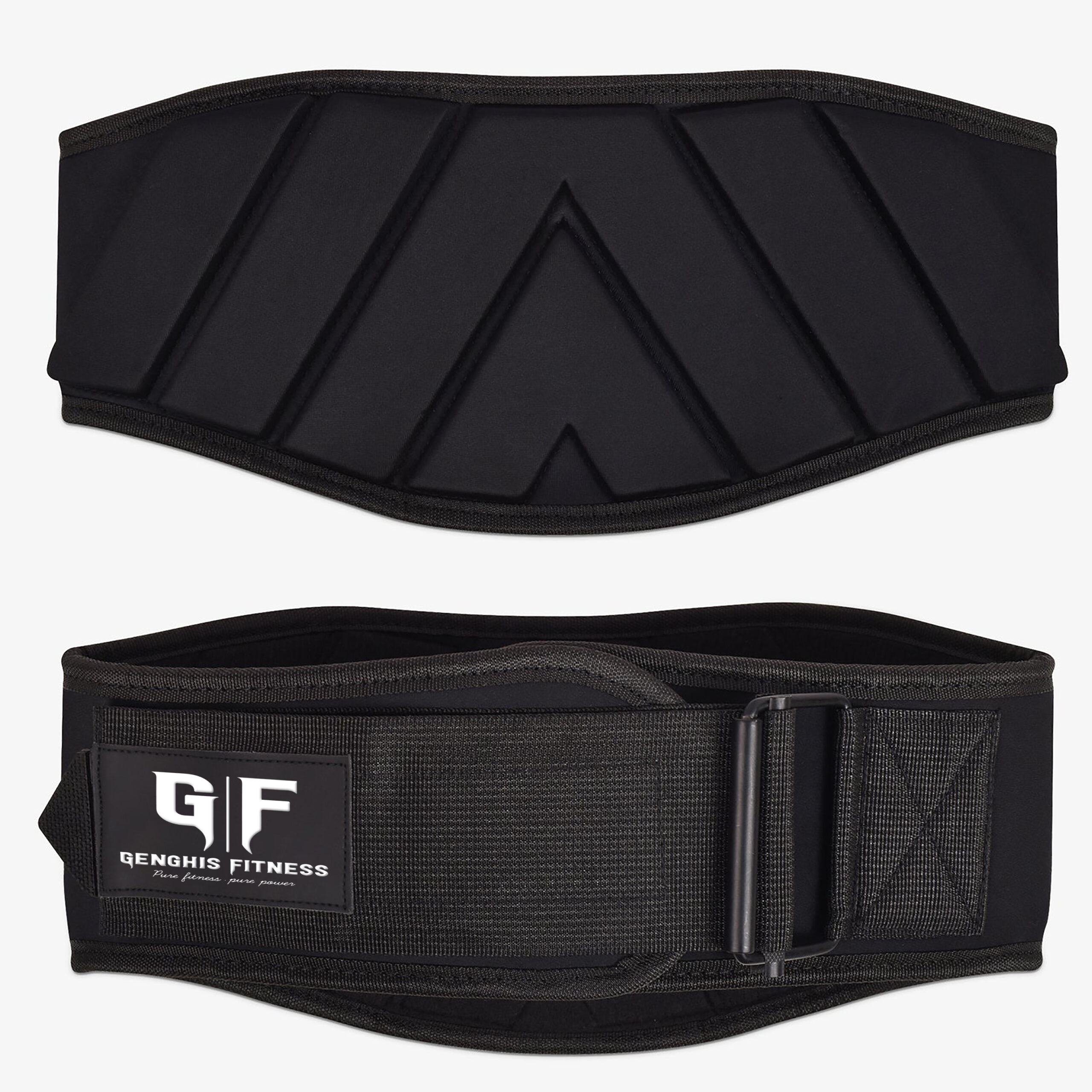
WEIGHTLIFTING BELT MATERIAL COMPARISON: LEATHER VS NYLON VS NEOPRENE FULLY EXPLAINED
Why Belt Material Is the Most Important Buying Decision
Every weightlifting belt on the market makes the same basic promise: spinal support through increased intra-abdominal pressure during heavy lifting. The material determines how well that promise is kept at different training intensities, how comfortable the belt is across a full session, how long it lasts, and what kind of maintenance it requires. Getting the material right for your training style means the belt works with you instead of against you. Getting it wrong means you either have more belt than you need, or not enough when it counts. The three primary materials in serious training belts are leather, nylon, and neoprene. Here is exactly how they compare across every factor that matters in the gym. The full range of options from nylon to neoprene to leather is available at Genghis Fitness.
The physics behind any lifting belt are the same regardless of material. When you brace your core outward against a rigid belt, the intra-abdominal pressure increases beyond what unbelted bracing can achieve. That elevated pressure creates a pressurized cylinder that stiffens the lumbar spine and reduces disc and facet joint loading during heavy squats, deadlifts, and pressing movements. A study in the Journal of Strength and Conditioning Research confirmed this mechanism. What differs between materials is the degree of rigidity, the comfort during use, the durability over time, and the care requirements. All three materials can deliver meaningful spinal support. The right choice depends on who you are as a lifter and what you are trying to accomplish.
Leather Belts: Maximum Rigidity and Long-Term Durability
Stiffness and Support
Leather is the stiffest of the three materials, particularly in thicker constructions of 10mm to 13mm. That stiffness is its primary advantage. When you push outward against a 13mm leather belt during a maximum-effort squat, the belt does not compress or deform. It provides an unyielding wall that your core muscles brace against with maximum force. This rigidity translates directly to higher achievable intra-abdominal pressure compared to more flexible materials at equivalent brace effort. For athletes training at 90 percent of their one-rep maximum and above, the stiffness advantage of leather is real and measurable. The powerlifting leather belt and 4 inch leather belt represent this standard.
Break-In Period
New leather belts are stiff to the point of discomfort for the first four to six weeks of use. The leather is unyielding against the torso and often leaves red marks on the skin during early sessions. This break-in period is not a flaw. It is the leather conforming to your torso shape. After the break-in, a well-conditioned leather belt fits like custom equipment and improves with each subsequent use.
Longevity and Maintenance
A quality leather belt maintained with periodic conditioning lasts a decade or more. The leather does not stretch, deform, or lose its structural properties with age when cared for correctly. Apply a leather conditioner every four to six weeks, wipe down with a dry cloth after each session, and store flat or loosely coiled. The long-term cost per year of ownership for a quality leather belt is lower than for any other material category.
Nylon Belts: Versatility and Immediate Comfort
Flexibility and Feel
Quality multi-layer nylon lifting belts are stiffer than neoprene but more flexible than leather, placing them in the middle of the rigidity spectrum. They are comfortable immediately out of the box with no break-in period, adjust quickly with Velcro or ratchet closures, and are significantly lighter than leather alternatives. For athletes who train varied rep ranges, change exercises frequently within a session, or perform Olympic lifting movements where the flexibility of nylon is preferable to leather rigidity during dynamic movements, nylon is often the best fit.
Performance Ceiling
Where nylon underperforms leather is at maximal loads. Under a very heavy bracing effort, a nylon belt compresses slightly compared to the completely unyielding surface of a thick leather belt. For the majority of training loads, this difference is negligible. For competitive powerlifters attempting 90 percent-plus maximal effort squats and deadlifts, the difference becomes meaningful and leather is the correct choice. For everyone else, a quality nylon belt provides all the support the training demands.
Durability and Care
Nylon belts last two to four years of regular training use with proper care. The closure system, whether Velcro or ratchet, is typically the first component to show wear. Velcro accumulates chalk and debris that reduces its holding strength over time. Ratchet buckles are more durable but can occasionally need adjustment. Hand-wash nylon belts in cold water monthly and inspect stitching at stress points regularly.
Neoprene Belts: Comfort and Warmth for General Training
Compression and Warmth
Neoprene weightlifting belts are the softest and most flexible of the three material categories. They excel at providing warmth to the lower back muscles through heat retention, and they are extremely comfortable for extended wear during general gym sessions where the belt stays on across many different exercises. The compression they provide supports general lumbar comfort and provides proprioceptive feedback about lower back position during movement. For general fitness training, cross-training, and any session where the belt is used more for warmth and general support than for maximal intra-abdominal pressure, neoprene is the most comfortable option.
Limitations for Heavy Training
Neoprene compresses significantly under the force of a heavy Valsalva brace, which limits the intra-abdominal pressure it can help generate compared to stiffer materials. For sets at 80 percent and above of a one-rep maximum, a neoprene belt underperforms both leather and quality nylon. It is appropriate for moderate loading, general fitness training, and warmth-focused applications rather than as a primary competitive or near-maximal lifting support tool.
Durability
Neoprene degrades faster than leather or nylon when exposed to repeated sweat saturation, extreme temperatures, and UV light. A well-maintained neoprene belt lasts 18 to 24 months of regular use. Hand-wash in cold water, air dry completely, and store away from heat sources and direct sunlight to maximize lifespan.
Side-by-Side Comparison: The Definitive Breakdown
Rigidity: Leather wins at 10mm-13mm thickness. Nylon is second at quality multi-layer constructions. Neoprene is softest and most flexible.
Comfort out of the box: Neoprene and nylon are immediately comfortable. Leather requires a 4 to 6 week break-in.
Best for maximal loads: Leather, especially 10mm and 13mm models. Nylon for moderate to heavy training. Neoprene for general fitness.
Longevity: Leather wins by a wide margin at 10 or more years with proper care. Nylon lasts 2 to 4 years. Neoprene 18 to 24 months.
Maintenance: Leather requires periodic conditioning. Nylon and neoprene require only cold-water washing.
Best for dynamic movements: Nylon, followed by neoprene. Leather is least appropriate for Olympic lifts and highly dynamic training.
Value over time: Leather has the lowest cost per year of ownership. Nylon and neoprene have lower upfront cost but require more frequent replacement.
Which Belt Material Is Right for You
If you are a powerlifter, strength sport competitor, or anyone regularly training at 85 percent or more of your maximum on compound lifts, a leather belt is the correct long-term choice. Start with the 10mm lever belt or the 4 inch leather belt and commit to the break-in period. If you are a general strength athlete, CrossFit participant, or Olympic lifter who trains across a wide range of intensities and movements, a quality nylon belt delivers the right balance of support, flexibility, and convenience. If you are a general gym-goer who wants lumbar warmth and modest support during varied training, neoprene is comfortable and accessible.
FINAL WORDS
Belt material is not a minor detail. It is the primary variable that determines whether your belt delivers the intra-abdominal pressure increase your training demands. Match the material to your actual training intensity and goals rather than buying the most expensive option or the cheapest. Leather for serious strength sport. Nylon for varied high-intensity training. Neoprene for general fitness and warmth. All three are available from Genghis Fitness: powerlifting leather, nylon, and neoprene. Choose the right tool for the job and your back will thank you for years.
Certified strength and conditioning specialists with over 10 years of experience in powerlifting, nutrition, and evidence-based fitness content. Based in New York City.
TRAIN WITH EQUIPMENT THAT MATCHES YOUR EFFORT
Serious strength training demands serious gear. A lever belt, quality straps, and knee sleeves are not accessories. They are tools.
Lifting Straps Knee SleevesExplore the full weightlifting belt guides for lever belt comparisons, leather belt reviews, neoprene belt recommendations, sizing guides, and sport-specific belt selection across powerlifting, CrossFit, and Olympic lifting.