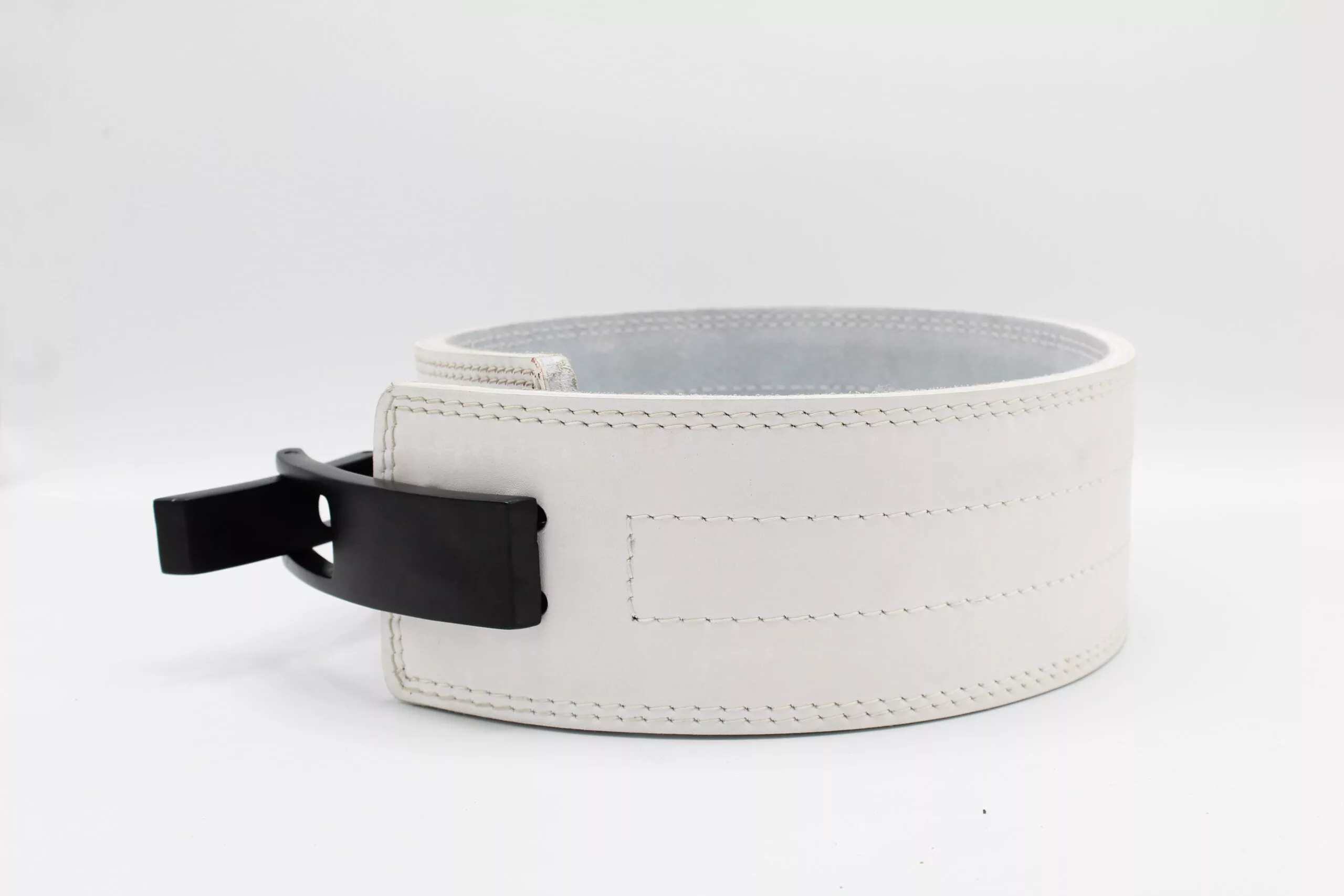
WHITE LEVER BELT: THE COMPLETE GUIDE TO PERFORMANCE, CARE, AND PLATFORM PRESENCE
A white lever belt is a deliberate choice. It is not the default option, it is not the path of least resistance, and maintaining it in competition condition takes slightly more attention than its black counterpart. Lifters who choose white do so with intention. They want their gear to make a statement on the platform, they understand what that commitment requires, and the confidence it projects is backed by the same full-grain leather construction and over-center lever mechanism that makes any serious lever belt the competition standard. This guide covers everything you need to get the most from a white lever belt: performance mechanics, fit, care, competition use, and how to keep it looking exactly as sharp in year three as it did on the day it arrived.
THE LEVER MECHANISM: HOW IT WORKS AND WHY IT MATTERS
Whether a lever belt is white, black, or any other finish, the functional mechanism is identical. A hinged metal plate attaches to the front end of the belt via two mounting screws. On the other end of the belt, a fixed catch bar sits across the leather. When you flip the lever plate down, it hooks over the catch bar and pulls both ends of the belt together. The geometry of the hinge is engineered to produce an over-center lock: the plate travels slightly past the mechanical center point in the closed position, creating a self-locking effect that holds the belt closed under any intra-abdominal pressure a human can generate. Opening requires you to physically lift the lever plate. Nothing else releases it.
This mechanism delivers two performance advantages over a prong buckle. First, it creates identical tension on every closing, eliminating the variability that comes from choosing different holes based on feel. Second, it allows you to put on and remove the belt in under five seconds, which matters between heavy sets when your hands are chalked, your adrenaline is high, and the last thing you need is to fumble with a stiff leather prong. Our 10mm lever belt delivers these advantages with stainless steel lever hardware and full-grain leather construction across both standard and white finish options.
DIALING IN FIT ON YOUR WHITE LEVER BELT
Fit adjustment on a white lever belt is identical to any lever belt. Loosen the two mounting screws with your Allen key, slide the lever plate toward the belt edge for a looser fit or toward the center for tighter, and retighten. Move one hole position at a time and test between adjustments. The target fit: the lever closes with firm but manageable effort, the belt sits uniformly against your torso without gaps or edge pressure, and you can slide two fingers under the leather when closed at rest. Take a full breath into your belly, not your chest, and push outward before closing the lever. The resulting tension during bracing should be hard resistance without restricting the inhalation itself.
For white leather specifically, the break-in process follows the same timeline as black leather but requires one additional consideration. The white finish can show pressure marks during early sessions where the leather is still stiff and the contact pattern between the belt and your torso is being established. These marks fade as the leather breaks in and the contact becomes uniform. Do not attempt to aggressively condition a new white leather belt to accelerate the break-in past what the material structure can accommodate. Light conditioning before the first session and patient, consistent use through the first four to six weeks produces the best result.
MAINTAINING WHITE LEATHER IN COMPETITION CONDITION
White leather requires more frequent surface attention than black leather because every mark is visible. Chalk is the primary contaminant in most powerlifting environments and it shows immediately on white surfaces. The solution is a post-session routine that takes under two minutes. Brush chalk off the surface with a soft bristle brush before it sets into the grain. Wipe the surface with a lightly damp cloth to remove residual dust. Allow the belt to dry fully before storing it. This routine after every training session keeps chalk from bonding to the leather and accumulating into stains that require more aggressive cleaning to address.
For deeper cleaning before meets or after sessions where chalk accumulation is heavier, use a leather cleaner specifically formulated for white or light leather applied with a soft cloth. Work in circular motions along the grain, then wipe off with a clean damp cloth and allow to dry completely. Condition with a colorless conditioner every one to two months. Never use a conditioner with any tint or pigment on white leather. Even a conditioner labeled natural can carry enough warm pigment to shift white leather toward cream over repeated applications. Colorless conditioners labeled for light leather are the only safe option for maintaining the finish.
COMPETITION USE: FEDERATION APPROVAL AND PLATFORM VISIBILITY
White lever belts are approved for competition in all major powerlifting federations including the IPF, USAPL, USPA, and British Powerlifting, provided the belt meets the applicable width and thickness specifications. Belt color has never been a regulated parameter in any major federation rulebook. Verify current equipment rules with your federation before each meet as rule updates occur, but color approval has been consistent across the history of organized powerlifting competition.
The visibility advantage of a white belt in competition footage and photography is real and practically useful. Coaches reviewing video can track belt position, body mechanics, and equipment interaction more clearly against a white background than a black one that blends into dark singlets and equipment. Athletes documenting their lifting for coaching feedback, competitive record, or social media presence benefit from the contrast a white belt creates in any lighting condition. These are not trivial considerations for athletes who take their competitive development seriously and treat their training documentation as part of that development.
Pair your white lever belt with accessories that match your competition kit. Knee wraps for equipped squat work, wrist wraps for bench, and leather lifting straps for your heavy deadlift training in the prep phase. Equipment that you train in consistently performs consistently when it matters most. Choose it with intention, maintain it with discipline, and let the quality of your work be the last word on what the white belt represents.
STORING AND TRANSPORTING YOUR WHITE LEVER BELT
White leather requires more careful co-storage than black leather. Dye transfer from darker items in a gym bag, such as dark compression shorts, black knee sleeves, or dyed canvas straps, can permanently stain white leather if the items are stored in contact for extended periods, especially when any of them are damp. Store your white belt in a separate cloth bag or sleeve within your gym bag to prevent surface contact with potentially dye-transferring items. A simple cotton drawstring bag adds almost no weight and creates the separation that prevents an irreversible color change to the finish.
For travel to competitions, wrap the belt in a clean white or light-colored cloth and place it in the most protected section of your bag away from items that could mark the surface under pressure. After arriving and unpacking, hang the belt or lay it flat rather than leaving it compressed in the bag during the days leading up to the meet. A belt that has been compressed during travel benefits from a few hours hanging free before the competition day to allow any compression marks to relax back to the natural curve of the leather. This is standard practice for experienced equipped lifters and it takes no effort beyond the habit of unpacking your gear promptly when you arrive at your destination.
Certified strength and conditioning specialists with over 10 years of experience in powerlifting, nutrition, and evidence-based fitness content. Based in New York City.
The complete weightlifting belt guides answers every belt question in one place: which type suits your training, how to size correctly, how to break in leather, and how to brace with a belt for maximum intra-abdominal pressure.