LIFTING BELT: THE COMPLETE GUIDE TO CHOOSING AND USING THE RIGHT ONE FOR YOUR TRAINING
The lifting belt is the most researched, most validated, and most universally used accessory in serious strength training. From competitive powerlifters moving world-record weights to recreational athletes working through their first full year of barbell training, the belt shows up at every level of the sport for a consistent reason: it works. It increases intra-abdominal pressure, reduces compressive loading on the lumbar spine, and allows athletes to train at intensities that would otherwise carry meaningfully higher spinal injury risk. This guide gives you a complete understanding of what lifting belts are, how they work physiologically, which type to choose for your specific training context, and how to use one correctly to extract its full benefit every session.
THE PHYSIOLOGY: WHY LIFTING BELTS WORK
The spine is not self-supporting under the loads that serious strength training imposes. The surrounding musculature, the intervertebral discs, and the ligamentous system all share the compressive and shear forces generated during heavy squats, deadlifts, and overhead presses. A lifting belt increases the contribution of intra-abdominal pressure to spinal support by giving the core musculature a rigid circumferential surface to push against. When the lifter braces the core outward against the belt, the resulting IAP increase acts as a pressurized internal cushion that takes some of the bending load off the lumbar discs and reduces the compressive force on the vertebrae per unit of external loading. Research measuring IAP during belted versus unbelted lifting confirms IAP increases of 30 to 40 percent when a properly fitted belt is actively braced against at heavy loads, translating directly to reduced spinal stress per rep across every heavy set.
THE MAIN TYPES OF LIFTING BELTS
LEATHER POWERLIFTING BELT
Full-grain leather at 10mm or 13mm thickness is the gold standard for maximum rigidity and the highest IAP generation per bracing effort. The stiffness of quality leather creates the most resistance to outward abdominal pressure, producing the highest IAP of any belt material category. Leather belts are competition-legal in all major powerlifting federations and are the equipment choice of the strongest athletes in the sport worldwide. The Genghis Fitness powerlifting leather belt uses full-grain leather construction with reinforced stitching at all high-stress points. The trade-off versus synthetic materials is a four to six week break-in period before the leather conforms comfortably to the body, and the need for periodic leather conditioning to maintain material integrity across years of use.
LEVER BELT
The lever belt is a leather belt with a lever mechanism closure rather than a prong buckle. The lever clicks into a fixed position set by the lifter and releases with a simple thumb press. This makes the lever belt significantly faster to apply and remove between heavy sets than a prong belt, which requires threading the belt through holes with each application. For athletes training at high frequency with multiple heavy sets per session, the time saved across a training career is genuinely substantial. Lever belts maintain the same full-grain leather rigidity of prong belts with the added practical advantage of speed and perfect tension consistency across every single application without variation.
NEOPRENE AND NYLON BELTS
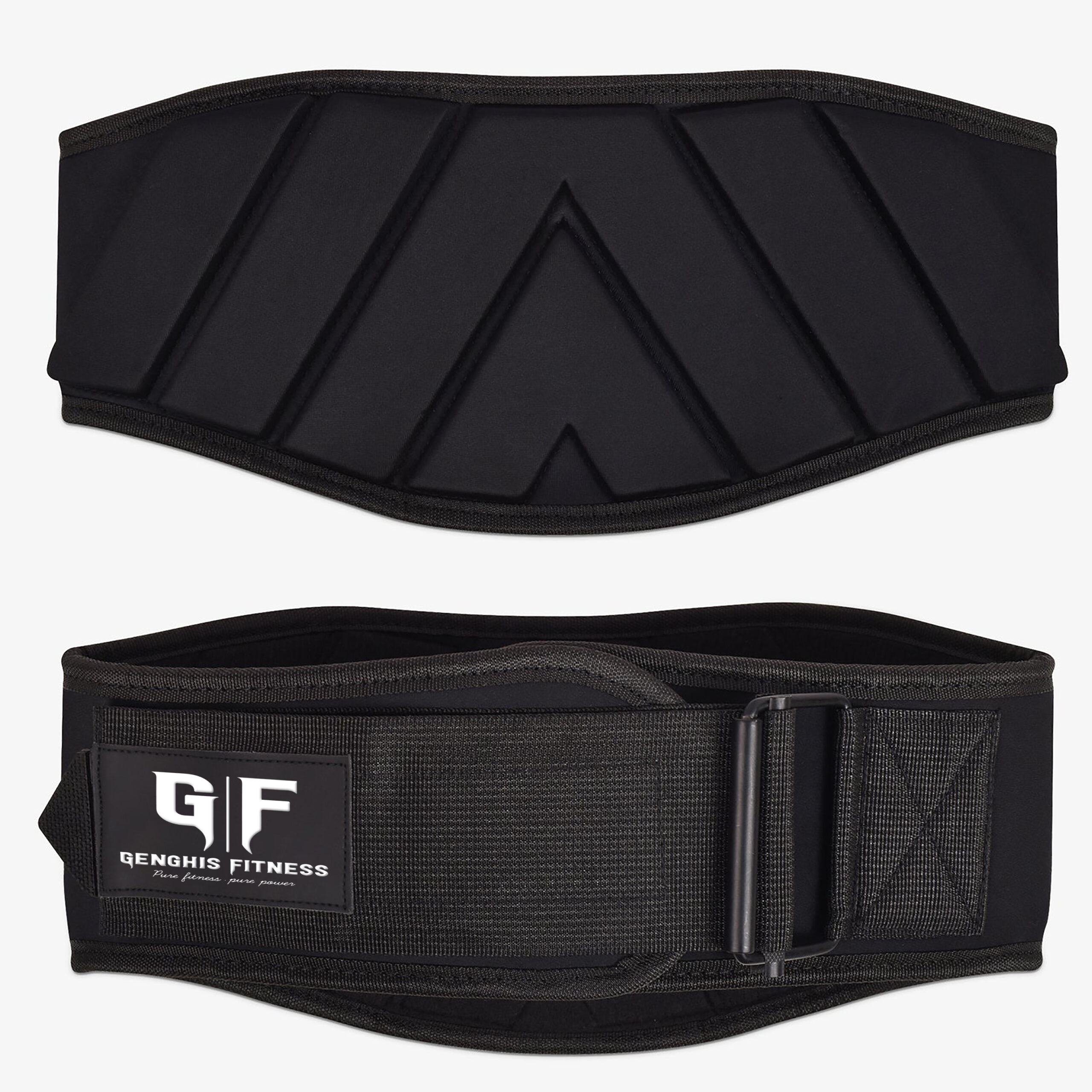
The neoprene weightlifting belt provides comfortable, flexible support for athletes whose training ranges from moderate to heavy intensity without consistently reaching the near-maximum loads of competitive powerlifting. Neoprene is immediately comfortable with no break-in, more flexible at the extremes of squat depth than leather, moisture-resistant, and available at accessible price points. It is the practical choice for CrossFit athletes, recreational lifters, and anyone who trains hard but not at the extreme intensities where leather’s superior rigidity becomes the determining performance variable. The nylon lifting belt uses high-denier webbing to provide firm, adjustable support at the lowest cost in the quality belt market, with superior packability for athletes who train across multiple locations.
HOW TO CHOOSE THE RIGHT LIFTING BELT
Match the belt type to the training context and the training goals. Competitive powerlifters training for federation meets need full-grain leather, either prong or lever based on their preference for adjustment speed between sets. Athletes training at high intensity who value comfort and immediate usability will benefit most from quality neoprene. Athletes who prioritize packability and moisture resistance for daily training convenience will find nylon the most practical choice. Width at 4 inches is appropriate for most athletes. Narrower belts at 3 inches suit athletes with shorter torsos where a 4-inch belt contacts the hip bones at deep squat positions and creates discomfort that interrupts training focus. Always choose a belt that fits the actual training waist measurement rather than the clothing waist size.
SIZING YOUR LIFTING BELT CORRECTLY
Measure your waist circumference at the position you intend to wear the belt during training, typically at or just above the iliac crest. Do not use your clothing waist size, which is typically measured at a different location several inches lower on the torso. Compare your measurement to the manufacturer’s sizing chart and order accordingly. For lever belts, the lever must lock at the position that creates adequate tension for meaningful IAP generation during bracing. For prong belts, the buckle should engage through the middle holes of the available range at your preferred training tension. When choosing between two sizes, size down for lever belts and neoprene sleeves. A slightly snug belt worn at the correct position delivers more functional IAP benefit than a belt that is too large and cannot be adequately tightened during bracing.
HOW TO BRACE CORRECTLY WITH A LIFTING BELT
The belt does not brace for you. It provides the surface that makes deliberate active bracing more effective than unbelted bracing alone. Position the belt at the correct torso location before each heavy set. Take a full breath into the belly and lower back, expanding the torso in all directions. Brace the abs outward with maximum deliberate force against the belt as if preparing to absorb a strong punch to the stomach. Maintain this brace throughout the entire lift from liftoff to lockout. This precise bracing sequence is the technique that produces the IAP increase the research measures and that elite lifters describe as the distinguishing feature of correct belt use. Athletes who wear belts without consciously executing this bracing sequence on every rep get only the passive circumferential support of the belt material, which is significantly less protective than the active bracing IAP mechanism.
PAIRING YOUR BELT WITH OTHER TRAINING SUPPORT
A lifting belt is most effective as part of a complete joint support approach. On heavy squat days, add knee sleeves for joint warmth and proprioceptive support and knee wraps when maximum effort squatting is programmed. On heavy deadlift days, lifting straps eliminate grip as a limiting variable so that the posterior chain determines when the set ends rather than forearm fatigue. On heavy pressing days, wrist wraps maintain wrist alignment under load. Together these tools create the complete mechanical support environment that allows training at the intensities where genuine long-term strength development happens without accumulating the joint stress that forces extended training interruptions.
FINAL WORDS
The lifting belt is not complicated. It is a device that increases intra-abdominal pressure when you brace actively against it, which reduces spinal loading during heavy compound movements. Choose the right material for your training context: leather for maximum rigidity and competition preparation, neoprene for comfort and range-of-motion flexibility, nylon for packability and daily training convenience. Size it correctly using your actual training waist measurement rather than your clothing size. Brace actively on every heavy set with deliberate intent. Use it at training intensities above 80 percent of your maximum and train without it below that threshold to maintain intrinsic core strength. The Genghis Fitness 10mm lever belt and powerlifting leather belt are built to the quality standards that make this tool work as effectively as the research and elite training experience consistently promise.
Certified strength and conditioning specialists with over 10 years of experience in powerlifting, nutrition, and evidence-based fitness content. Based in New York City.
This guide is part of the Genghis Fitness weightlifting belt guides, where 167 articles cover every belt type, training use case, and buying decision from beginner to competition level.