Lactose-Free Milk: What It Is, How It Compares to Regular Milk, and Who Needs It
Lactose-free milk has gone from a niche specialty item to a mainstream grocery staple found in virtually every supermarket in the US and across Europe. For the estimated 65 percent of the global adult population that has some degree of lactose malabsorption, it represents a way to keep dairy in the diet without the bloating, gas, and cramping that regular milk can cause. For people without lactose issues, understanding what lactose-free milk actually is clarifies whether it offers any advantage over regular milk.
The short answer is that lactose-free milk is real dairy milk with one enzyme added. Everything else about its nutritional profile is essentially identical to regular milk. The nuances are worth understanding because they affect how you use it, whether you actually need it, and how it fits into a diet built around performance and recovery.
What Lactose-Free Milk Actually Is
Lactose-free milk is produced by adding the enzyme lactase to regular cow’s milk. Lactase breaks down lactose, the naturally occurring sugar in milk, into its two component simple sugars: glucose and galactose. Both are easily absorbed in the small intestine without requiring the digestive lactase enzyme that lactose-intolerant individuals produce in insufficient amounts.
The process does not involve removing lactose from the milk. The lactose is converted in place, which means the resulting product has the same total carbohydrate content as regular milk but in a different form. Because glucose and galactose are sweeter-tasting than lactose, lactose-free milk tastes noticeably sweeter than regular milk despite containing no added sugar. This surprises many people who expect it to taste identical.
Nutritional Comparison: Lactose-Free vs Regular Milk
Protein and Calcium
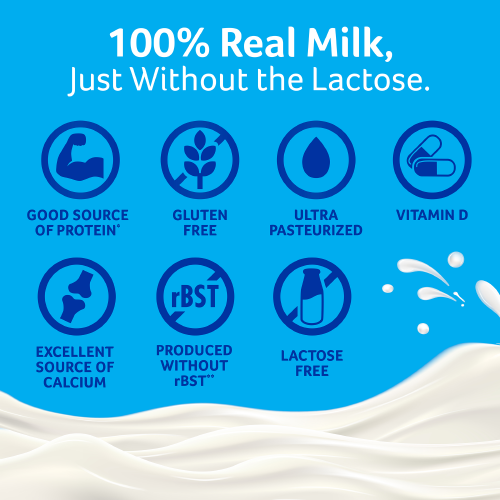
The protein and calcium content of lactose-free milk is essentially identical to regular milk of the same fat percentage. An 8-ounce serving of whole lactose-free milk provides approximately 8 grams of protein, 300 milligrams of calcium, and the same fat content as whole regular milk. The whey and casein protein fractions are completely intact. For athletes using milk as a post-workout protein source, lactose-free milk delivers the same muscle recovery benefits as regular milk.
Calcium absorption from lactose-free milk is comparable to regular milk. Some earlier research suggested that lactose may enhance calcium absorption, but more recent studies have found that people with lactose intolerance absorb calcium from lactose-free dairy at rates similar to those from regular dairy consumed by people without lactose issues. The practical takeaway is that switching to lactose-free milk does not compromise your calcium intake.
Vitamins and Minerals
The vitamin and mineral profile of lactose-free milk mirrors regular milk almost exactly. It provides vitamin D (in fortified versions), vitamin B12, riboflavin, phosphorus, potassium, and iodine in comparable amounts to regular milk. Research indexed on PubMed confirms that the lactase treatment process does not degrade these micronutrients. Lactose-free milk is nutritionally equivalent to regular milk for all practical purposes.
Who Actually Needs Lactose-Free Milk
Lactose intolerance exists on a spectrum. Some people can consume small amounts of dairy without symptoms but react to larger quantities. Others experience significant discomfort from even a small glass of milk. The severity depends on how much residual lactase enzyme the individual produces, the quantity of dairy consumed, whether dairy is eaten with other foods that slow digestion, and the bacterial composition of their gut microbiome.
People of East Asian, West African, Middle Eastern, and Southern European descent have significantly higher rates of lactose malabsorption than people of Northern European descent, where the gene mutation that allows lactase persistence into adulthood is most prevalent. If you are uncertain whether lactose is the source of your digestive symptoms after dairy, a two-week elimination of regular dairy with substitution of lactose-free products is a clean way to test. If symptoms resolve, lactose was likely the issue.
Lactose-Free Milk vs Plant-Based Milk Alternatives
Protein Content
The most important difference between lactose-free cow’s milk and plant-based milk alternatives is protein content. Lactose-free milk contains 8 grams of complete protein per 8-ounce serving with all essential amino acids present. Almond milk contains 1 gram of protein per serving. Oat milk contains 2 to 3 grams. Rice milk contains about 1 gram. Only soy milk approaches dairy at 6 to 8 grams of complete protein per serving.
For athletes and lifters who use milk as a meaningful protein source in their diet, this difference is significant. Switching from lactose-free dairy milk to almond or oat milk to avoid lactose dramatically reduces the protein contribution of that beverage. If you are lactose intolerant and want dairy-level protein from a liquid source, lactose-free milk is the straightforward solution. Plant milks work well for people who are avoiding all dairy for other reasons, but they are not protein equivalents.
Calcium and Micronutrients
Most commercial plant-based milks are fortified with calcium to approach dairy levels, but the bioavailability of fortified calcium from plant milks is slightly lower than from dairy in some studies. The iodine content of plant-based milks is typically much lower than dairy milk, which is worth noting for people who rely heavily on dairy as an iodine source. Lactose-free milk retains all the naturally occurring micronutrients of dairy without the need for fortification.
Using Lactose-Free Milk for Athletic Performance and Recovery
Milk has a well-established role in post-workout recovery. The combination of fast-digesting whey protein and slower-digesting casein protein in dairy milk makes it a natural whole-food recovery drink. Research has compared chocolate milk to commercial sports recovery drinks and found comparable results for glycogen replenishment and muscle protein synthesis in multiple studies. Lactose-free chocolate milk delivers these same benefits without the digestive discomfort for people who react to regular lactose-containing dairy.
Using lactose-free milk in protein shakes, oatmeal, smoothies, and cooking maintains the nutritional contribution of dairy across your diet without any modification to your recipes or meal structure. The taste is slightly sweeter, which most people find agreeable. For serious lifters building a high-protein diet around whole foods, keeping dairy in the picture via lactose-free milk is often easier and more cost-effective than replacing it with supplements. Pair consistent nutrition with reliable training equipment like the powerlifting leather belt and wrist wraps built for athletes who take both sides of performance seriously.
Shelf Life and Storage
Standard lactose-free milk has the same refrigerated shelf life as regular milk, typically seven to ten days after opening. Ultra-high temperature (UHT) processed lactose-free milk, which is common in Europe and increasingly available in the US, has a significantly longer shelf life of several months when stored unopened at room temperature. Once opened it requires refrigeration and should be consumed within seven to ten days.
The longer shelf life of UHT lactose-free milk makes it a convenient pantry staple for people who do not consume dairy daily but want it available for cooking and baking. It is slightly more expensive per liter than standard pasteurized lactose-free milk but the reduced waste from less frequent spoilage often offsets the price difference for moderate consumers.
Cooking and Baking With Lactose-Free Milk
Lactose-free milk performs identically to regular milk in virtually every cooking and baking application. It can be used cup-for-cup in any recipe that calls for regular milk. The slightly sweeter taste is noticeable in beverages but largely imperceptible in cooked or baked applications where other flavors dominate. Sauces, soups, custards, pancakes, and baked goods all turn out identically when lactose-free milk replaces regular milk.
The one minor exception is in very long high-heat applications like caramelization. Because glucose and galactose undergo Maillard browning and caramelization at slightly different temperatures and rates than lactose, lactose-free milk can brown marginally faster in some applications. This is rarely a practical issue but worth knowing if you are doing precise confectionery work.
FINAL WORDS
Lactose-free milk is real dairy milk with the lactose enzymatically converted to simple sugars. Its protein, calcium, and overall nutritional profile are functionally identical to regular milk. If dairy causes you digestive discomfort and lactose is the culprit, lactose-free milk removes the problem without removing any of the nutritional value. It is one of the more elegant dietary solutions available: same food, same benefits, none of the symptoms. Keep your nutrition dialed in and your training consistent with gear built to match your intensity.
Certified strength and conditioning specialists with over 10 years of combined experience in powerlifting, nutrition coaching, and evidence-based fitness content. Based in New York City, the Genghis Fitness team tests every protocol in the gym before writing about it.