Genghis Fitness · Equipment Reviews and Buying
Leather Weightlifting Belt Review Framework: How to Evaluate Any Belt, What Real Performance Testing Reveals, and Red Flags to Avoid
Updated 2026 | By Team Genghis Fitness | 22 min read
Leather weightlifting belt reviews vary widely in quality, from genuine long-term performance assessments by serious strength athletes to short-term impressions from casual gym users who have never loaded the belt to its limits. Understanding how to evaluate belt reviews critically, and what performance characteristics actually matter in real training use, allows athletes to extract useful purchase guidance from the review landscape rather than being misled by reviews that assess belts only at loads and durations too light and brief to reveal their limitations. This guide provides the framework for evaluating any leather weightlifting belt through the lens of real strength training performance.
What Matters in Long-Term Belt Performance
The properties that matter in a leather weightlifting belt become most apparent over weeks and months of real training use at significant loads, not during initial impressions from light lifting or a single session. The performance characteristics to assess in a belt review are: stiffness retention over time (does the belt maintain its firmness after hundreds of training sessions, or does the leather soften to the point of providing inadequate IAP support?), buckle hardware longevity (do the prong or lever mechanism continue to function reliably after hundreds of openings and closings under load?), leather surface durability (does the outer surface maintain its integrity without cracking, delaminating, or fraying at the edges?), and fit consistency (does the belt continue to fit correctly as the leather adjusts to the body, improving rather than deteriorating?). Research on leather structural integrity under repeated loading published in the Journal of Materials Science confirmed that full-grain leather maintains its structural properties through significantly more loading cycles than lower-grade leather alternatives, explaining the longevity difference between premium and budget belt options.
Red Flags in Belt Reviews and Belt Construction
Several construction characteristics predict poor long-term performance and are identifiable before extended use. Multiple layers of thin leather glued together (rather than a single thick piece of full-grain leather) will delaminate along the glue lines under repeated flexing. Edge finishing that reveals rough or uneven leather fibre (rather than smooth, sealed edges) indicates the belt was cut from the interior of the hide where fibre structure is weaker. Stitching that is raised above the leather surface (rather than countersunk into it) will abrade through contact with clothing and the bar during training. Buckle hardware that feels cheap or rattles when shaken is likely to develop mechanical unreliability under the loads of serious training. Any review that does not mention loading the belt to near-maximum strength training loads should be weighted accordingly, as many construction failures only manifest under serious loading.
How to Use Reviews from Serious Strength Athletes
The most useful belt reviews come from athletes who have used the belt for 6 months or more at loads exceeding 80 percent of maximum in squats and deadlifts, and who have specific observations about buckle reliability, leather softening or stiffness retention, and fit over time. Reviews from powerlifters and competitive strength athletes carry significantly more weight than reviews from general gym users because their training demands expose belt weaknesses that moderate loads never reveal. When evaluating a specific belt, look for: reviews mentioning specific training weights and session frequency, reviews that cover at least 3 to 6 months of use, observations about the break-in period and how the belt changed over time, and specific notes about any hardware or construction issues encountered. The complete construction quality checklist that applies to any leather belt evaluation is in our leather weightlifting belt guide.
The Genghis Fitness Leather Belt Performance Profile
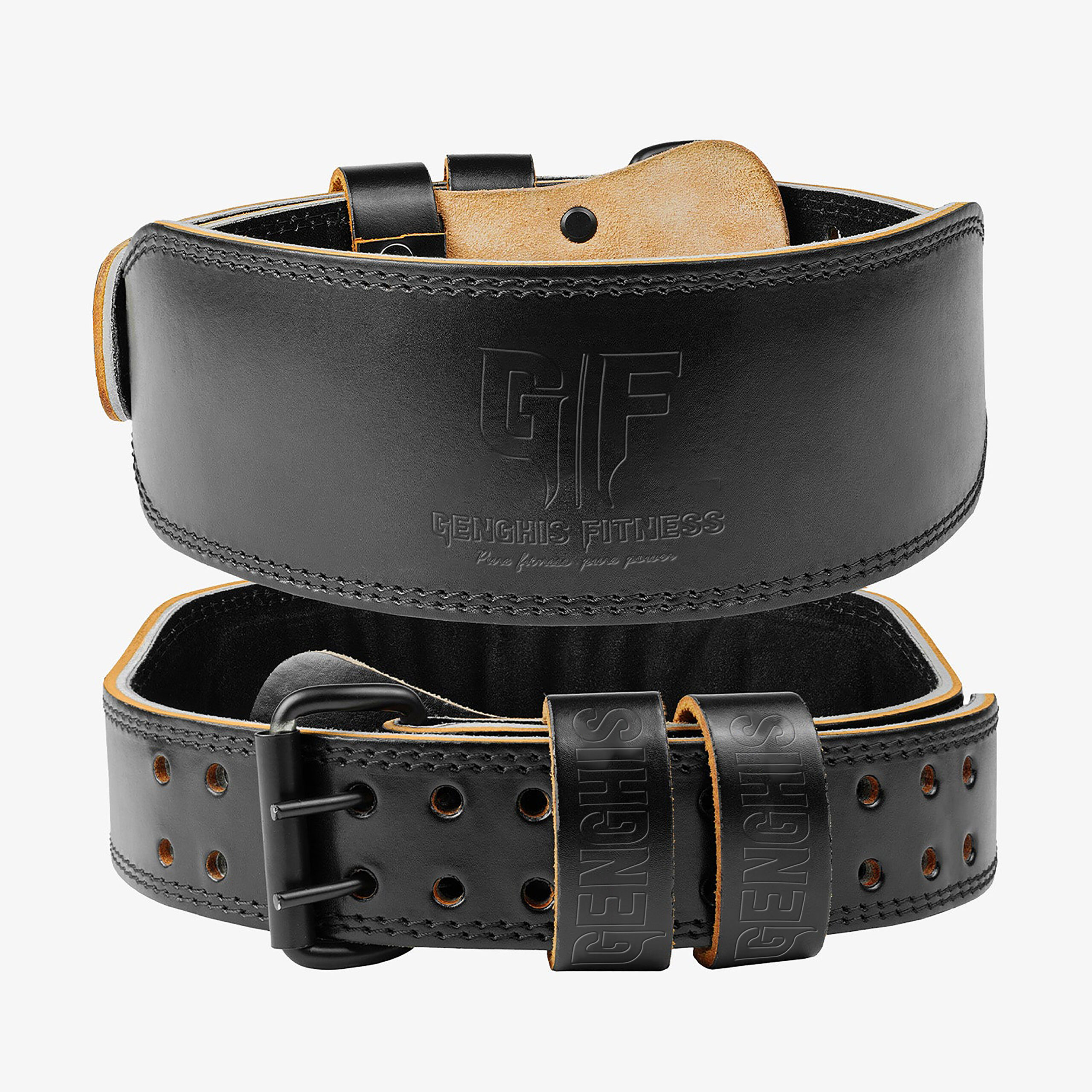
The Genghis Fitness powerlifting leather belt is constructed from full-grain leather at 10mm thickness with competition-legal uniform width, welded D-ring connection points, and countersunk stitching at the edges. The lever variant, the 10mm lever belt, uses a quality lever buckle mechanism designed for rapid on-off under competition time constraints. Both variants are designed around the construction standards that serious strength athletes require for belts used at near-maximum loads in regular training and competition. Athletes looking for the 4-inch leather option will find the 4-inch leather weightlifting belt the appropriate product for training that prioritises the tapered width profile for comfort at the front of the belt.
Genghis Fitness Belt Range: Options Across Different Training Needs
The Genghis Fitness leather belt range covers the main construction formats that serious strength athletes require. The powerlifting leather belt provides the standard prong-buckle format in competition-legal 10mm full-grain leather. The 10mm lever belt provides the lever-buckle format for athletes who prefer the faster on-off mechanism. The 4-inch leather weightlifting belt provides the tapered-width format for athletes who prefer narrower front width. And the custom designed lifting belts allow specification of personal dimensions and aesthetic preferences. Each of these products is designed to meet the construction quality standards described in this review framework: full-grain leather, competition-legal dimensions, reinforced attachment points, and the hardware reliability that serious training demands. Pairing any of these belt options with lifting straps for heavy deadlift sessions and knee sleeves for squat sessions creates the core protective equipment stack for complete strength training across all primary compound movements. Athletes who evaluate belts using the construction quality framework in this guide rather than relying on price or marketing claims as quality proxies consistently make better purchasing decisions. A belt purchased once at the correct quality level for the training demands involved provides better long-term value than multiple cheaper belts purchased sequentially as their construction limitations become apparent under training loads that exceed their design limits. Quality compounds over time in both equipment and the strength built using it. The complete construction evaluation checklist applies equally to every leather belt on the market regardless of brand.
Frequently Asked Questions
How Do You Test a Leather Belt Before Buying Online?
Online belt purchases cannot be physically tested before buying, making the evaluation framework described above the primary quality assessment tool. Look for: clear product photos showing edge finishing quality, stitching depth, and hardware construction; company transparency about leather grade (full-grain versus split leather); return policies that allow return if the belt does not fit correctly; and reviews specifically from athletes who train at the loads you train at. Established strength sports equipment companies that target the powerlifting and Olympic lifting community are more reliable sources than general fitness merchandise sellers because their customer base trains at the loads that expose belt quality differences.
Is a More Expensive Leather Belt Always Better?
Not necessarily, but the correlation between price and quality in leather belts is stronger than in many equipment categories because the primary quality driver (leather grade and thickness) has a direct material cost that cannot be bypassed without compromising quality. Belts below 60 USD almost universally use inferior materials or construction that underperform at serious training loads. Above 150 USD, quality plateaus and additional cost primarily reflects brand premium rather than performance improvement. For most serious training athletes, belts in the 80 to 150 USD range represent the practical quality-to-value optimum.
Evaluate Correctly. Buy Once. Train for Decades.
Quality leather construction that holds up when the weight is real.
Shop Powerlifting BeltShop 10mm Lever BeltCertified strength and conditioning specialists with over 10 years of experience in powerlifting, nutrition, and evidence-based fitness content. Based in New York City.
Related guides and comparisons are collected in the weightlifting belt guides, covering all belt materials, thicknesses, closure systems, and sport-specific recommendations in one location.