LIFTING BELT FOR MEN: HOW TO CHOOSE, USE, AND GET THE MOST FROM YOUR BELT
A lifting belt is not optional equipment for men who squat and deadlift heavy. It is the single most impactful accessory you can add to your compound training. A belt increases intra-abdominal pressure during maximal loading, reduces compressive stress on the lumbar vertebrae and intervertebral discs, and allows athletes to train at higher intensities with greater confidence in spinal safety. The question is not whether to use one. The question is which belt type matches your training style, body proportions, and goals, and how to use it correctly so that you extract the full performance and protective benefit the tool is designed to deliver.
WHAT A LIFTING BELT ACTUALLY DOES
The mechanism of a lifting belt is not about restricting the torso or substituting for core strength. It is about giving the core musculature a rigid surface to brace against, amplifying the effect of deliberate core engagement during heavy loading. When you take a deep breath into the belly and brace your abs outward against the belt, the resulting pressure increase inside the abdominal cavity acts as a hydraulic cushion that supports the lumbar spine from the inside. Research on intra-abdominal pressure during belted lifting consistently demonstrates IAP increases of 30 to 40 percent with a properly fitted, actively braced belt compared to unbelted lifting at equivalent loads. This pressure increase reduces the bending moment on the lumbar spine and directly decreases the compressive force on the discs and facet joints that accumulates across a heavy training session.
THE MAIN LIFTING BELT OPTIONS FOR MEN
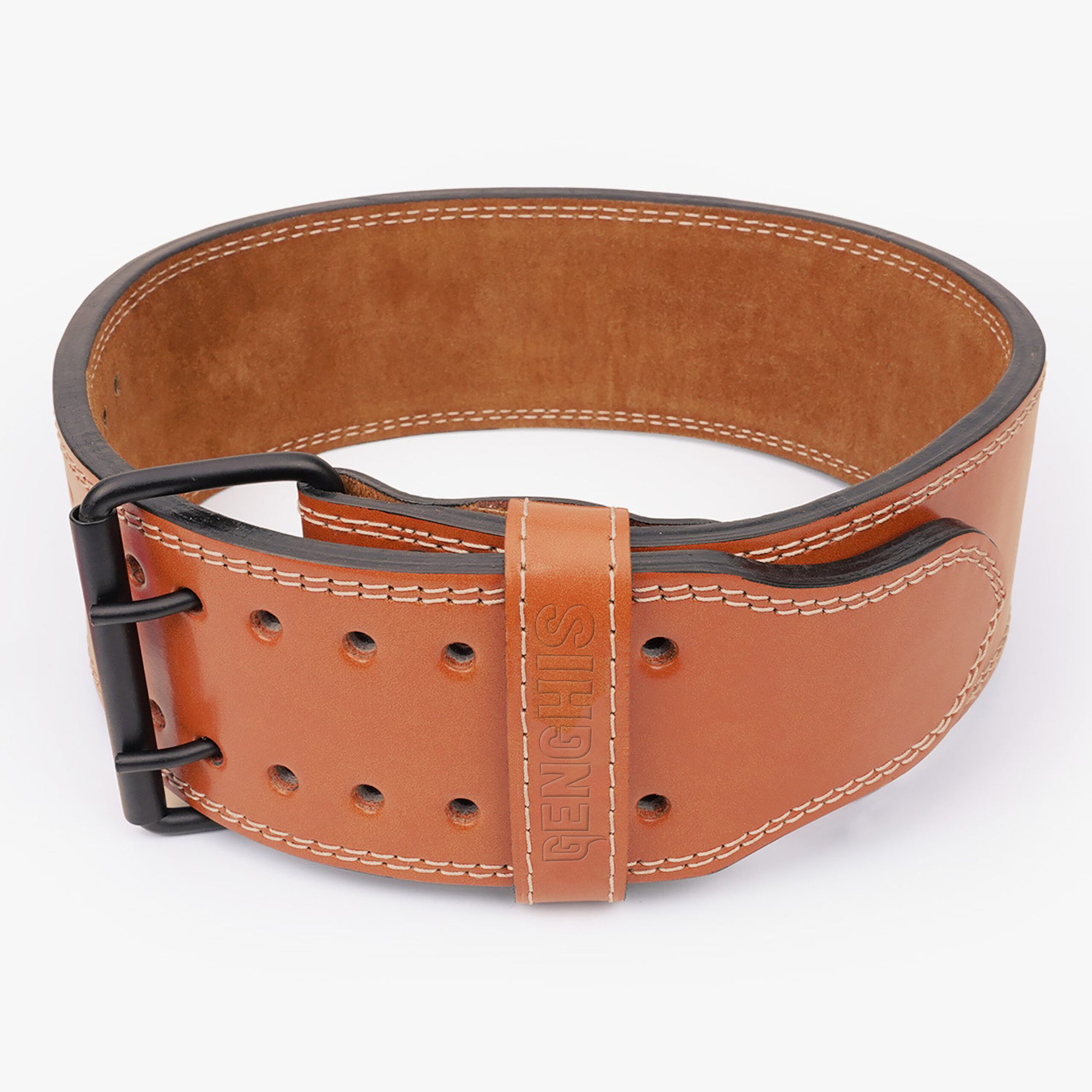
LEATHER POWERLIFTING BELT
The leather powerlifting belt is the standard choice for athletes who compete in powerlifting federations or who prioritize maximum rigidity for maximal loading sessions. Full-grain leather at 10mm thickness provides the stiffest bracing surface available, generating the highest intra-abdominal pressure per unit of bracing effort. The break-in period of four to six weeks is the primary trade-off compared to synthetic alternatives. Once broken in, a quality leather belt conforms to the individual body geometry of the athlete who uses it, creating a personalized fit that no synthetic material can replicate over time. The 10mm lever belt provides the same full-grain leather rigidity with the quick-release lever closure that eliminates the slow threading of prong designs between heavy sets, making it the practical preference for most serious athletes.
NEOPRENE BELT
The neoprene weightlifting belt offers immediate comfort with no break-in period, better flexibility at the extremes of squat depth than leather, and a price point that is accessible to athletes at every budget level. Neoprene is appropriate for general strength training, CrossFit, and functional fitness where the training intensity ranges from moderate to very heavy but does not consistently reach the near-maximum loading of competitive powerlifting. For men who train hard multiple times per week but are not preparing for powerlifting competition under federation rules, a quality neoprene belt provides genuine and meaningful spinal support across every session without the cost or maintenance demands of leather.
NYLON BELT
The nylon lifting belt uses high-denier webbing and a roller buckle or lever closure to deliver firm, adjustable support at the lowest cost in the quality belt category. Width is consistent at 4 inches across the full circumference, creating even support coverage from lumbar through anterior abdominal contact. Nylon is lighter than leather, packs flat in any gym bag, and handles sweat without requiring conditioning. For men who split their training between multiple facilities or who travel frequently for work, the packability of a nylon belt makes it the most practical everyday training choice that does not compromise the support function that heavier compound training demands.
HOW TO SELECT THE RIGHT SIZE
Belt sizing is one of the most commonly misunderstood purchasing decisions in strength training. Measure your waist circumference at the exact position you intend to wear the belt during training, typically at or just above the iliac crest for squat and deadlift work. Do not use your clothing waist measurement, which is typically taken several inches lower on the body. Compare your training waist measurement to the manufacturer’s sizing chart. For lever belts, the lever must be able to lock at the tension position that provides the desired support level during bracing. For prong belts, the buckle should reach through the correct hole range at your preferred training tension without being positioned at either extreme. When in doubt between two sizes, size down for lever belts and neoprene sleeves. A slightly tighter belt worn at the correct position delivers more functional IAP benefit than a belt that is too large and cannot be tightened to adequate bracing resistance.
CORRECT BRACING TECHNIQUE WITH A BELT
A belt only produces its full IAP benefit when the core actively braces against it on every rep of every set. Wearing a belt without bracing correctly produces only passive circumferential support, which is far less protective than the active bracing IAP mechanism that the research consistently measures and validates. The correct bracing sequence for every heavy set: position the belt at the correct torso location, take a deep breath into the belly and lower back simultaneously to expand the torso circumferentially in all directions, then brace the abs outward with maximum deliberate force against the belt as if preparing to absorb a punch to the stomach. Maintain this brace from the moment the weight leaves the rack or floor until it is safely back to the starting position. Practice this bracing pattern consistently on every warm-up set so it is completely automatic on the working sets where it matters most for both performance and spinal safety.
COMPLETE EQUIPMENT SETUP FOR HEAVY TRAINING
A lifting belt works best as part of a complete support equipment system that addresses every major joint under sustained heavy loading. Pair it with knee sleeves for joint warmth and compression throughout every squat session and knee wraps for maximum effort squat days when additional joint support and elastic assistance are warranted. Use lifting straps on high-volume deadlift sets where grip would otherwise limit the posterior chain training volume that actually builds strength. On heavy pressing days, wrist wraps maintain wrist alignment under load so that the joint is supported through every pressing rep. These tools together create the mechanical support environment where you can train at the intensities that produce genuine long-term strength development while managing cumulative joint stress intelligently enough to train consistently for years.
FINAL WORDS
A lifting belt for men is the most evidence-supported, most practically impactful training accessory available for anyone who lifts heavy. Choose the material that matches your training context: leather for maximum rigidity and competition preparation, neoprene for comfort and versatility across all intensities, nylon for packability and daily training convenience. Size it correctly using your actual training waist measurement. Brace actively against it on every heavy set. Reserve it for the intensities where it genuinely matters and train without it on lighter work to maintain intrinsic core strength. The Genghis Fitness 10mm lever belt and powerlifting leather belt are built to the standards serious training demands. Get the right one, learn to use it correctly, and let the IAP science do what decades of elite lifting experience and peer-reviewed research confirm it does.
Certified strength and conditioning specialists with over 10 years of experience in powerlifting, nutrition, and evidence-based fitness content. Based in New York City.
The complete weightlifting belt guides answers every belt question in one place: which type suits your training, how to size correctly, how to break in leather, and how to brace with a belt for maximum intra-abdominal pressure.