Neoprene vs Leather Weightlifting Belts: The Complete Powerlifter’s Guide for US and European Strength Athletes
Your belt choice shapes every heavy rep you will ever pull, squat, or press. Here is the definitive breakdown so you never second-guess it again.
Walk into any serious powerlifting gym from Brooklyn to Birmingham, England, and something becomes immediately obvious. The biggest, strongest lifters in the room are almost always wearing a belt. But look closer and you will notice they are not all wearing the same belt. Half are in thick, rigid leather. The other half are in flexible neoprene. Some have a lever buckle that clicks shut with one finger. Others are cinching a traditional prong through a row of holes.
Every single one of those athletes made a deliberate choice. That choice was not random. It reflects their sport, their training style, their competition requirements, and their specific body mechanics. And if you are lifting heavy without having made that same deliberate choice, you are either using the wrong tool or leaving performance on the table.
This is the guide that ends the confusion. We are going deep into the actual mechanics of what a weightlifting belt does to your body, what neoprene and leather each bring to the table, how the two compare across every practical category that matters, what a nylon belt does differently, why belt thickness is a legitimate performance variable, and which exact setup works for each type of athlete. By the time you finish this, you will know precisely what to buy and why.
No brand fluff. No fence-sitting. Real information for real lifters who are serious about their training.
Why the Belt You Choose Has Real Biomechanical Consequences
Most people have the wrong mental model of what a weightlifting belt actually does, and this incorrect understanding leads directly to bad purchasing decisions and poor belt technique. The popular belief is that the belt braces your spine the way a back brace does, holding your lumbar vertebrae in place by external force. This is completely wrong, and understanding why it is wrong is the foundation of understanding why material choice matters.
A weightlifting belt does not support your spine directly. What it does is create a rigid, non-yielding surface for your core muscles to actively push against. When you brace your core correctly, taking a massive breath and expanding your entire torso in every direction as if you are about to absorb a punch, you dramatically increase intra-abdominal pressure. This pressurized column of fluid and air in your torso acts as a hydraulic cylinder that mechanically reduces compressive and shear forces on the lumbar spine during loaded movement.
The belt amplifies this mechanism by giving your abdominal muscles a wall to push against. Without a belt, your core can only expand as far as your skin and fascia allow. With a rigid belt, your core can generate force against an unyielding external surface, increasing intra-abdominal pressure far beyond what bare bracing achieves. Research published in studies indexed on PubMed covering intra-abdominal pressure during resistance training has shown that wearing a weightlifting belt can increase intra-abdominal pressure by 30 to 40 percent compared to unbelted lifting at equivalent loads. That is a significant mechanical advantage that directly translates to greater spinal protection and higher performance capacity under heavy weight.
Here is the critical point that makes the material question relevant: the belt’s ability to generate this effect depends entirely on how rigid and incompressible it is under load. A belt that compresses or gives way when you brace against it fails the primary mechanical purpose. A belt that holds its shape absolutely, giving your core a true rigid wall to push against, maximizes the pressure effect and delivers real performance and safety benefits. This is the central biomechanical reason leather and high-grade neoprene exist in their current forms, and it is why the neoprene versus leather question is ultimately a question of physics applied to human performance.
What Is a Neoprene Weightlifting Belt? The Full Science and Practical Breakdown
Material Properties and Why Neoprene Works for Athletes
Neoprene is a synthetic polychloroprene rubber originally developed by DuPont in the early 1930s and has since found applications in wetsuits, medical braces, and athletic support gear. In weightlifting belt applications, neoprene is used because of a very specific property combination: it resists compression under moderate loads while remaining flexible enough to allow natural torso movement, and it provides thermal insulation that keeps the lower back muscles warm and pliable throughout training.
High-quality neoprene belts are typically 7mm to 10mm thick and are reinforced internally to increase their resistance to compression without sacrificing the flexibility that defines the material. The construction often involves multiple neoprene layers bonded together with a nylon outer shell for durability and moisture resistance. Some premium neoprene belts incorporate internal plastic or polypropylene stiffeners to bridge the gap between the material’s natural flexibility and the rigidity a heavy lifter needs.
The most common design feature of neoprene belts is the contoured or anatomical shape. Rather than being a uniform rectangle, neoprene belts typically taper at the front (narrower over the abdominal area to allow comfortable breathing and hip flexion) and widen at the back (providing maximum coverage over the lumbar spine). This design makes them genuinely comfortable for long training sessions and movements that require significant forward lean.
Closure systems are where neoprene belts differ most from leather. The vast majority use a hook-and-loop Velcro system that allows stepless adjustment and rapid on/off capability. Some higher-end neoprene options use dual Velcro strips, double-layer backing, or reinforced adhesive bonding to maintain grip strength under heavy loads and resist the slow degradation that standard Velcro experiences over months of heavy use.
Who Should Be Using a Neoprene Belt: The Athlete Profile
Neoprene belts have a very defined athlete profile that they serve exceptionally well. The ideal neoprene belt user is a lifter whose training involves high-volume, dynamic, multi-modal, or rapidly transitioning movement patterns. This is the CrossFit athlete who cycles through heavy thrusters, power cleans, and 400-meter runs in a single workout. This is the functional fitness competitor who needs lumbar support during barbell movements but cannot have a thick, rigid belt restricting their movement quality during gymnastics or conditioning work.
The Velcro closure system, often cited as neoprene’s weakness (and it does have limitations), is actually a genuine competitive advantage in this context. A competitive CrossFit athlete can put on a neoprene belt in under five seconds, pull a heavy squat clean, rip the Velcro open, run 800 meters, and put the belt back on without losing meaningful time in a workout. A thick leather belt with a prong buckle cannot match this practical convenience in a multi-modal training environment.
Neoprene also suits recreational lifters and gym-goers who train for general health and fitness rather than sport performance. If you are squatting, deadlifting, and pressing four days a week at intensities between 60 and 80 percent of your maximum, a neoprene belt provides meaningful lumbar support during your heaviest sets while staying comfortable and non-restrictive throughout the rest of your session. The zero break-in period means you get immediate functional performance from day one.
Athletes who train in environments where the belt needs to double as warmth, such as outdoor strength gyms in colder climates or during early morning winter training sessions across the Midwest, the UK, or Northern Europe, also benefit from neoprene’s thermal retention properties. The material actively traps body heat, keeping the lower back muscles at working temperature between sets.
The Honest Pros and Cons of Neoprene Belts
What neoprene does well: Immediate comfort from the first session with zero break-in period, lightweight and compact for athletes who travel frequently, excellent versatility across diverse movement patterns, Velcro closure allows rapid transitions between belt-on and belt-off states, thermal retention benefits for cold environments, generally lower price point than equivalent leather belts.
Where neoprene falls short: Velcro degrades over time and loses grip strength with accumulated lint and debris, the material has inherent compressibility that limits its effectiveness at truly maximal loads, contoured design can create localized pressure points in some body types, lifespan is typically 2 to 4 years of heavy use versus 15 or more years for quality leather, not permitted in many sanctioned powerlifting competitions.
The most important honest limitation of neoprene is what happens at intensities above 85 to 90 percent of your one-rep maximum. At those loads, the belt needs to be genuinely rigid to create the firm wall your core needs to push against. Neoprene, regardless of quality, has some degree of compressibility built into the material. Under extreme load, that slight flex limits the magnitude of intra-abdominal pressure you can generate. For recreational lifters who train at moderate intensities, this difference is largely academic. For competitive powerlifters training at near-maximal intensities regularly, it is a meaningful performance limitation.
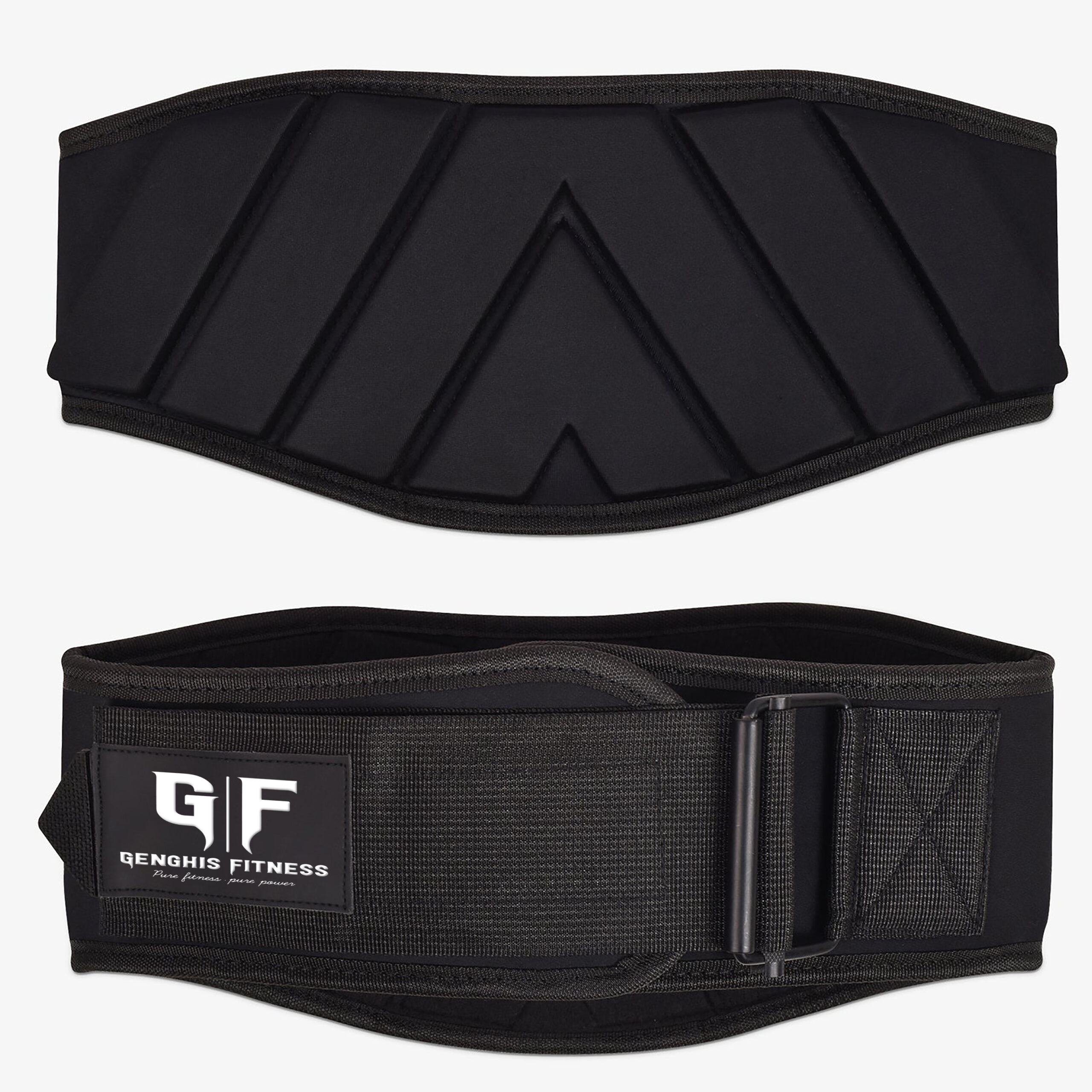
The Genghis Fitness Neoprene Weightlifting Belt is built for athletes who need reliable lumbar support and all-day wearability without the rigid break-in process that leather demands. If your training is dynamic, fast, and varied, this is your belt.
What Is a Leather Weightlifting Belt? Why Powerlifters Have Trusted It for Over a Century
The Material Science of Full-Grain Cowhide in Strength Applications
Leather has served strength athletes since before organized powerlifting existed as a sport. The reason is not tradition or aesthetics. The reason is that properly tanned, full-grain cowhide is one of the most rigid, incompressible, durable flexible materials available for this specific application. Under the loads generated by elite strength athletes, a quality leather belt does not compress, does not yield, and does not fail. It gives your core muscles the most rigid possible surface to push against, maximizing the intra-abdominal pressure mechanism described above.
Construction quality is what separates functional leather belts from overpriced disappointments. The best leather weightlifting belts are cut from a single piece of full-grain cowhide (the outermost layer of the hide, which has the tightest fiber structure and the greatest tensile strength). They are vegetable-tanned rather than chrome-tanned, a slower and more expensive process that produces a stiffer, denser, more structurally consistent material. The thickness is uniform across the entire belt, typically either 10mm or 13mm, and the width is consistent all the way around (usually 4 inches, approximately 10 centimeters) rather than tapering at the front.
This uniform width and consistent thickness design is what makes leather belts the choice for powerlifting competition. Regularity of support across the full circumference of the torso, combined with genuine incompressibility, creates the optimal environment for generating maximum intra-abdominal pressure in a competition squat, deadlift, or bench press.
The Break-In Period: What Every New Leather Belt Owner Needs to Know
More lifters have given up on leather belts prematurely because of the break-in period than for any other reason. A brand new, high-quality leather belt is stiff. Genuinely, almost board-like stiff. The first few sessions wearing it can be uncomfortable, producing pressure points at the edges and requiring significant effort to buckle and adjust. This experience leads some athletes to conclude that leather belts are simply not for them, which is a mistake based on a fundamentally temporary experience.
The break-in period for a 10mm leather belt typically takes 4 to 8 weeks of regular training use. A 13mm belt takes somewhat longer. During this period, the leather is slowly compressing at the stress points specific to your torso shape, conforming to the precise geometry of your individual body. What starts as a stiff, universal piece of material gradually transforms into something that fits your exact dimensions, your exact pressure points, your exact buckle position. After full break-in, a quality leather belt does not feel like a piece of external equipment. It feels like an extension of your core.
To accelerate the break-in process, experienced powerlifters manually flex the belt back and forth along its length repeatedly before initial use, apply a leather conditioner (neatsfoot oil, lanolin-based conditioner, or commercial leather dressing are all widely used), and wear the belt during warm-up sets rather than only on working sets. The more time the leather spends bent around your torso under load, the faster it develops a personalized shape. Patience here is genuinely rewarded.
One more important point: no two leather belts feel the same after break-in. Your belt becomes uniquely yours in a way that is difficult to fully describe until you experience it. It fits nobody else’s body as well as it fits yours. This personalization is one of leather’s most underappreciated long-term advantages.
Honest Pros and Cons of Leather Weightlifting Belts
What leather does well: Superior rigidity for maximum intra-abdominal pressure at near-maximal and maximal loads, approved for sanctioned competition across IPF, USAPL, British Powerlifting, and most European federations, dramatically longer lifespan (15 to 25 years with proper care), becomes increasingly personalized to your body over time, provides consistent and repeatable bracing surface for every heavy rep.
Where leather falls short: Significant break-in period that requires patience and commitment, heavier and bulkier to transport than neoprene, prong buckle requires two hands and more time to adjust between sets (lever buckle largely solves this), higher initial purchase price, not practical for workouts involving rapid continuous transitions, requires periodic leather conditioning to maintain material integrity.
The Genghis Fitness Powerlifting Leather Belt is made from full-grain cowhide to competition specifications and designed to deliver maximum intra-abdominal support for athletes who are serious about their squat, deadlift, and total numbers. This is the foundation piece of any serious competitive powerlifter’s gear setup.
Lever Buckle vs Prong Buckle: The Closure System Comparison That Changes the Game
Within the leather belt category, the choice between a lever closure and a prong buckle closure is the next decision to make, and it is one that directly affects your day-to-day training experience.
A prong buckle works exactly like a traditional belt, with a roller and one or two prongs that fit through holes punched in the leather. Single-prong and double-prong designs both exist. Single-prong is generally preferred for competition because it is easier to adjust and the single-prong mechanism is more reliable under extreme loads. Double-prong adds a small amount of additional security but can be more cumbersome to buckle and unbuckle between sets.
A lever buckle uses a hinged metal plate that snaps into a slotted bar attached to the belt. You set the adjustment once by sliding the lever bar to the correct hole position, and from that point forward you simply open and close the lever to put on and take off the belt. The same exact tightness every single time, achievable with one hand in a matter of seconds. For competitive powerlifters who want total consistency in belt position and tightness across every working set, the lever system is the superior choice.
The trade-off is that adjusting a lever belt requires a hex key or screwdriver to move the adjustment bar. If your weight fluctuates (as it does for athletes who cut weight for competition), or if you want to wear the belt slightly tighter for competition than you do in training, you need to carry a tool and spend a few minutes making the adjustment. For athletes whose weight is stable and whose training tightness matches competition tightness, this is a non-issue.
The Genghis Fitness 10mm Lever Belt gives you competition-legal 10mm thickness with the one-click convenience that makes heavy training sessions faster and more consistent. If you are stepping on a powerlifting platform, this is the system most elite competitors trust.
Neoprene vs Leather Head to Head: Every Variable That Matters
Rigidity and Support at Maximal Loads: Where the Real Difference Lives
At training intensities below 75 percent of your one-rep maximum, the practical support difference between a quality neoprene belt and a quality leather belt is small for most athletes. At these intensities, your technique, your breathing pattern, and your independent core bracing strength are the dominant factors. Both materials provide a meaningful increase in intra-abdominal pressure over unbelted training, and neither material is failing you at moderate loads.
Increase the intensity to 80, 85, 90 percent and above, and the separation becomes real and measurable. The rigid surface of a properly broken-in leather belt provides a bracing wall that allows significantly greater core force production than neoprene’s more compliant material. Under maximal loads, the small compressibility of even high-quality neoprene limits the peak intra-abdominal pressure you can achieve. For athletes training in the 85 to 100 percent intensity range regularly, this is not a theoretical difference. It affects your ability to maintain bracing position through the sticking point of a maximal squat or the lockout of a heavy deadlift.
Think of bracing against a concrete wall versus bracing against a thick rubber mat. Both give you something to push against. One gives you a firm, unyielding surface that returns all your force back into your body as bracing stability. The other absorbs some of that force into its own deformation. That is the difference between leather and neoprene under extreme load.
Comfort and Wearability Across Long US and European Training Sessions
This category goes to neoprene without question for new users. From literally the first session, a neoprene belt is comfortable, conforms to the body, and requires zero adjustment period. Walk into the gym, put it on, train hard, take it off. The experience is seamless.
Leather takes weeks to reach the same comfort level, and the early sessions with a new leather belt can genuinely be a test of patience. However, once a leather belt reaches full break-in, the comfort gap between the materials narrows substantially. Many veteran powerlifters with decades of experience describe their broken-in leather belt as more comfortable than neoprene because it has conformed precisely to their body’s specific contours and pressure points in a way that no neoprene belt, which is designed for general body types, can replicate.
For athletes training in hot, humid environments, such as outdoor strength facilities in Texas summers or gym boxes without climate control, neoprene’s thermal retention can become a liability. The same property that keeps the lower back warm during cold morning training makes the belt uncomfortably hot in high-temperature environments. Leather breathes somewhat better and does not accumulate heat to the same degree, which some athletes find genuinely preferable during long summer training sessions.
Durability, Lifespan, and Long-Term Value Calculation
This is where the true cost analysis changes the financial picture completely. A high-quality leather belt maintained with basic care (periodic conditioning, proper storage, cleaning after sessions) lasts 15 to 25 years. There are competitive powerlifters using the same leather belt they bought when they were 22 years old. The structural integrity of full-grain cowhide does not meaningfully degrade under normal training conditions over these time scales. The leather may develop surface patina, the finish may wear in high-contact areas, but the functional structure remains intact.
A neoprene belt has a finite functional lifespan driven primarily by Velcro degradation. Standard hook-and-loop Velcro accumulates lint, fabric fibers, and debris over time, progressively losing its grip strength. Most neoprene belts need replacement every 2 to 4 years with heavy training use. The neoprene material itself can also crack or delaminate at the stress points over time, particularly in the area where the belt bends repeatedly each session.
When you calculate cost per year of ownership at quality price points, a premium leather belt that lasts 20 years at a higher upfront cost delivers significantly lower annual cost than repeatedly replacing neoprene belts every three years. Gym and fitness equipment represent a real ongoing expense for serious athletes. The long-term math consistently favors quality, durable gear over cheaper replacements. The team at SGFinance Calculators has broken down gym membership and active lifestyle costs in a framework that makes this kind of long-term value thinking concrete and actionable. Whether you are tracking gym expenses in Singapore, New York, or London, the principle is the same: smart upfront investment in gear that lasts beats repeated spending on replacements.
Competition Legality Across Major US and European Federations
This category is straightforward and often the deciding factor for competitive athletes. Most major powerlifting federations, including the IPF (International Powerlifting Federation), USAPL (USA Powerlifting), British Powerlifting, the European Powerlifting Federation (EPF), and the majority of national federations across both sides of the Atlantic, specify that competition belts must be made from leather or similar non-elastic material. Maximum width is typically 10 centimeters (approximately 4 inches).
Neoprene belts are not permitted in most sanctioned powerlifting competitions. Using a neoprene belt exclusively in training and then switching to a leather belt for competition day is a recipe for underperformance. The mechanical difference between materials is significant enough that your body needs to adapt to the specific feel and rigidity of a leather belt before using it in competition. If you plan to compete in sanctioned powerlifting, train in the equipment you will compete in.
Some tested federations and unsanctioned events are more permissive about belt material and construction. Strongman competitions, for example, typically allow any belt style. Check your specific federation’s equipment rulebook before making a purchase decision based on competition requirements.
Price and Budget: Making the Right Investment Decision
Neoprene belts span a wide price range from approximately $20 for basic single-layer designs to around $80 for premium reinforced options. Quality neoprene belts in the $40 to $60 range represent a reasonable investment for recreational and functional fitness athletes. Budget neoprene belts at the very low end are sometimes worthwhile because the material and construction tolerances at this price point are still functional for moderate training loads.
Leather belts from reputable manufacturers typically range from $60 to $200 depending on construction quality, thickness, and closure system. The critical advice here is to avoid cheap leather belts under $40 to $50. Belts at this price point are almost universally made from bonded leather (leather scraps glued together), multi-layer laminated hides rather than single-piece full-grain cowhide, or lower-quality tanning processes that produce a less rigid, less durable material. They do not deliver the performance and longevity advantages of real leather and often perform worse than a quality neoprene belt. If you are investing in leather, invest correctly or stick with neoprene until you can.
Nylon Lifting Belts: The Third Option Every Serious Lifter Should Know About
The neoprene versus leather conversation dominates belt discussions, but nylon weightlifting belts represent a genuinely different solution worth serious consideration, particularly for Olympic weightlifters, hybrid athletes, and athletes in sports where barbell work is a training tool rather than the sport itself.
High-quality nylon belts are constructed from tightly woven nylon webbing (the same material used in heavy-duty strapping and seat belts) combined with a ratchet or lever closure system. They are typically 4 inches wide, which matches competition leather belt specifications, and range from about 7mm to 10mm in effective thickness. They weigh significantly less than leather belts of equivalent width, fold flat for storage and travel, and require no break-in period.
Where nylon shines is in Olympic weightlifting and other sports involving technical overhead or highly positional movements. During the snatch and clean and jerk, the bar needs to travel close to the body through specific geometric positions, and the athlete needs to move into deep squat positions and locked-out overhead positions that a very rigid belt can interfere with. A nylon belt provides meaningful support during the pull phase of these movements without the rigidity that blocks position quality during the receiving and overhead phases.
Nylon also works well for strength and conditioning athletes (football players in US programs, rugby players in European club programs) who incorporate significant barbell volume into their training alongside sport-specific conditioning. The goal for these athletes is building strength and power to express in their sport, not maximal powerlifting performance. Nylon gives them the support they need without the maintenance demands of leather and with more positional freedom than rigid leather allows.
The Genghis Fitness Nylon Lifting Belt delivers serious support with a lightweight footprint that travels well and transitions smoothly between training modalities. If your training lives between the worlds of pure powerlifting and pure athletic conditioning, nylon is worth a hard look.
Belt Thickness Explained: 10mm vs 13mm for Powerlifters in the US and UK
The 10mm Belt: Competition-Legal Versatility for Intermediate to Advanced Lifters
The 10mm leather belt is the most widely used option in sanctioned powerlifting competition across the US, UK, and European federations. The IPF, USAPL, British Powerlifting, and EPF all permit 10mm belts in competition, and most elite lifters at world-level competition use 10mm as their standard choice. The reason is practical: 10mm provides excellent rigidity and intra-abdominal pressure support at near-maximal and maximal loads while remaining manageable in terms of break-in time and wearability through a full competition session.
For athletes who compete in weight classes and monitor the weight of their gear carefully, 10mm leather is also the lighter option. Every gram matters in close weight class situations, and a 13mm belt adds meaningful mass to the scale weight.
The 10mm break-in period is also shorter than 13mm. For most athletes training consistently, a 10mm belt reaches functional break-in within 4 to 6 weeks. The leather is thinner and therefore more responsive to the repetitive flexion that constitutes the break-in process.
The 13mm Belt: Maximum Rigidity for Elite-Level Loads and Specific Competition Formats
A 13mm leather belt is the most rigid, most supportive option in the standard range. Elite-level powerlifters who regularly work with weights in the top 1 to 2 percent of human lifting capacity sometimes prefer 13mm for the additional rigidity it provides. At loads of 600, 700, 800 pounds and above, that extra 3mm of incompressible leather creates a meaningfully more stable bracing environment that can make a real difference at the limits of human performance.
The break-in process for 13mm is substantially longer and requires more dedication. Expect 8 to 12 weeks of regular use before a 13mm belt feels comfortable and fully personalized. The initial stiffness is significant and the early sessions require patience. Belts this thick can also create edge bruising in the early break-in weeks, particularly for athletes with prominent lower ribs or hip bones.
Not all federations permit 13mm in competition. Some specify maximum thickness requirements, and 13mm may fall outside those limits. Check your federation rulebook. For recreational powerlifters who train heavy but do not compete, or for strongman competitors where rules are more permissive, 13mm is worth considering if you are regularly training at elite-level loads. For most competitive athletes, 10mm is the more practical and widely applicable choice.
How to Size Your Weightlifting Belt Correctly: Avoid the Most Common Buying Mistake
Belt sizing is where a significant percentage of first-time buyers make an expensive mistake. Using your pants waist size or estimating based on general body size consistently leads to belts that are too large, too small, or sized correctly on paper but positioned incorrectly due to a misunderstanding of where the belt actually sits.
The belt does not sit at your pants waist. It sits between the top of your hip bones (the iliac crest) and the bottom of your lowest ribs. For most athletes, this puts the belt 2 to 4 inches higher than the pants waist. Measure your actual torso circumference at this exact position with a soft measuring tape while standing naturally and not holding a tensed position. This measurement is your true belt sizing reference.
For leather belts with prong or lever closures, the target fit is for the belt to buckle approximately at the middle hole of the available range when fastened at your training tightness. This gives you adjustment range in both directions as your weight fluctuates or as the leather stretches slightly during break-in. If you are exactly between sizes, sizing down for leather (because leather stretches) and sizing up for neoprene (because the Velcro is adjustable and you want full coverage) is the standard recommendation.
For neoprene belts with Velcro closures, the critical measurement is that the Velcro panel overlaps by at least 3 to 4 inches when fastened at your heaviest-use tightness. Insufficient Velcro overlap creates a belt that can pop open under a heavy load, which is a dangerous failure mode during a maximal effort. If you are near the boundary between neoprene belt sizes, always go larger to ensure adequate Velcro contact area.
One mistake worth specifically calling out: buying a belt so small that you can only fasten it at the tightest possible setting leaves you zero room for adjustment as your training evolves. You want adjustment room on both ends. A belt that only works at maximum tightness has nowhere to go when you need it tighter (for a competition attempt) or want it slightly looser (for a high-rep set during a volume training block).
When Should You Start Using a Belt? The Training Philosophy Debate Across Strength Communities
The “Build Foundation First” School of Thought
A significant contingent of experienced strength coaches in American and European powerlifting programs advocates for spending the first 6 to 12 months of serious barbell training without a belt. The reasoning is grounded in core development physiology. Your ability to generate intra-abdominal pressure depends on the strength and coordination of your core musculature: the transverse abdominis, the diaphragm, the internal and external obliques, and the multifidus. These muscles need to be trained independently before a belt amplifies their function.
If you introduce a belt too early, before these muscles have developed adequate baseline strength and coordination, the belt becomes a compensatory device rather than a performance amplifier. Lifters who rely on a belt from their earliest training sessions often develop a bracing skill that only works with belt assistance, rather than a true, transferable core bracing pattern that the belt then enhances. The evidence supporting this approach is discussed in exercise science literature on core muscle activation during belted and unbelted lifting, which consistently shows that lifters with pre-existing core strength use belts more effectively than those who adopt them without that foundation.
The “Strategic Tool Use from the Start” Approach
The counterargument, prevalent among competitive powerlifting coaches who work with athletes at high intensities from early in their training career, is that a belt used intelligently does not prevent core development. The key qualifier is strategic use: not putting a belt on for every warm-up set and moderate-intensity rep, but introducing it specifically for working sets above 80 percent of your current maximum where spinal loading and injury risk are genuinely elevated.
Used this way, the belt is genuinely a safety and performance tool for your heaviest training. Your core still develops independently during all the moderate-intensity and lighter work that constitutes the majority of most training programs. The belt is present only when the load is high enough that the additional intra-abdominal pressure support is both measurably beneficial and a meaningful factor in injury risk reduction.
The middle ground most coaches and evidence converge on: do not use a belt for any training below 75 percent of your working maximum. Let your core develop its independent bracing capacity on lighter work. Introduce the belt progressively as intensities climb above 75 to 80 percent. This gives you the best of both worlds: a developing core that can brace effectively without the belt and a belt that amplifies that already-developed bracing capability when it matters most.
The Right Belt by Sport and Training Style: US and European Athletic Contexts
Competitive Powerlifters in USAPL, IPF, British Powerlifting, and EPF
If you compete or intend to compete in sanctioned powerlifting in North America or Europe, the decision is clear and non-negotiable: you need a competition-legal leather belt. Verify the specifications for your specific federation. IPF and most affiliated national federations (including USAPL, British Powerlifting, and EPF member organizations) require leather or similar non-elastic material, maximum 10 centimeters wide, with no thickness restriction (though practical options are 10mm or 13mm). Buy what you will compete in and train in it consistently from the beginning of your preparation.
The tactical advice that veteran competitive powerlifters universally give is to never attempt a competition performance in a belt you have not fully broken in and trained with extensively. The mechanical and psychological adaptation to your specific belt is a real competitive variable. Go to the platform in familiar equipment that you have already trusted with your heaviest training sets.
CrossFit and Functional Fitness Athletes in the US and European Functional Fitness Scene
For CrossFit athletes at the local box level through the CrossFit Games qualifier level in both American and European competitive circuits, neoprene or nylon is almost certainly the correct material choice. The combination of heavy barbell work, bodyweight gymnastics, monostructural cardio (rowing, running, cycling, swimming), and rapid workout transitions makes a thick, rigid leather belt genuinely impractical. The time cost of adjusting a prong buckle between a heavy clean set and a 500-meter row is real. The discomfort of wearing a board-stiff new leather belt through a 20-minute workout with diverse movement patterns is real.
High-level CrossFit athletes competing at regional or international levels who have events with significant pure strength components sometimes maintain both a neoprene belt for training and a leather belt specifically for any heavy, strength-dominant competition events. This dual approach is reasonable for athletes who have justified training time and budget. For the vast majority of CrossFit athletes, a quality neoprene belt is the right single-belt solution.
Olympic Weightlifters and Strength-Based Team Sport Athletes
Olympic weightlifters (competing under IWF rules in the US, UK, and across Europe) work with belts that prioritize positional freedom over maximum rigidity. The snatch requires the bar to pass close to the body and transition through hip contact, while the clean requires a deep receiving position under a heavy bar overhead. Both movements demand lumbar support during the pulling phase without restriction during the receiving and overhead phases. Thinner leather (8 to 10mm) or quality nylon belts serve these athletes best.
Strength and conditioning athletes playing American football, rugby union and league, wrestling, combat sports, and other team or individual sports use barbell training as a means to an end, not as the sport itself. Their belt needs to support heavy compound lifts during strength blocks while staying out of the way of the athletic, multi-planar movement patterns their sport demands. Neoprene or nylon is typically the functional choice here. The goal is athletic performance, not maximal bracing for a single-rep competition attempt.
General Fitness and Recreational Strength Training
If your training goal is general fitness, health, and performance with no specific sport competition target, and you train consistently at moderate to moderately heavy intensities, a neoprene belt serves you well and costs less upfront. The comfort, versatility, and ease of use align with what a recreational lifter actually needs.
However, if your recreational training is primarily strength-focused and you regularly work above 80 percent intensity on your core barbell lifts, consider making the investment in a quality leather belt. You will feel the support difference at those intensities, the belt will outlast 5 or 6 neoprene belts over its lifespan, and the experience of training with a fully broken-in leather belt is something most serious recreational lifters who make the switch describe as genuinely transformative.
Common Belt Mistakes That Are Quietly Killing Your Performance
Even experienced, well-trained athletes make belt errors that limit the equipment’s effectiveness and sometimes create problems. These are the most common ones and exactly how to correct them.
Wearing the belt too loose: The belt needs to generate real resistance to your brace. If you can take a full breath without feeling the belt pressing back against your torso, it is not tight enough to be functional. The test is simple: brace hard and try to expand your abdominal wall against the belt. You should feel firm, unyielding resistance. If the belt gives way or slips, tighten it until that resistance is present.
Wearing the belt in the wrong position: The belt should sit between your lower ribs and the top of your hip bones, covering your entire lumbar spine. Too high (over your ribs) and it provides no lumbar support. Too low (on your hip bones) and it restricts hip movement and interferes with your squat depth and deadlift setup. The bottom edge of the belt should sit just above the top of your hip bones when you are standing naturally.
Bracing after tightening the belt instead of before: The proper technique is to take a full brace first, expanding your torso in every direction, and then tighten the belt against your already-expanded core. This ensures the belt is set against your braced torso diameter, not your relaxed diameter. Many lifters do this backwards, which means the belt is sized to a smaller torso than the one they actually brace to, limiting the pressure benefit.
Using the belt for every single set regardless of intensity: Putting a belt on to do warm-up sets with 50 percent of your working weight, doing accessory work with the belt on, or wearing it during light mobility work is not protective and is actively preventing your core from developing the unassisted bracing capacity it needs. The belt is a tool for heavy sets where its mechanical advantage is real and meaningful.
Never training without a belt at any intensity: Athletes who exclusively train with a belt at all intensities tend to develop a weaker unassisted bracing pattern than athletes who strategically train without the belt for lighter work. Your raw core strength is the foundation. The belt enhances that foundation. Let your core do work without the belt regularly, especially during lower-intensity training blocks and accessory movements.
How to Take Care of Your Belt and Make It Last
Neoprene Belt Maintenance: Simple But Critical
After every training session, wipe your neoprene belt down with a clean damp cloth to remove sweat, salt residue, and chalk. Sweat is mildly acidic and, left to accumulate on neoprene, degrades both the material and the Velcro closure over time. For deeper periodic cleaning, hand wash in cool water with mild soap and air dry completely away from direct heat sources. Machine washing damages the neoprene and accelerates Velcro degradation.
Maintain your Velcro by cleaning it periodically with a stiff-bristled brush to remove the lint, fabric fibers, and debris that progressively accumulate in the hook strips and reduce grip strength. Lint is the primary cause of early Velcro failure, and a few minutes of cleaning every couple of months extends belt lifespan significantly. Store the belt rolled loosely or hanging flat. Avoid prolonged direct sunlight exposure, which degrades neoprene chemistry over time.
Leather Belt Maintenance: Investment Protection for a Multi-Decade Tool
Leather belt maintenance is minimal but important. After training sessions, wipe the belt with a dry or lightly damp cloth to remove sweat and chalk. Allow it to air dry completely before storing. Sweat salt can dry into the leather surface and contribute to cracking over time if not addressed.
Apply a leather conditioner every 2 to 3 months or whenever the leather begins to look or feel dry. Neatsfoot oil is the traditional choice used by powerlifters and leatherworkers alike. Lanolin-based conditioners and commercial leather care products (Leather Honey, Bick 4) also work well. Apply sparingly with a cloth, allow it to absorb, and wipe off any excess. Over-conditioning is actually counterproductive: too much oil softens the leather excessively, which reduces the rigidity that makes the belt functional.
Store leather belts lying flat or hanging vertically rather than tightly rolled, which creates permanent creases in the leather over time. Avoid extreme heat storage (hot car trunks in summer will damage leather). Avoid prolonged moisture exposure or direct contact with wet surfaces, which can cause the leather to warp, mold, or stiffen in ways that are difficult to reverse.
Building Your Complete Strength Training Gear Arsenal
Your belt is the centerpiece of your support gear setup, but it works within an ecosystem of equipment that collectively allows you to train harder, recover better, and reduce injury risk across your entire training career. Once you have the right belt for your application, here is what to consider adding.
Knee health under heavy squats is the next priority. For most strength athletes, neoprene knee sleeves for squatting are the appropriate starting point. They provide compression, retain heat in the joint, and improve proprioception during the squat without altering technique. Knee wraps are for maximal efforts where mechanical support from the elastic is a deliberate performance variable.
Upper body joint health requires attention as pressing loads increase. Quality wrist wraps maintain the wrist in a neutral, powerful position during bench press, overhead press, and front rack movements. Elbow health during high-volume pressing and pulling benefits from the compression and thermal support of reversible elbow sleeves, which are frequently overlooked until tendinopathy becomes a problem.
For pulling movements, grip becomes the weakest link well before your actual pulling capacity is maximized. Lifting straps allow you to load your back and legs to their actual capacity during deadlifts, rows, and carries without grip being a limiting variable. Use figure-8 lifting straps for maximum grip security during truly maximal deadlift attempts.
The Genghis Fitness Belt Lineup: Built for Athletes Who Are Serious About Numbers
Every belt in the Genghis Fitness lineup was built with a specific athlete in mind. Not a hypothetical beginner. Not an average recreational user. An actual serious athlete who trains to lift heavy, trains consistently, and demands performance from their equipment.
The Powerlifting Leather Belt is full-grain cowhide construction at competition-standard dimensions. This is the belt you put on when your squat and deadlift numbers matter more than anything else. It delivers maximum rigidity, maximum intra-abdominal support, and a lifespan measured in decades, not years.
The 4-Inch Leather Weightlifting Belt maintains the competition-standard 4-inch width uniformly across the entire circumference. If you compete in federations with width requirements, this is built to those specifications. Consistent support from front to back, from the first rep to the last.
The 10mm Lever Belt pairs competition-legal leather thickness with the lever closure system that serious competitive powerlifters prefer for its consistency and speed. Set your tightness once. Click it shut before every heavy set. Open it between sets. Repeat at every training session with perfect, repeatable tightness.
The Neoprene Weightlifting Belt is the functional fitness athlete’s belt. Built for high-volume, multi-modal training where comfort, versatility, and fast transitions matter more than maximum rigidity. Ready to perform from session one with zero break-in time.
The Nylon Lifting Belt bridges the materials, delivering solid support with lightweight, travel-friendly construction. Built for hybrid athletes whose training spans strength and conditioning without living exclusively in either world.
For athletes who want gear as individual as their training, the Custom Designed Lifting Belt service lets you build something that is specifically yours, from material and color to personal branding that makes your competition gear unmistakably represent your identity as an athlete.
FINAL WORDS
The neoprene versus leather question does not have a universal answer, because the right belt is always the one that fits the specific athlete, the specific sport, and the specific training demands. What this guide gives you is the framework to make that decision correctly rather than randomly, based on what was on sale or what your training partner happened to be wearing.
If you are a competitive powerlifter training for sanctioned meets in the US or Europe, leather is the answer. A 10mm competition-legal belt, broken in through consistent use, is the single most impactful gear purchase you will make in your sport. Invest in quality, break it in with patience, and that belt will outlast your entire competitive career and then some.
If you are a CrossFit athlete, a functional fitness competitor, or a recreational lifter whose training is varied and dynamic, neoprene gives you the support you need in a package that fits how you actually train. It is not a compromise, it is the purpose-built solution for your application.
If you are somewhere between those two poles, training heavy but valuing versatility, a nylon belt or a neoprene belt while you build toward heavier intensities is a perfectly legitimate starting point. Your belt choice will evolve as your training evolves.
Whatever belt you choose, use it correctly. Brace before you tighten. Position it properly. Train without it on lighter sets. Maintain it so it lasts. The belt is a tool, and like every tool, its value depends entirely on the skill and intention of the person using it. Build that skill alongside your strength, and the belt becomes the final piece that allows you to express both safely and at maximum capacity.
The strongest version of you is already in training. The right equipment just removes every excuse not to find it.